
Making hot sauce is a fool’s game. I know this to be true. There are many great hot sauces available. They aren’t super-expensive, and a bottle lasts for some time. I’m making hot sauce anyway. We have many more chiles in the garden than we can keep up with. Plus, at least for me, the process is fascinating and the results will hopefully be great. I’ve made fermented hot sauce once before and I’ve also made fermented dill pickles.
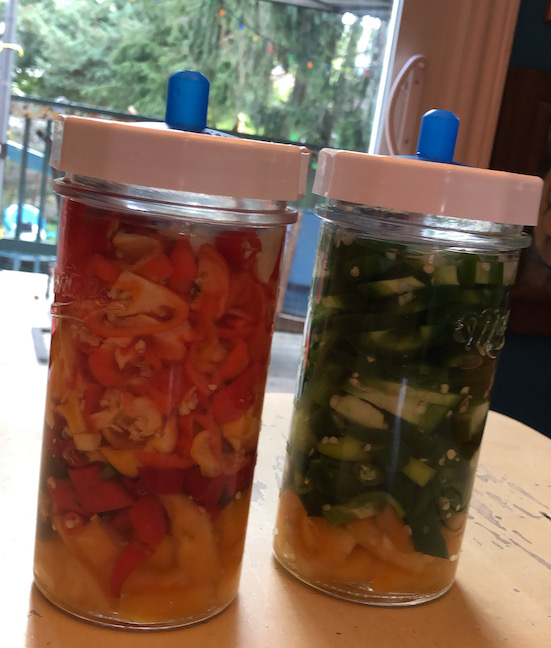
This time, I was prepared with 2 jars with fermentation caps. When gas needs to escape, it can, through the blue tops.
The process is called lacto-fermentation, and it is used to ferment kimchi, dill pickles and sour kraut, as well as for making great hot sauce. Here’s a very basic explanation of what it is all about. It turns out that nasty, harmful bacteria don’t like salt baths, which is good for us. A brine is poured into a jar full of whatever you want to ferment. It kills the nasty bacteria, and a friendly bacteria called lactobacillus takes over. The friendly organism converts sugars in the vegetable into lactic acid. The lactic acid preserves the vegetable and makes it taste great.
Each of the jars has a few cloves of garlic and 2-3 different peppers. As well, each of the jars has some tomato. I used my garden chiles and supplemented those with some scotch bonnets and some jalapenos. I know that the goal of some people who make hot sauce is to make it poisonously hot. That doesn’t suit me. I’m good with hot to very hot.
Fermentation apparently starts pretty quickly and bubbles will form in the jar. I’ll let it ferment for a couple weeks. After that I’ll separate the brine and puree the chiles etc in a blender with just enough brine added to make it blend well. Then the plan is to press the puree through a sieve, releasing the finished hot sauce into a bowl below.
This will be as far as I am taking this batch. I’ll bottle the sauce and keep it in the fridge. Fermentation will continue slowly in the fridge and the taste of the sauce will change some, apparently. I’ve read it keeps in the fridge for several months. Some people do what some commercial hot sauce companies do. They add vinegar and cook it to kill the active lacto-bacillus and stabilize the sauce for longer shelf life.
There are many people out there providing resource material online about fermenting and lots of people with a ton of knowledge. As I continue to experiment, no doubt I’ll learn a great deal by reading websites and watching videos. Meanwhile, I’ll be really happy if I manage to make a yummy hot sauce.
 27th Street