
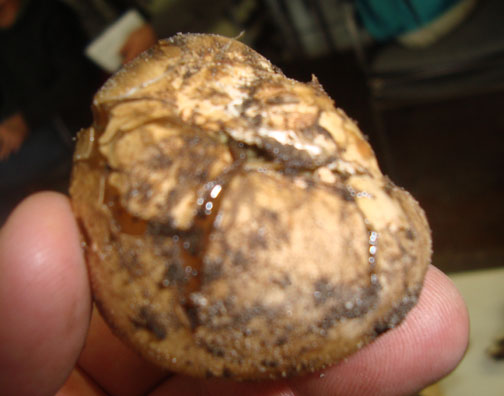
Stinkhorn: egg stage
There are two basic types of mushrooms hunters – those who collect mushrooms for dinner and those who collect for pure study. It kind of reminds me of fly fishing, where there are catch and release fly fishermen and there are bank-napping bait plonkers. As with the fly fishing example, there are of course many mushroom hounds who fall somewhere in between. Still, we’re talking about significantly different approaches.
Mushroom hounds who collect for food tend to target species. If they have a choice of several forests to forage in, they know one is likely to have some chanterelles, for instance, that’s the clear choice of destination. Or, they may target certain types of forest habitat that will likely contain the goodies they seek. Mushroom hunters who collect for study seem happy in any forest in which they can find a wide variety of species to collect and identify. Although I’m very interested in learning about as many species as possible, let there be no doubt that I collect mushrooms for food. Perhaps that is because I’m a novice. After all, for years I killed fish for food whenever I went fishing. It has only been in the past two decades that I almost totally stopped killing fish. I became much more interested in figuring out what bugs trout were eating, and at what stage of their lifecycle, and imitating that bug, presenting it to the trout as naturally as possible.
Through this summer, I have foraged in a number of forests, introduced to me by my brother Salvelinas Fontinalis, and I’ve begun to develop what I’ll call spots. I know a specific part of a certain forest where I’m likely to find hedgehog mushrooms. I know another spot for chanterelles and still another for lobsters. Sometimes, I’ll stop at the hedgehog spot on the way to other forests. It’s only a few minutes out of my way, and if conditions are right, there will be half a dozen nice hedgehogs waiting for me.
The pure study guys can find joy in anything they find. This might include tiny slime moulds or a resupinate that looks suspiciously like a swatch of paint on an old stick (likely one I broke getting at a hard to reach chanterelle). I have a lot of respect for the naturalists in the crowd. I wish I could better identify birds and trees and woodland flowers, tell the difference between a wasp and a hornet, find and name a dozen butterflies and so on. I’m working on learning a lot more about the natural world around me.
I can’t help but notice that most of the edibles I have been collecting are quite unique. It’s hard to mistake a chanterelle for anything else. Same with a hedgehog, which has teeth instead of gills or pores. Once you’ve seen a lobster mushroom, you won’t mistake it for anything else. Hunter’s Hearts, which I wrote about the other day, are equally distinctive. This hasn’t been a great summer for boletes, so I’ve only learned to identify a few of them. I’ve ignored most of the mushrooms that a casual observer might call “normal-looking mushrooms”. I did eat one agaricus, likely a meadow mushroom this summer, harvested from my neighbour’s lawn, but not until I did a spore print to be as sure as possible about what I was eating.
 27th Street
Lovely. Wish I could join you on those walks and hunting.