
I was just looking at the stats for this blog and I could not help but notice that many of the visitors here came looking for information about foraging for wild mushrooms or cooking wild mushrooms. There have been searches for edible mushrooms, poisonous mushrooms, and of course there have been the usual searches for King Bolete Map Ontario.
After a couple dry summers, we’ve had our share of rain this year and rain is a key ingredient in the fruiting of mushrooms, so perhaps that’s why all the interest. A persistent forager can do OK in Ontario forests. It isn’t spectacular the way it is on the west coast, but if you’re willing to put in the effort (and put up with the mosquitoes and deer flies), you can pick a modest basket of tasty edibles from time to time.
Some people think I’m out to discourage foragers because of a post I made here some time ago called “no edible mushrooms in Southern Ontario”. I thought I was having some harmless fun, but some people thought I was seriously saying there are no edible mushrooms in Southern Ontario. One reader corrected me: I am sorry to say, but I believe you are wrong friend. You see, I think your absolute statement of not one edible mushroom across all the forests and belts of SO is going a bit overboard.
Another reader, who chose to just call himself Mr. Goat was more aggressive in censuring me:
You ignore his very partial list of commonly found edibles in Southern Ontario and decide to use passive aggressiveness (which you call humour) – hippy dippy (what exactly does that mean – probably some outdated cliche about drug users – I wonder how many prescriptions you take..) to imply that Kevin is wrong. So on the record, you are either very ignorant or egotistical. Possibly a good helping of both. Your neck of the woods may have nothing (in terms of mushrooms to eat) , and you may want to educate yourself before you rant and post definitive key words that could confuse those that have not yet had a proper grounding in the basics of mushroom identification. Shame on you.
This was a valuable lesson for me. I learned that the way a post is received may not always be the way it was intended, and I appreciate that Mr. Goat set me straight.
My advice to those of you who are thinking about taking to the woods to pick some dinner, is to do your homework and be very careful what you eat. On an average day in the woods, you are likely to find many more mushrooms that will make you sick than tasty edibles. I know some people who simply won’t forage because they are afraid of being poisoned, but I’ve met other people who seem to have a devil-may-care attitude about it.
A field guide helps but many times a photo isn’t enough to make an identification. Lots of times I’ll find mushrooms I haven’t found before and I’ll try to make an identification, only to find that I just can’t be sure. I’ve had some mushrooms appear in my backyard that I’m maybe 90% sure are blewitts. They’ve fruited twice. I’ve studied them. I’ve taken spore prints. I’ve photographed them and shown the photos to others who are more knowledgeable than I am. Still I couldn’t be sure. SO I DID NOT EAT THE MUSHROOMS.
There are lots of questions to ask. What is the texture like? Does it smell? Does it change colour if you bruise or cut it. Does it have gills? Pores? Teeth? What is the colour of the spores (learn to take a spore print). Is the cap dry or damp or slimy? If you break a piece off, does a latex-like substance exude? Look closely. Look at the details.
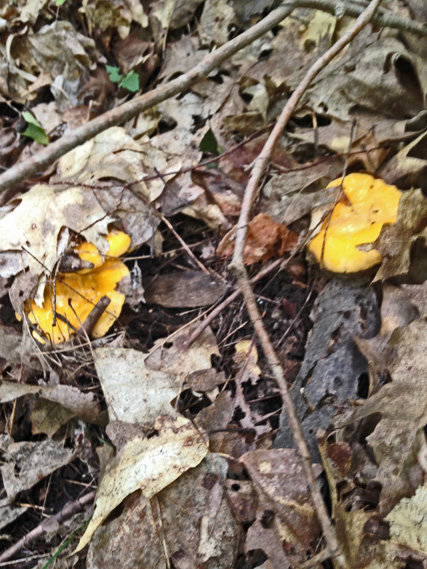 With experience, you learn to easily identify a number of tasty and safe mushrooms that are common in our area. If you have a friend who is willing to take you out to the woods for an identification lesson, that’s a great head start.
All I ask is that if you are not sure of your identification, don’t eat the mushrooms. Don’t say to yourself, “it sorta looks like this one in the book” and then take it home and eat it. There are a few mushrooms in Ontario that will kill you beyond doubt and they are not uncommon. Every year I find a few mushrooms I know are killers. There are many more which will simply cause some nasty gastro-intestinal distress. The saying among foragers is there are old mushroom hunters and there are bold mushroom hunters, but there are no old, bold mushroom hunters.
If you pick mushrooms in the woods for consumption, please cook them. Some mushrooms are fine when cooked, but may give you an upset stomach uncooked. Others might be OK raw, but you don’t know what other forest critter has been crawling around your mushroom.
The next question is where to go. I recommend you find a forest near you and start looking. You have to start somewhere. No doubt some spots are better than others but the only way to find out is to get out in the woods and look. Last Sunday I visited 4 forests I had never been to before. A couple of them did not turn out to be very promising, but the other ones are places I’ll return to again.
 27th Street
Im gonna jump in here and offer up a few truths about picking wild mushrooms.
There are about 2000 different species of mushrooms which grow wild in Ontario. About 10% or 200 species are classified by mushroom folks as being poisonous, about 10% or 200 species are classed as being edible. The other 80% or 1600 species are classed as being inedible. The inedible ones are just that. They arent poisonous but there is some good reason why you just cant eat them. They might taste totally horrible or be hard as an oak board or completely indigestable but there is some good reason why you dont want to be eating them. In the mushroom world poisonous means it might kill you or it might make you so sick you wish you were dead or it just makes most people quite sick. In Ontario it is illegal to send a kid to school with a peanut butter sandwich because some kids are so allergic to peanuts that they die when they eat them. If peanuts were a mushroom it would be called poisonous. Eating arsenic will kill you and if arsenic was a mushroom it too would be called poisonous. Dont eat poisonous mushrooms. The ones that can kill you do it with a toxin that can not be cured. Honest. If you are bitten by a rattlesnake you might die but probably a dose of antitoxin will save you. The dangerous mushrooms have no antitoxin, you just die in a quite painful way. The 200 or so species that are classed as edibles are what interests most people who start to pick wild mushrooms. There are a couple of sad truths here that a budding gourmet needs to understand. Just because a mushroom is classed as edible doesnt mean it tastes good. Many of the 200 edible species taste totally disgusting or are slimey or have a texture that resembles eating a slug so you wont be eating all 200 edibles. The other sad truth is that for almost every mushroom that is edible there is another mushroom that looks very much the same that is poisonous. That means that you cant take a sort of casual approach to eating wild mushrooms if you want to survive the process. Oh look these mushrooms look just like the honey mushrooms in my book, I’ll pick a basket for supper. Ooops sorry you just ate a plate of deadly Gallerina and you have 4 days to live and there is no cure. sorry. You need to know what you are doing hence the motto: when in doubt throw it out. That motto though isnt good enough because every year folks die from eating poison mushrooms when they were absolutely certain they knew what they were eating but they just didnt have enough knowledge or experience to be able to know that they were wrong.
So what do you do if you want to join the fun? Really there are a couple of choices with one of the choices being a LOT better than the other. Choice one is buy one or more field guides and study hard. Most days that isnt a bad way to learn but there are some problems with it. First problem is that your book might have a crappy photo and you will never find a decent match in the book. Written descriptions can be more reliable but remember they arent always perfect. Second problem is that most field guides deal with 200-300 species and simply leave out the other 1700. What if that mushroom you are about to eat is actually one of the ones the book left out but the book describes a mushroom that is sort of the same as the one you want to eat?ooops. The second approach is to find someone who knows what they are doing and get them to teach you. My opinion is that this is the only way to go. The problem is that finding someone who knows what they are doing isnt easy. There are folks who will teach you in exchange for money. There arent very many who will spend the time it takes to teach you for free. Cant blame them really. You can also join a mushroom club. You should do this even if you find an individual to teach you because the experience you will get is priceless. In Ontario there is only one mushroom club, The Mycological Society of Toronto. That is a pretty pompous name for a mushroom club but they are a decent bunch and if you want to learn about mushrooms you want to join the club. Membership costs 30 bucks a year for a family. Google them then join. For your 30 bucks you get
-access to formal courses in mushroom identification
-20 or more organized forays each year
-a very informative newsletter
-access to an online forum for members only
-access to their library of books
-access to some very very knowledgeable mushroom experts
-and a bunch of other stuff
The forays are the thing you want to focus on. On a foray 10 – 50 mushroomers will meet at a forest and after milling around signing in for a while and catching up on news the group splits up and heads into the woods. You can take to the woods solo or you can buddy up with one or more people but the idea is to collect as many different species of mushrooms as you can in 2 or 3 hours of diligent searching. At the end of the allotted time everyone brings their mushrooms back to the start point and puts their mushrooms on tables. The foray leader will then go through the mushrooms and identify every mushroom on the table. Every one. He holds up the mushroom, explains what it is and what features led to that identification. You can see the mushroom. Pick it up and feel it. Ask questions. Learn what sort of habitat it likes. Learn if it is edible. Sometimes if it is edible the person who picked it might let you take it home and eat it. Then they move on to the next mushroom. This whole identification process might take 2-3 hours. In a dry week they might find only 30 species. In a wet week in September finding 150 different species in 2-3 hours of looking is definitely possible. There simply isnt a better way to learn then to have some experts discuss a mushroom that you can actually touch. Will the forays show you some real hotspots for finding mushrooms? Well no. These guys arent stupid and they wont show you their private secret picking locations. Nor will they tell you if you ask. But they will teach you about mushrooms and get you looking in the right sorts of habitat. If you are interested in mushrooms spend the 30 bucks. nuff said.
I feel the need to issue a special warning here and you need to take this pretty seriously. If you spend any time in the woods at all chasing mushrooms you will for certain (especially in September and October) encounter folks with an eastern European background out collecting mushrooms. They will be seen lugging 5 gallon pails full of mushrooms and they generally are quite happy to let you look at their catch and they will even offer advice on which are particularly tasty. The operative rule here is NEVER believe anything one of these Euros tells you about the edibility of the mushrooms you see in their buckets. Never. I say this for several reasons and I am quite serious.
-Many of these folks have absolutely no clue what they are doing
-Many go out into the woods and simply load up with every mushroom they can find and Uncle Kawalsky sorts them out back in Toronto,but they neglect to mention that.
-The Euro mushroom tradition goes back much farther than the North American tradition and most of these folks handle their mushrooms in a way that will sometimes (but not always) detoxify some of the sickeners. They might for example boil a species in 10 gallons of water for 10 minutes then change the water and repeat 3 times at night with a rising moon. Or they might only ever pickle that species and pickling might detoxify them/ (The deadly ones can not be detoxified). The point is that they likely handle the mushrooms in some way that doesnt include frying them and eating them and if you try to eat some of what these folks are picking you could get very very sick. If you meet some of these Euros go ahead and admire their harvest but dont try to emulate them. Seriously.
In general you can not learn to identify all 2000 species of Ontario mushrooms unless you start very young and become obsessed. What you can do however is learn to positively 100% for certain identify the 30 or so really tasty edibles that are also fairly common. You do that one species at a time with a target of maybe 5 species each year. You can do that quite safely if you have a good mentor. Once you get up to about 20 species that you can identify you will find that on most days of the season you can walk into the woods and emerge with enough tasty edibles for a meal or two. On some days you will find a motherlode of tasties. Really that is all you need to be a successful forager. Concentrate on a small number of mushrooms and learn them very very well and you will have more mushrooms than you can eat. Happy hunting.