
A friend of mine was surprised when I mentioned the other day I had 8 paintings on the go in my studio. This in not an unusual circumstance for me – I’ve worked this way for many years. I don’t do this to make more paintings as some kind of production strategy. In fact, these days I’m a fairly slow painter. I may work on several pieces at once, but those paintings can be in play for a very long time.
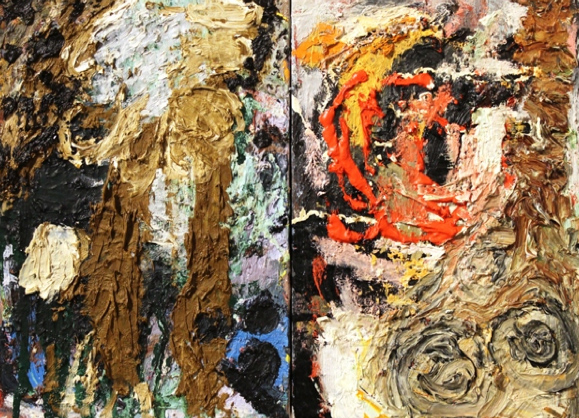
Denizens by Eugene Knapik (from Paintings from the Lost Forest, at Yumart, May 2014)
I work on paintings in groups and in every session I make changes to most or all of the works in the group. Along the way I’ll pull paintings out of the group, either because I think they’re finished or because I’ve hit some kind of creative cul de sac, or because there is something about a painting that is intriguing or vexing me but I can’t yet figure it out. When I pull a painting out, I often add another in – sometimes a painting I had earlier abandoned and at other times a clean canvas.
I’ll work on a painting and I come up with some motif or idea or direction and I’ll try variations of that idea on a few paintings. Other times, an idea will emerge while I’m working on a painting that I can’t find a place for in that picture, so I move over to another painting and try it out. Surrounding myself with an array of dynamic images in play helps me improvise. It also reminds me to not get hung up or stuck on a particular motif or image.
The result of this approach is that I often have several images in flux at the same time. When things aren’t going so well in the studio this can seem hopeless, like all my paintings are mired in my own muddy ideas. On the other hand when it’s going well, several paintings can fall into place at once. This happened last winter with the paintings I exhibited at Yumart. I struggled with a group of paintings for a very long time, and then in late fall and winter there was a kind of inevitability about my paintings, and I found myself completing painting after painting.
This phenomenon is magic to me, and maybe it’s the magic that drives me to continue making paintings. It’s difficult to describe this experience. I suppose it is an exaggeration to say it is an ecstatic experience, by which I mean being outside of myself. I think maybe it is more about achieving a state of mind in which painting is thinking in a really direct way. When Ronald Bloore was my teacher many years ago, he often said painting is thinking but I think it took me a very long time to understand what he meant.
Right now there are 8 paintings on the go – all oil paint – and after this morning all wet. Now I’ll let them dry for a week or so and maybe when I do the next session I’ll add two fresh canvasses into the mix.
 27th Street
I don’t think it is a “natural” ability for me. More like something that I’m really interested in that I’ve worked on for a long time.
I envy you having the visual vocabulary to think in paint. I am fascinated by this ability, which I utterly lack.