
Here’s a short video I shot in the forest yesterday. I was finding hedgehog mushrooms. I believe these were Hydnum repandum, with the lumpy cap. I also found some Hydnum umbilicatum, with the flatter cap and the belly button.
Here’s a short video I shot in the forest yesterday. I was finding hedgehog mushrooms. I believe these were Hydnum repandum, with the lumpy cap. I also found some Hydnum umbilicatum, with the flatter cap and the belly button.
What’s your favourite band name? My current favourite is a band from the 1920s – Gid Tanner and the Skillet Lickers. Here they go….

Lobster mushroom
Hypomyces lactifluorum is also known as the lobster mushroom. In fact it is the product of one fungi attacking another. The host mushroom is either Lactarius piperatus or Russula brevipes. The attacking fungus is a sac fungus, or ascomycete. It’s the red stuff. It colonizes the host and when that happens, the host tends to contort in shape and it turns the colour of cooked lobsters – hence the name. It also makes the otherwise unpalatable host into a delicious edible mushroom. When you find these in the woods, they’re often partially obscured by leaves on the forest floor. Sometimes the colour isn’t as intense as the one in the photo. If it turns from red-orange to more of a crimson, that’s usually an indicator that it is past its prime.
Bugs and slugs and worms love lobsters and so they require some special cleaning. First of all they are very firm and can be washed under running water. The next step is to slice then into roughly eighth inch thick slices. Then it’s a matter of cutting away anything that isn’t white or red. It’s worth the extra work to do this. Lobsters also dry up nicely in a dehydrator and are excellent in soups and stews. Even after drying and rehydrating, they retain their firm texture.
I have to remind you here to be exceptionally careful when foraging any wild mushrooms for the table. If you can’t identify a mushroom with total certainty, don’t eat it. Don’t take risks. There are some nasty mushrooms in the woods. If you’re interested in mushrooms, start with a couple good field guides but even better, find a friend who has plenty of experience who can teach you. When I started, my brother helped me out and I learned way more from him in a short time than I could have by studying books.

lobster in the woods
After a morning hiking around looking for mushrooms in the woods, there’s nothing our Newfoundland dogs enjoy more than a swim.
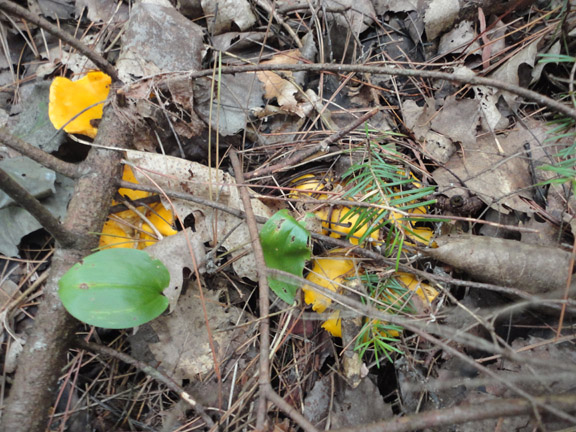
chanterelles
There is a small area of a big forest I visited today, where chanterelles really love to grow. It’s just off a trail, down in a little hollow. If you aren’t looking for them, you might well miss the mushrooms growing on this spot. When I’m there, I watch from the trail for the tell-tale hint of bright yellow. If I see yellow, I move slowly into the area and look closely, because the mushrooms are often partially obscured by the forest duff.
In the forests I visit, I mostly find smallish chanterelles – one over two inches tall or with a cap over two inches wide is uncommon. Yet today I found a cluster of chanterelles, all in one hollow, that were much bigger than the norm.
 The mushroom below is more the size chanterelle I’m used to finding – the one above is a monster.

Monotropa uniflora is commonly called Indian Pipe. It’s one of the most unusual plants in the forest because it contains no chlorophyll. Instead it derives nutrients from fungi that in turn derive nutrients from trees – it’s a fascinating 3-way relationship.
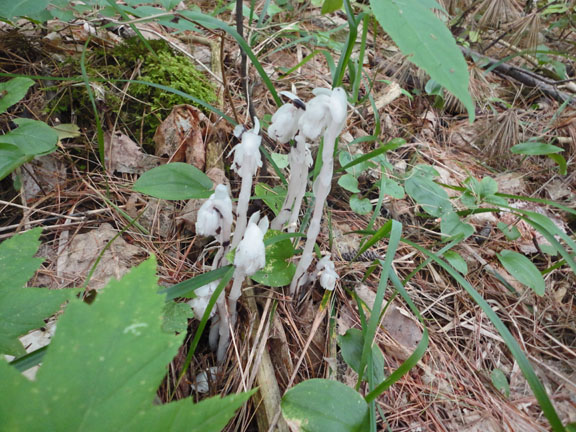 There was plenty of Indian Pipe in the forests I visited today. It grows in clumps scattered here and there about the forest.

Hydnum umbilicatum
Today I was fortunate to find several Hydnum umbilicatum and Hydnum repandum- the hedgehog mushrooms, sometimes also known as the sweet tooth. In our area, the Hydnum repandum tend to be larger. They have a rounder cap and they tend to be more pale in hue. The Hydnum umbilicatum is flatter, and sometimes has more orange on the cap. It also has a belly-button shape in the top of the cap, hence the “umbilicatum”. I find both varieties taste the same, both delicious and similar to chanterelles. Of course both varieties of hedgehogs have their signature teeth.
I know one forest that reliably fruits these mushrooms (and a couple other forests in which I occasionally find them). This forest is a “stop on the way” forest for me. It’s a large forest but I normally only find edible mushrooms in one small area of it. It’s on the way to other forests I like, so I stop on the way and spend 15 or 20 minutes poking around. I find a few lobster mushrooms there, and an occasional chanterelle and sometimes a few boletes, but the hedgehogs are the prize of this spot. When they’re fruiting I can sometimes find a dozen or more in just a few minutes.
Hedgehogs are among the easiest edible wild mushrooms to identify but still, if you aren’t 120% sure what you’ve got, don’t eat it. Not even just this once. Remember there are old mushroom hunters and bold mushroom hunters but there are no old, bold mushroom hunters. Please be careful.

I took the dogs for a walk in the woods this morning, looking for some tasty mushrooms for dinner. First let me say, NEVER, NEVER, NEVER eat any wild mushrooms unless you can identify them as edible beyond a shadow of a doubt. There are plenty of mushrooms in the forest that can kill you or make you very sick.
This morning I picked Hypomyces lactifluorum (lobster mushrooms), chanterelles, hedgehog mushrooms (Hydnum umbilicatum) and one ornate bolete.
This is Christopher Plock blowing two horns at once, as special guest of The Meteors this afternoon at Timothy’s.
 Chris is not only an amazing sax player and a great singer, he’s also a great neighbour!

