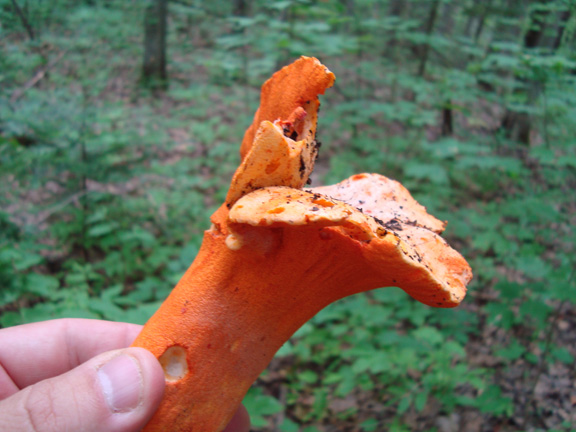
Some people I know won’t eat lobster mushrooms. These fungi are Hypomyces lactifluorum, basically a red-orange cup fungus that has attacked a host. The host is usually considered to be either Russula brevipes or Lactarius piperatus. The problem is that the host often gets distorted and so cannot be so easily identified and some people are worried that the Hypomyces can attack a poisonous host.
The following is from Tom Volk’s pages: So I know you’re going to ask “Is it edible?” well that’s a complicated question. The Hypomyces part is known to be edible, but what about the host? Could the Hypomyces parasitize a poisonous mushroom? Apparently Hypomyces is a pretty good taxonomist, only parasitizing Russula or Lactarius species. According to Clark Rogerson and Gary Samuels, “In large populations of Hypomyces lactifluorum where the host can be determined with some confidence, the host has proven to be Russula brevipes; but associated nonparasitized hosts often belong to the Lactarius piperatus complex.” Russula brevipes is a known edible, so it’s not too surprising that the complex of these two species is edible. However Lactarius piperatus has an exceedingly hot flavor that renders it inedible for most people– but that hotness is neutralized by the parasite Hypomyces, making it very delicious. It is conceivable that Hypomyces lactifluorum could parasitize a poisonous mushroom and cause problems for the mushroom eater. However, the lobster mushroom has been eaten for hundred of years without any known problems. If you eat this mushroom you’re taking a very, very slim chance of there being a problem, in my opinion.
I eat these all the time, and I consider them to be excellent for the table. One of the features I like about them is that they retain a nice firm texture after cooking.
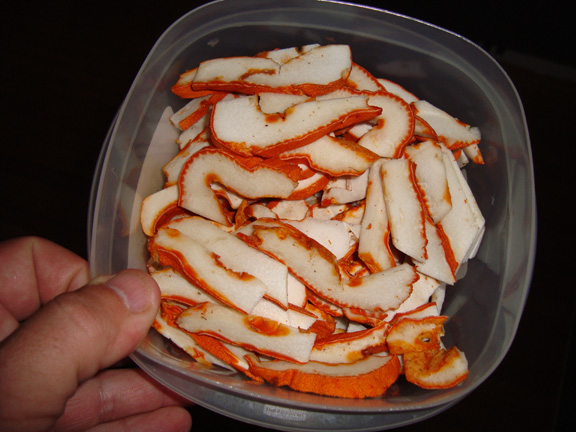
These mushrooms can be a little difficult to clean. Sometimes slugs get in them, and they get very dirty, and parts of them may have wormholes or otherwise not look so appetizing. The first thing to note is that there is no problem cleaning these under a jet of water, so that’s the first thing I do. After that, simply slice them into thin slices, and cut away anything that isn’t red-orange, white or firm. Anything that has turned deep red will also have turned spongy. The phot shows a basket of lobsters that has been prepared for drying.


 27th Street