
I’ve been working on creating a path through part of the gardens out back.
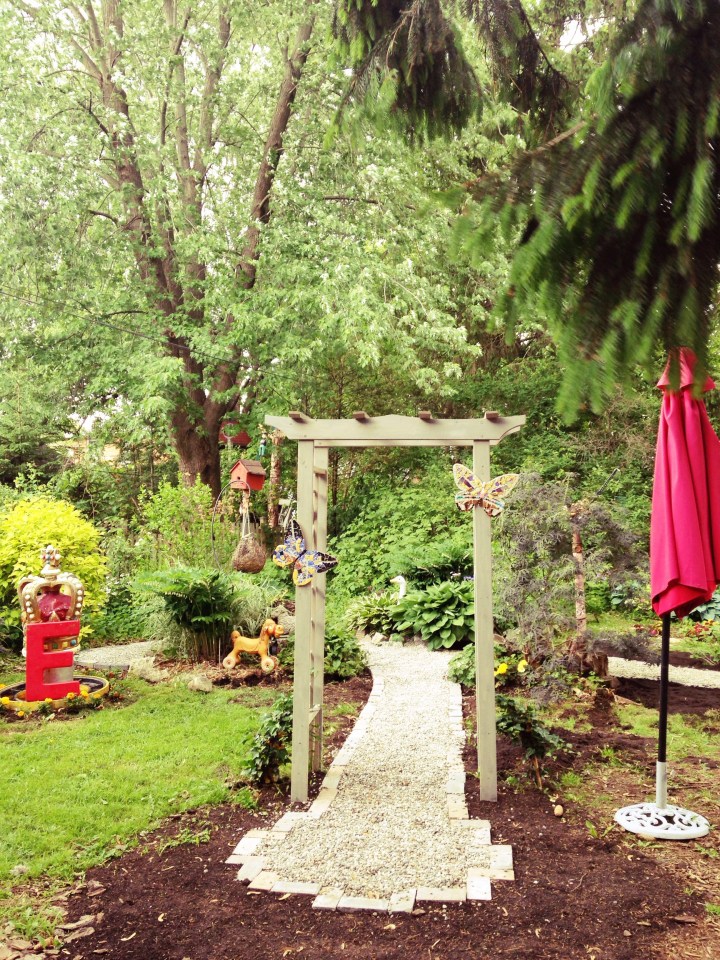
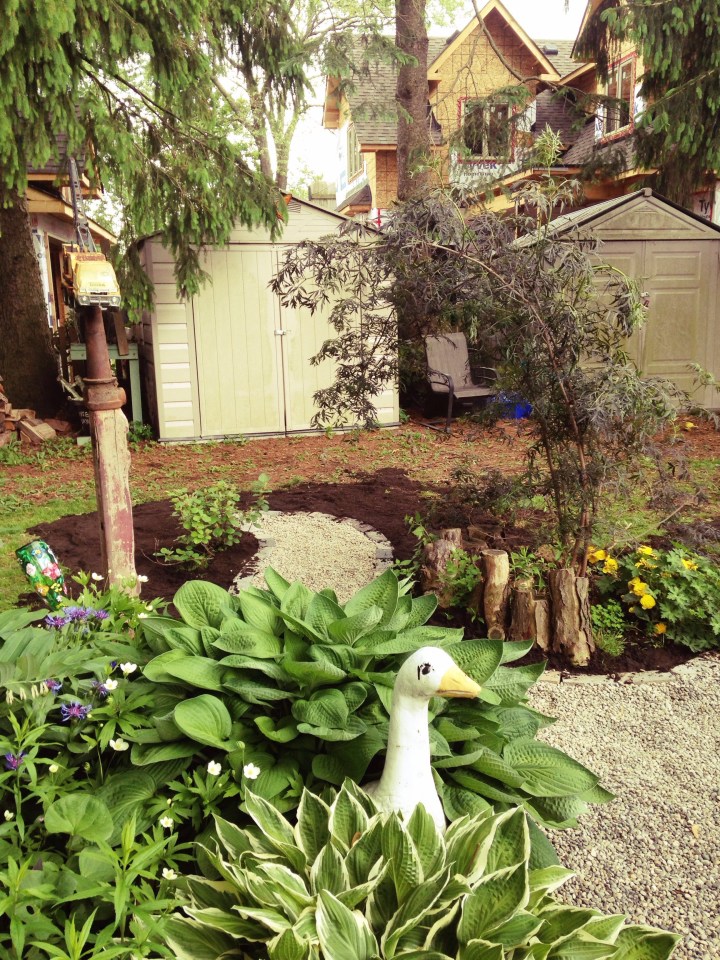
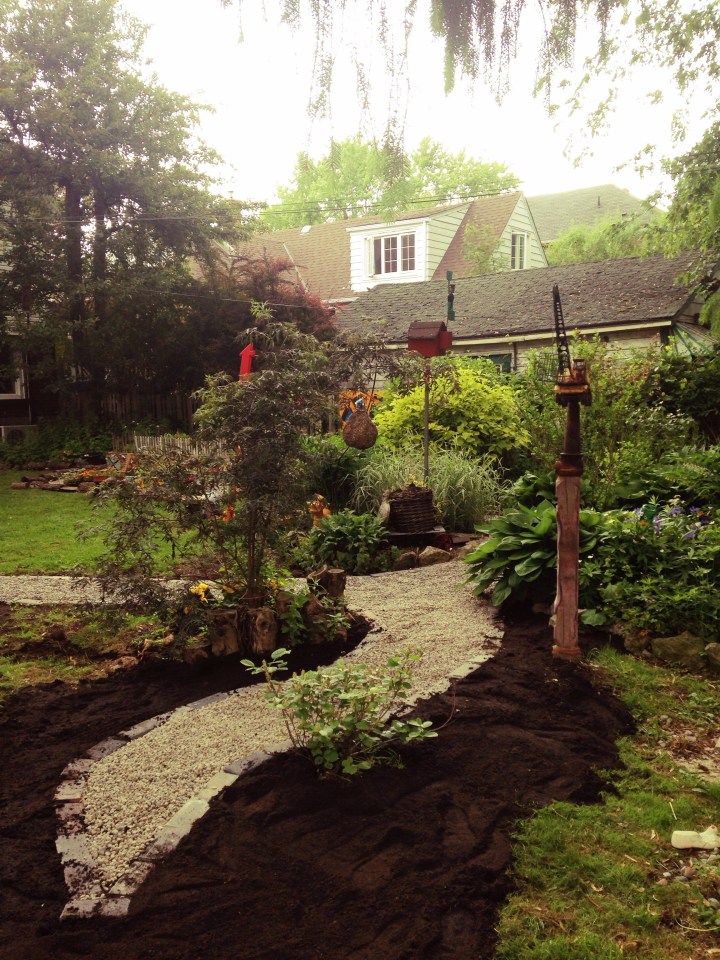
The gravel is in (for now…I may expand it down the road). Tomorrow I’m going to work on adding in two gardens, one on each side of the main path.
I’ve been working on creating a path through part of the gardens out back.
The gravel is in (for now…I may expand it down the road). Tomorrow I’m going to work on adding in two gardens, one on each side of the main path.
I wasn’t thinking about guitar when I went to Midwest Banjo Camp. In fact I don’t think too much about guitar. I can’t play one of those things for beans. First of all it has one too many strings. What’s that all about? However, at banjo camp they also teach guitar and fiddle and bass and yes mandolin too. So it was a surprise treat for me to hear Pat Donohue performing at workshops and in concert.
At one of the faculty concerts, he performed a delightful tune he calls Stealin’ from Chet. I searched for it in the YouTube machine, because all the collected knowledge in the the universe seems to be in there in one form or another, and sure enough I found a performance of Pat Donohue doing just that tune. Here it is….
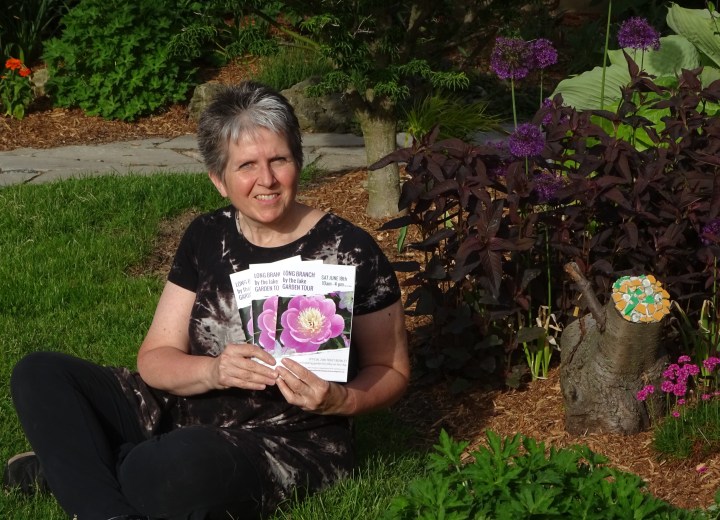
Inside Toronto did a nice piece about the upcoming Long Branch by the Lake Garden Tour, featuring a photo of Sheila Gregory (AKA Tuffy P for regular blog readers).
Regular visitors to this blog know that if nothing else, I have been a regular poster in this space for years, with few lapses. Very recently, however, I took a little personal holiday and went on a road-trip, and a couple weeks after returning, I took off again to attend the Midwest Banjo Camp. This was my second camp. I attended 2 years ago and I had intended to go again last year, a plan which was scuttled by my calamitous slip and fall on our front steps which left me with 14 screws humpty-dumptying me back together.
If you were a banjo freak, you like me would jump at a chance to attend this camp. For a Thursday to Sunday long weekend each June, many of the best banjo players on the planet gather to teach a couple hundred people who are working on their banjo skills (and more – there are also classes in guitar, fiddle, bass, mandolin and dobro as well as vocal classes).
There are broadly speaking two streams at camp, bluegrass and old time, but it isn’t quite as simple as that. Sometimes the two streams overlap. Within the bluegrass camp there are traditional bluegrass pickers, jazz players, newgrass players, and pickers who are off on musical planets of their own. There is quite a spectrum on the old time side (my personal interest) as well. Here are a couple examples from previous camps to demonstrate what you might call the broad range of the old time banjo experience.
First here is Ken Perlman. Ken is one of the two organizers of MBC, and he has been doing a fantastic job putting these together. I really admire Ken’s effort and dedication to this. It isn’t easy to get everything right and make banjo camp a fantastic experience for all the participants. Ken literally “wrote the book” on melodic clawhammer. He has recently been studying the fiddle music traditions of Prince Edward Island down east here in Canada.
On the other end of the spectrum is Cathy Barton Para. Cathy, who taught at camp along with her husband and musical partner Dave Para, comes from a much different clawhammer banjo tradition – let’s call it the Grandpa Jones tradition, which is fitting because the Paras were good friends with Grandpa and Ramona Jones and their family. I have never seen anyone play clawhammer with the kind of infectious joy and energy as Cathy Barton Para. At camp she teaches a seemingly endless array of fantastic tunes and songs.Here are Cathy and Dave playing a medley of tunes at camp concert from a few years ago.
There were many players teaching at camp who fall somewhere between the two poles I described. For instance, there was Art Rosenbaum, a player with an unbelievably extensive retertoire, and many of those tunes he learned directly from elder players. Mr. Rosenbaum plays clawhammer as well as various finger-picking styles, and he “wrote the book” on old time banjo tunings. I confess I’m in awe of Art Rosenbaum, and I consider it a privilege to have been able to hear him play in an small workshop setting. Here he is from one of the Stephen Foster music weekends they hold down in Florida, performing some slide banjo.
Bob Carlin taught at camp this year. He is not just a fine musician, he’s also an author and a researcher on the subject of the banjo, and he has a new book out called The Banjo: An Illustrated History. I was able to buy a copy at camp and Bob was kind enough to inscribe it for me.
I took a few of Bob Carlin’s classes. Bob teaches repertoire, and in doing so teaches various techniques, tells stories, gives history lessons and so on. I learned a lot in those classes, and also had a chance to chat with Bob a little outside of the formal class setting. He is a very engaging, super-knowledgeable fellow.
Joe Newberry is another excellent musician teaching at camp this year. “Once you’re my student once, you’re always my student”, Joe says. I took a class Joe teaches called at the corner of 2nd and 5th in which he simplifies a tune so it is played with the 5th string + using notes fretted on the 2nd fret. This class helped me pretty much right away in jams, to think about how to simplify what I was hearing to its bare bones and begin to play along with tunes I didn’t know. During some jams I was able to do this pretty well, grabbing a tune along the way, much to my own amazement. With some other tunes, let’s just say I have a ways to go, as I did sometimes find it pretty difficult to do this at speed.
One day during a jam, somebody asked Joe Newberry which tune was his favourite to play. He thought about it for a minute – there are so many tunes – and finally his answer was Last Chance.
It’s difficult to single out a few of the instructors from the broader group, because for sure I’ll miss some I should include. I did for instance take one excellent class with Roy Andrade. Somehow or another I didn’t take any of Adam Hurt’s classes, though I know he is an excellent teacher and player from my previous camp experience. I did get a chance to jam with Adam though and also with the amazing Walt Koken. I have no idea how I missed out on Brad Leftwich’s classes – he’s a player who learned Round Peak style by visiting the area and learning directly from players like Tommy Jarrell. The challenge is that there were so many fantastic players teaching – short of cloning, taking all the classes was impossible. I know I missed some things because I took more classes from Cathy Barton Para. I really love the tunes she brings to the table.
I’ve come home overflowing with all the ideas and tunes I learned over the past few days and I have lots of homework ahead of me, working on these over the coming months. I’ve only talked about the old time players teaching at camp because that’s where my primary interest lies, but for bluegrass fans, imagine learning from banjo pickers Bill Keith, Tony Trischka, Julie Elkins, Tom Adams, Janet Beazley, Dick Smith, Wes Corbett, the great fiddler Byron Berline, guitar whiz Tim May, jazz mandolin player Don Stiernberg and many more.
I also had a chance to meet banjo camp participants from all over the United States, and even another player from Toronto I had never previously met. I heard there was someone attending from Australia and another person from Germany, though I didn’t meet either of those folks.
For someone who has learned to play clawhammer in relative isolation, it was really great to be exposed to so many players. I began to feel more confident in jams, and less worried I would screw up and hit some sour notes. I realized quickly at this camp that I’ve learned a lot since the last one. I hope when I return for another camp I’ll have been able to make another leap forward with my playing.
For those who like the grittiest edge of country music….here’s Cast King. This is a great recording. Go buy it. Mr. King has passed on now, but I still listen to Saw Mill Man regularly.
It’s the James Hunter Six!
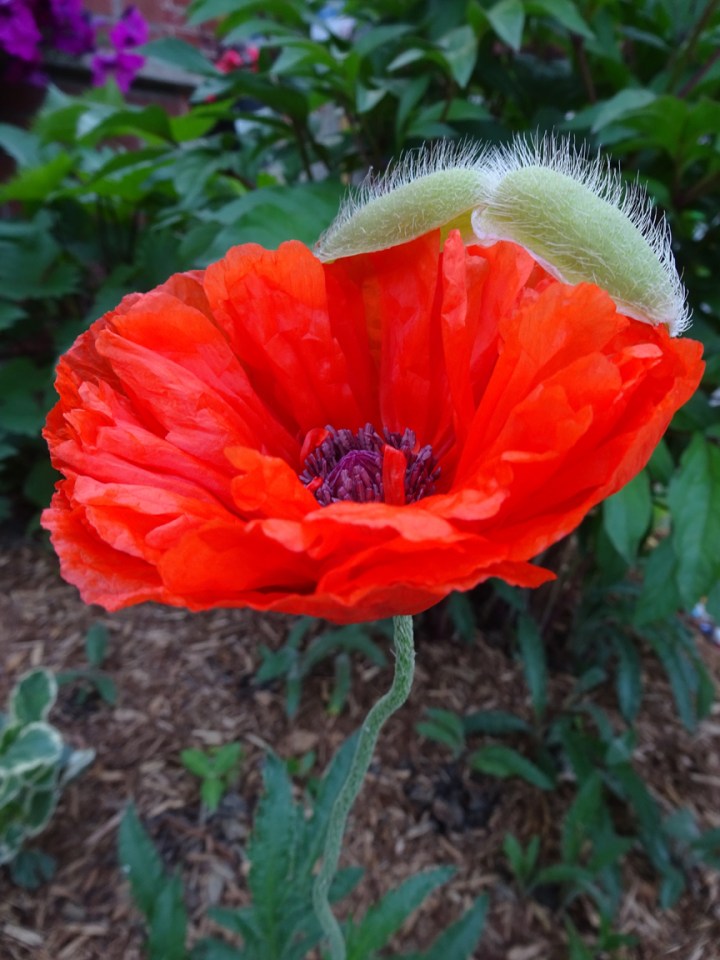
Poppies have popped this morning in our 27th Street gardens!
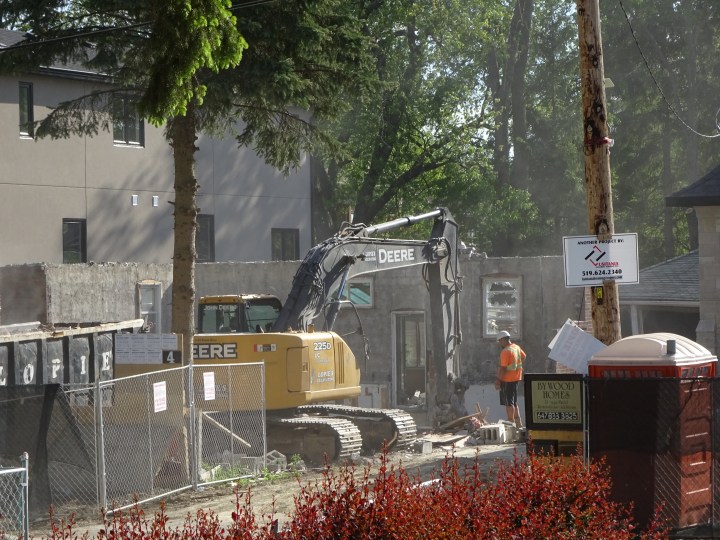
This is what was formerly 4 Twenty Seventh Street, the house we knew as Ottie’s place. It is being torn down today to make way for a pair of the kind of “soldier houses” which provide the builders with the greatest possible profit, and which we are seeing more and more around the neighbourhood. The Committee of Adjustment refused the application to sever this property. Sadly, the Ontario Municipal Board chose to overturn that refusal and the severance was granted. I spoke at the OMB hearing in a failed effort to help convince the adjudicator to uphold the City’s ruling. This was a particularly disappointing ruling because for the first time, 4 of these soldier houses in a row are being allowed. A pair of houses has already been squeezed into the former 2 Twenty Seventh property.
A few years ago I reclaimed part of a disused, stumpy area on the north side of our yard for a veggie patch. Digging the ground was impossible because of the old stumps, so I built a box. The rest of this area I planted with various anchor shrubs which are doing nicely. I recently added a second box for veggies, and isolated the whole veggie growing area with a gravel pad, surrounded by old chunks of firewood.
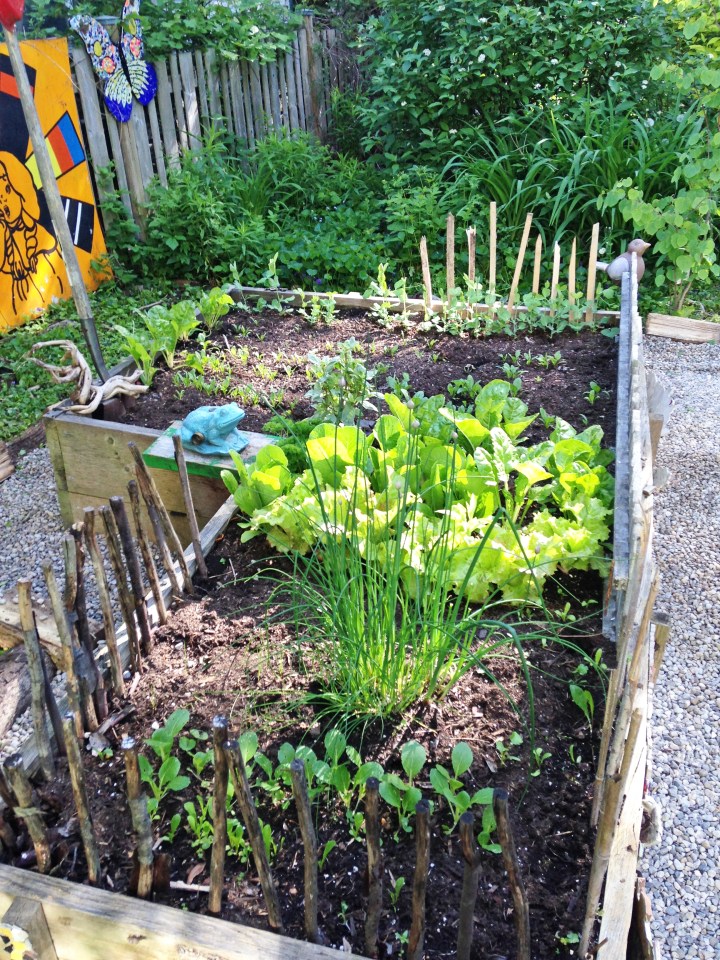
Our backyard has quite a few mature trees, so it doesn’t have the sustained hot sun needed for peppers and tomatoes to thrive. Herbs, lettuce, spinach, chard and lots of other things do just fine though. This year I’m trying snow peas and we’ll see how they do. I’ve staggered the lettuce plantings so I should have some fresh salad greens for some time. Some of the lettuce is getting big enough I can start picking it soon. 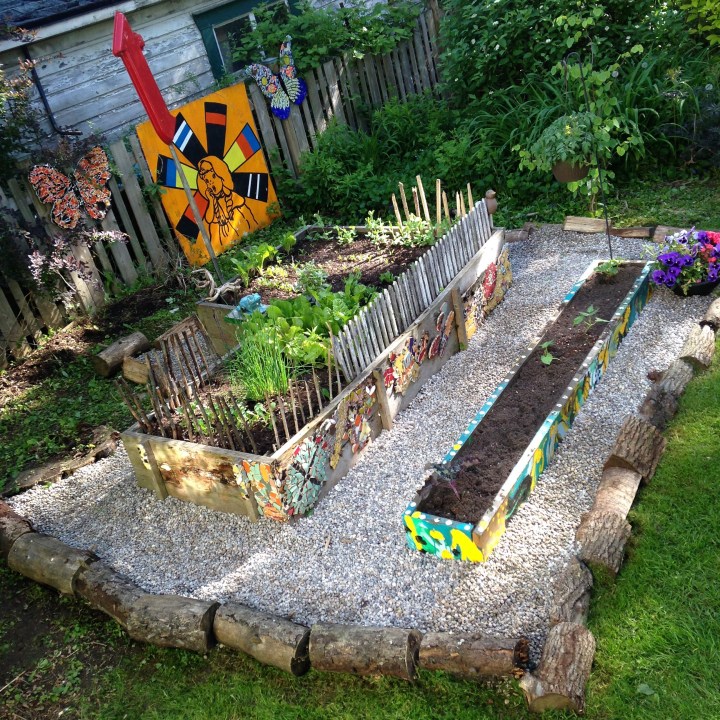
Our veggie patch is not large but our needs are modest, and I like picking fresh greens for dinner.
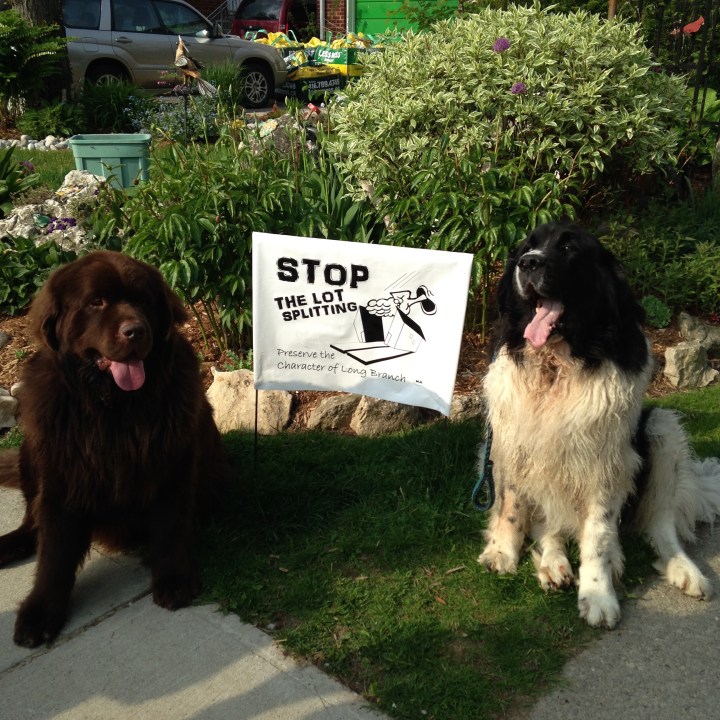
A neighbour from up the street dropped by the other day with a lawn sign and asked if I’d like to have one on my front lawn. I’ve never had a lawn sign for anything, not for or against anything, not in support of a politician, none of that. This time I agreed to put up the sign. It says STOP THE LOT SPLITTING – Preserve the character of Long Branch.
When we moved to Long Branch, I believed that Toronto’s Official Plan, The Committee of Adjustment and the Ontario Municipal Board would protect our neighbourhood from the lot-splitting which has been increasingly occurring around here. This was naive. I didn’t think there would be such a radical spike in severance applications, and I was very disappointed to see so many Ontario Municipal Board decisions supporting these applications.
Our neighbours are getting good at fighting, and have become increasingly educated and experienced. Some neighbours have got together to form a neighbourhood association. I don’t know, maybe that will help. It seems as if the deck is stacked against those in the community who would like to see some kind of planning around the future of our neighbourhood.
Will the lawn signs help? At the very least they are a constant reminder that many people in our community are opposed to lot splitting. There is little recourse once the OMB has made a decision. At least the signs publicly express dissatifaction. A post on another blog suggests the lawn signs will have minimal impact. This blogger expresses concern for the brand image of the neighbourhood association should people think the new neighbourhood association is behind the lawn sign initiative (apparently it isn’t). For my part I have no concern over where the initiative comes from. I like the message. It’s direct and to the point, and from the heart. I may not be able to affect OMB decisions (I’ve twice spoken at the OMB on severance issues without success) but at least I can shout out my opinion. The developers and the OMB and the Committee of Adjustment and the politicians and so on will just have to live with that.
 27th Street