comment 0

D Tunes

In Old Time music, most standards are by convention usually played in particular tunings. It doesn’t mean they have to be played in certain keys, just that they usually are. This simplifies things for players jamming, for instance. If the tune is going to be Cripple Creek, for instance, the clawhammer players will normally tune to A, but if it’s going to be Angeline the Baker, you’ll see them tuning again to D. There are also banjo tunings for those “mountain modal” tunes as well, like Shady Grove. There are also a number of specialty tunings that are used for a small number of tunes, like “Cumberland Gap tuning” for instance. Sometimes at jams, players will play a few tunes in a single key and then switch it up so that everybody isn’t always tuning.

Here are Wayne Shrubsall and Bruce Thomson at the Albuquerque Folk Festival, June 21, 2008 (I found the video on the Youtube machine) doing a medley of D tunes.

comment 1

Hey, there’s a whale on the beach

So what do you do when an 81 foot dead, potentially explosive whale washes up on the beach in your town? It happened in Trout River Newfoundland. Who knew that beached whales were explosive? Not me. It presents a problem for the town. Nobody wants to be blown up by a stinky rotting 81 foot blob of fatty flesh. Moreover, it’s going to get stinky in Trout River. At the same time, not many towns can boast of having this amazing creature on their beach. It seems townspeople would like the skeleton – what a great attraction for the town. Now how do you get from current state to clean, well-preserved skeleton? Whatever happens I hope the folks who live in Trout River are the eventual winners in the whale sweeps.

comment 0

Sandy River Belle

April Verch is a great Canadian fiddler from the Ottawa Valley. She is also a fabulous step-dancer, as you can see in this clip featuring the April Verch Band performing Sandy River Belle.

Now here’s  nice version played on the cookie tin banjo, by morbanjo

Finally, The Rabbit Hash Stringband does a great version…with vocals!

comment 1

Pressure Cooker

We watched a delightful documentary tonight called Pressure Cooker. It’s a film by Mark Becker and Jennifer Grausman, and it follows a Philadelphia high school Culinary Arts class as they get ready for a competition for major college scholarships. The kids come from a variety of circumstances and have some difficult family stories. The teacher is a remarkable woman named Wilma Stephenson. She is tough but tremendously generous of spirit toward her students. Watching the film, you get a chance to get to know the kids – before long I was cheering them on. This film is 27th Street recommended.

comment 0

Midgies

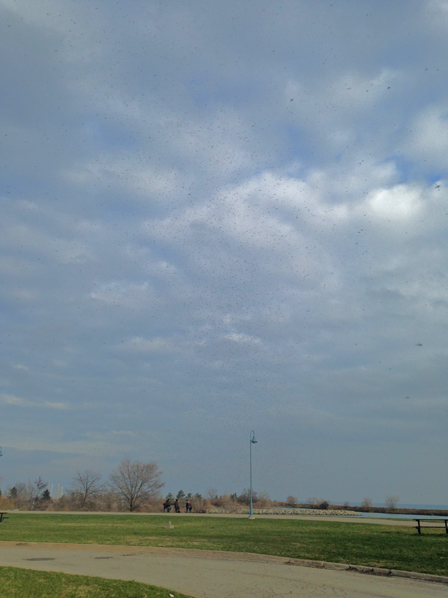
Right now our neighbourhood is being visited by squillions of little black flies. I think they’re aquatic, because the closer you go to the water the more there are. My guess is they are some kind of true fly, what fly fishermen would call a midge. They come every year but this year the quantities of them are just silly. It’s a challenge to avoid breathing them in or ingesting them. This morning it was no big deal because the swarms of insects were high, well above my head. This evening they started at the ground in swarms that stretched to the sky. Fortunately, they don’t bite, so they’re a minor irritant. As a plus, there are a lot of birds out there making a living off those bugs.

comment 1

A few thoughts on Paintings from the Lost Forest

Regular readers know that I have a painting show happening now at Yumart, here in Toronto. I don’t usually write much about my paintings. I like to let them speak for themselves. However, I was asked quite a few questions about the works at the opening last Saturday, and subsequently, I made a few notes about the paintings I’d like to share.

My paintings often take a very long time to stew, and I’ve been working on some of the paintings in this exhibition on and off for years. I work on several paintings at once, invent them and reinvent them as I go, without any pre-planning or preliminary drawings. Sometimes I’ll hit a dead end with a painting and I’ll put it aside. Days or weeks or months later, I’ll see it differently and add it back into the mix. I paint on the floor or on the wall or leaning on a paint can. I turn them upside down and I turn them sideways. At times I can work for a very long time and never seem to get anywhere, and yet at other times, several paintings come together at once.

The whole business remains a mystery to me. When I’m starting new works and I look at my last set of paintings, my usual reaction is, how did I make these things? I think that is one of the things that draws me back to painting again and again and again.

Some people have commented that these are landscape paintings. I don’t think of them quite in those terms, but no doubt there are elements of the land in my paintings. For starters they’re built up over time like the duff on a forest floor. In the forest, of course, the layers rot away and tell the story of the seasons. In my paintings, it is ideas that are built up, and in some cases scraped away. In the tondo, The Source, I had to use a Dremel tool to remove some previous bad ideas, that’s how pervasive they were. Bad ideas can be stubborn.

The paintings also reflect my interest in mycology (I wander the forests with my Newfoundland dogs, looking for tasty edible mushrooms), entomology (I learned about mayflies, caddisflies, stoneflies and a variety of terrestrial insects while chasing trout with a fly rod in many different streams in Canada and the USA), and the interaction of all kinds of cyclical things in nature and how they relate to one another – the life cycle of mayflies and the feeding habits of trout and swallows, for instance – or the fascinating inter-relationships between fungi and other fungi, and fungi and trees and other plants.

This phenology isn’t something that translates to painting in any kind of literal way. In fact, someone asked me the other day what inspired a certain painting and I found it difficult to answer. I know that my habit of looking at nature close-up has inspired some new painterly language for me, but when I’m painting I’m dealing with forms and colours and textures and surface qualities and at the same time ideas that often conflict and are often coloured by doubt. I’m changing one idea into another, or I’m scraping off an idea that has no legs. Sometimes the paint is wet and changes muddy up the space. At other times the paint is building up so thick that the texture begins to dictate form. I’m working on several paintings at more or less at the same time, and a move I make on one of them can in an instant change the direction of a number of paintings.

The title, Paintings from the Lost Forest, obviously refers to the physical forest, but titles like Lost Forest, or Forest of No Return or The Source or as I have titled some older paintings, Underground, also refers, at least in my mind, to what I’ll call the “well-spring”, that place in my imagination where I’m able to make that magical leap from paint to painting.

I title just about all of my paintings. In Paintings from the Lost Forest there are some repeated titles – Lost Forest for instance, and also Forest of No Return. It wasn’t that I was trying to make a series of paintings with those titles. It was more that I found myself grouping some of the paintings in my mind while I was making them. I borrowed the title for The Source from Courbet. Forest of No Return also has a reference. It comes from a song by that title in the Disney film, Babes in Toyland. One more note on titles – I’ve been asked about Afternoon Tea with AJ – who is AJ? AJ refers to the painter Asger Jorn, co-founder of CoBrA. A form that emerged when I was working on that painting reminded me of something I remembered from one of Jorn’s paintings, and so I gave a nod to him in the title.

Most of my recent paintings (with a few exceptions), have been smallish, falling squarely into a tradition of “easel painting”, although I don’t own an easel. I suppose small paintings have been very much out of fashion for a long time now, perhaps going back to the breakthroughs made by the American AbEx painters. Fortunately, I’ve never been too hung up on fashion. I like that these paintings can hang on a wall in somebody’s living room or rec room or wherever. They don’t need to have a museum environment. Paintings don’t have to have a large physical size to have a large presence, and I like that too.

 

Filed under: Art
comment 1

Let’s class this joint up…

Here’s Count Basie with Little Jimmy Rushing (Mr. 5X5!) on vocals. Sent for you yesterday and here you come today. This tune rocks.

Basie and Rushing were both favourites of my father’s. He’d say, “Listen to Basie’s piano, son, just listen”.

He used to play another record all the time, Brussels Blues, with Jimmy Rushing and Benny Goodman. “We’re going to rock, we’re going to rock this joint, we’re going to roll, we’re going to roll this joint, we’re goin’ to swing, we’re goin’ to swing this joint, we’re goin’ to rock…”. It was live and it was 1958 and it was rockin’ and these guys were hot. “Goin’ to Brussells, have me a real good time…”

My father was a working guy. He had his own business, making aluminum windows and doors and when the business got good he’d work long hours at it, and he’d come home and he’d be dog tired. Then he had this whole other side. He gobbled up books. In fact, it seemed like everyone around me was reading when I was growing up. My family fostered a love of books which I consider a great gift. I know lots of people who don’t read much, and I think they miss out on all the worlds books take you to. He loved books and he loved his old records.

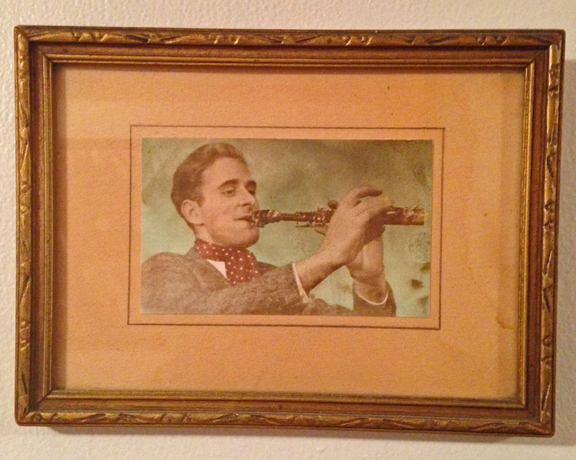
IMG_1037This is a photo of my father playing clarinet. I don’t know when it was taken but he was obviously a young man at the time. My mom used to hand-colour photos as a work-from-home kind of job -at some point, someone in the family – maybe it was my mom – told me that this was one of the photos she had hand-coloured. This picture hung in our house as long as I can remember. I have very few things from those days, but this is one that I treasure.

Those were the days of jazz and poker and hanging out at the track and betting the ponies. My father knew quite an array of characters from those days, including some with resumes from a darker side of life. When he told stories about those days, he would end every sentence with the word “and” so nobody else could get a word in edgewise (us Knapiks would much rather talk than listen…I remember family gatherings where all of us would shout to have our stories heard. I came by my love of storytelling honestly).

Tonight when I came across some Jimmy Rushing material on the YouTube machine, all those memories came tumbling back.