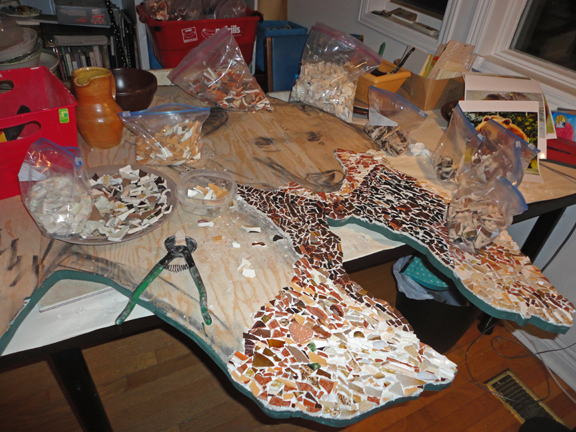
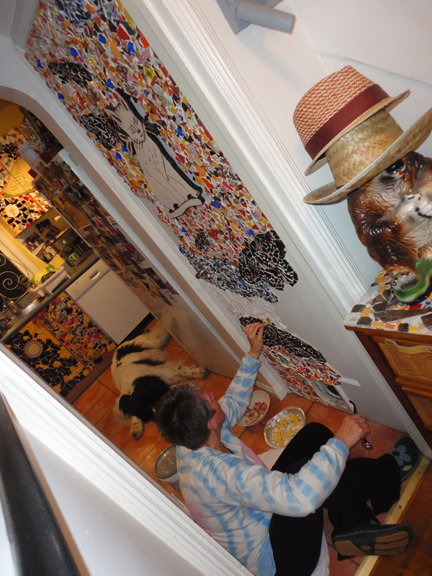
We’ve started into the mosaic grizzly bear. Sometimes when we do these mosaics, we’ll both work at the same time. Other times, and this is the way we’ve been attacking the bear, we do alternating sessions – Tuffy P does a section, I do a section, Tuffy P does a section and so on.
Some readers will recall that we recently created the 27th Street Book Box out of junk and stocked it with a number of books. We’re very please at how the book box has been embraced in the neighbourhood. Lots of books have been both taken and added to the box since we installed it. Some books were only around for a day or so before going off to a new reader. There is now a number of children’s books in the box, and the other day we had a sudden influx of new books. Right now, the box is just about as full as it can get. Thanks to those who have been using the box and adding new books to the mix. We’d also like to thank those that left encouraging notes for us in the box – we have a little bulletin board on the inside of the door with a pad of paper and a pen.
There is a wide spectrum of excellent reading in the box right now. If you’re out for a walk down 27th Street, be sure to stop buy and grab some reading material.
An organization in Toronto called Citizens Concerned about the future of the Etobicoke Waterfront, or CCFEW for short(er), organizes regular birdwalks at Sam Smith Park and at Humber Bay. There was one scheduled for this morning, so we trundled out in the rain to enjoy it.
wet bird walk
Intrepid but hopeless birdwatchers
The rain kept some of the birds down, but still I think we saw 19 species:
American Goldfinch (lots of them, flying around and singing)
Magnolia Warbler (one, which could just be seen hiding in some bushes)
Song Sparrow (a few)
Cliff Swallow (they nest at the water filtration plant….these, like other swallows, have been in decline)
Eastern Kingbird
Spotted Sandpiper
Ruddy Turnstone
Sanderling
Ring-billed Gull
Herring Gull
Belted Kingfisher
Hooded Merganser
Mallards (lots of them)
American Black Duck (hanging out with the mallards)
Mute Swans (the bullies of the waterfront)
Black Crowned Night Heron
Double-crested Cormorant
Red-necked Grebes
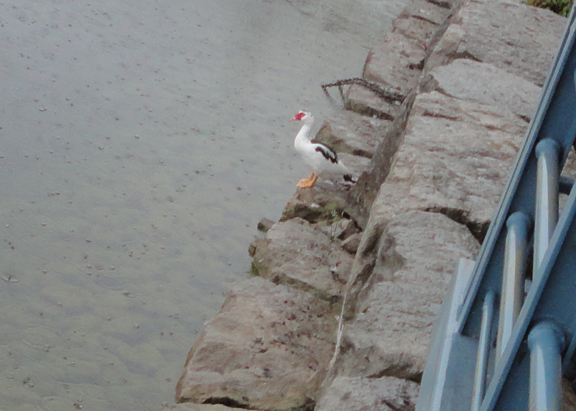
Muscovy (likely an escapee from a farm)
Muscovy Duck
Double-crested Cormorant
Red-necked Grebe
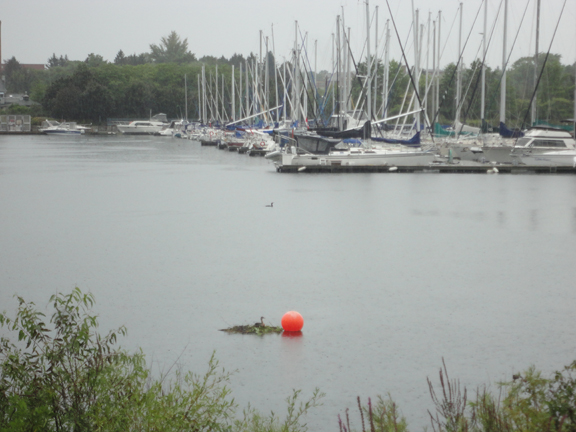
Sam Smith Park is a significant breeding area for Red-necked Grebes. We saw the female in the picture sitting on its nest while the male dove nearby for food (the male isn’t visible in the picture….the other bird in the picture behind the grebe is a cormorant). This is late for the birds to be on the nest. It could be the first attempt failed and this was a second try at raising a family. On another nest, we saw a mother grebe with two young ones. The babies have stripes on their heads.
In spite of unrelenting rain, we had fun on the bird walk. I’d like to go on the next one as well, in early October.
The musical focus of this blog has shifted somewhat this year. Although it has long reflected my general interest in what I jokingly call folky-dolky music, I had been focusing on the button accordion, because that is the instrument I was playing. Somehow or another I began romancing the banjo, and back around Christmastime, I made my first oil can banjo and started teaching myself to play in the manner known as clawhammer or frailing. Since that time, the music I’ve shared and written about here has had a lot more to do with banjo than button accordion. This isn’t to say that I have lost interest in button accordion music – not at all. It’s simply that my current infatuation with the banjo, particularly the open-backed banjo, is infectious and I can’t help but share it. It could be simply coincidence that this shift has coincided with a decided drop in interest and comments on this blog (that’s my story folks, and I’m sticking to it).
I realize that I have thrown the term Old Time music around freely in the past several months, and some people may think I mean old time, without the caps. I should be clear that by Old Time, I’m talking about a genre of music, one that was called Old Time, even when it wasn’t so very old. I don’t mean old time in the generic sense, like this is music that old timers enjoyed, although this is sometimes the case. So what is this Old Time music anyway?
If we are to believe Wikipedia, the label dates to 1923, a record company called Okeh and a performer named Fiddlin’ John Carson. It figures that a record company would be involved. To quote the entry in Wikipedia, “Okeh, which had previously coined the terms “hillbilly music” to describe Appalachian and Southern fiddle-based and religious music and “race recording” to describe the music of African American recording artists, began using “old-time music” as a term to describe the music made by artists of Carson’s style.” Old Time is dominated by rural dance music, music for clogging or buck-dancing or flat-footing, or square dancing. It also includes some ballads and solo or band music not specifically for dancing, but let’s not make things seem even more confusing. Old Time is often played by groups called string bands on instruments including fiddle, banjo (usually open-backed rather than resonator, but not always), mountain dulcimer, acoustic guitar, and sometimes bass.
All that said, it is a loose genre. Is Ottawa Valley fiddle music Old Time? I’d say so. Is Newfoundland button accordion music Old Time? That’s harder, but I’d say no. How about Cajun music? Let’s keep that separate, even though there are plenty of similarities. There are lots of regional styles that have their own characteristics. Some people will tell you that Old Time means Appalachian but it would be hard to exclude New England Contra Dance music or Texas Old Time music and so on. There are folks who will tell you that Old Time music is more strictly Appalachian or that the centre of the Old Time universe is Mount Airy in NC and Galax in Virginia. I love that music, but I choose to stick with a broader definition.
Here’s a fun video featuring some Old Time clogging or flat-footing.
Now here’s April Verch demonstrating Ottawa Valley step-dancing – a little different, but I think we’re talking the same language here.
So that’s what I’m talking about when I go on about Old Time music. I’ve been trying to learn a bunch of the Old Time standards on banjo. There is quite an extensive catalog of tunes that lots of players know and these have become the basis of jams. Within the broader matrix of this music, there are a variety of approaches to playing the banjo. I’d say that some of these are regional, and some are more individual. These styles have to do with how you pluck or strike the strings. I’m learning clawhammer, but there are also two-finger and three-finger approaches.
Clawhammer is a style in which you make your picking hand into the shape of a claw (more or less), and attack the strings by striking them with the nail of your index or middle finger, downward. Clawhammer is played on a 5-string banjo. The fifth, or short string is normally played as a drone, and you use your thumb to pick the drone string. When I started learning this, I found it to be very awkward and I thought, man I’ll never get this. If you look at teaching videos on YouTube, some teachers will strongly urge students to do nothing but try to sound a single string and the drone string in a simple rhythm (known as bum-ditty) for a week or two until the student gets it right. That is probably a good approach. Once you get used to the basic way of making sounds, it gets a lot easier, but it takes time to get your hand used to the motion.
Here’s Kurt Sutphin, a player from North Carolina. In this video, he’s interviewed by David Holt and then plays a tune called Sugar Hill. He’s playing a fretless banjo here. Once upon a time all banjos were fretless.
I think it would be really interesting to study all the different styles and tunes that fall under the broad Old Time umbrella, but I bet it would a mind-bending life’s work. I’m learning as I go, and I’m having a great time listening to many players and approaches.
Colonel Sam Smith Park sees a huge variety of birds (and birders) throughout the season. I’m planning on going on this bird walk. Hope to see you there.