comments 8

Kindle or Kindling?

As long as I can remember I’ve liked books. I don’t just mean that I like to read – I do like to read – but I mean I like books. What marvellous objects they are, physical containers for whole worlds. I like the physicality, the paper, the binding, the smell of the ink, the printing.

When I was growing up, we watched this curious clay figure on television. Gumby. He and his pony pal Pokey could go into any book. What a delightful idea.

As much as I spend time in front of a computer, I can’t imagine reading a book on-line. I read the other day though, that Amazon has reported great success selling on-line books this year. They also sell a reader, called a Kindle. Apparently, people happily pay 250 bones for a device on which they can read online books. It’s small and light-weight and very portable and doesn’t suffer glare problems. Some people also pay for newspaper subscriptions which appear daily on their kindle.  These are subscriptions in many cases to newspapers they can read for free on their lap-tops.

I guess I shouldn’t be surprised that this would start to catch on. Our society is fascinated with devices and gizmos and the internet has changed so much behaviour in a few short years. Years ago, many people spent loads of money on stereo systems that would enable them to hear music with the best possible sound quality. Now people seem to be satisfied with compressed files pumping downloaded music into their brains through ear-buds. Go figure. With digital music so popular, a focus on digital books – and a new model for selling books – is not unexpected.

More and more of our experiences are being replicated using devices and monitors. There are even computer games in which a player can pretend to play a musical instrument or pretend to play tennis or golf.  There are people who play so much pretend music that if they invested the same time learning a real instrument, they could learn to really play.

I expect there will be a day in which people will walk into my library, look at all the books and think, wow this guy is such a relic from the past. I’ve heard he even plays the accordion. I guess I can live with that. For now, I’m happy reading books in the normal way, and I’ll miss them when their gone.

comment 1

It’s a concertina but it’s not a concertina…well, what is it?

The instrument I call the diatonic button accordion is known to Portuguese players simply as a concertina. This is kind of confusing because there are various kinds of concertinas, such as the chemnitzer, which is closer to a bandoneon, the duet concertina, the English concertina, and the Anglo-German concertina. The instrument the Portuguese call the concertina isn’t called a concertina by any of the other cultures that use it. In this post, I’m going to show similar instruments used to make music from different cultural traditions.

That was David Frias playing a traditional Portuguese tune. Now here’s the late Rockin’ Dopsie playing Zydeco on a similar instrument. It looks like Dopsie’s playing a three-voice instrument, which, amplified, has a much different quality of sound than the Portuguese material. Dopsie is only playing the melody side of the instrument, and he’s playing it upside-down because he was left-handed. Of course he’s also backed by a whole band.

The next video features the great Conjunto player, Steve Jordan. Like Dopsie, Jordan only plays the melody side of the instrument. He uses electronic devices to filter and change his sound, and he plays a very jazzy feeling Conjunto. He’s an exceptional, fantastic player.

Here’s one more style of folk music that developed around essentially the same instrument. This is a band from LA that plays Colombian Vallenato music. They’re called Very Be Careful.

These players all use instruments with a common structure. Some musicians mess with the tuning, but the standard tuning for these instruments is in three keys, such as GCF, for instance. Imagine three diatonic harmonicas set up on top of one another. ADG is common and so is FBbEb. There are some custom tunings that are sometimes used to make it easier for the player to play the music of a particular culture. The biggest limitation of the instrument is that it is not fully chromatic. If you don’t use the left side, you can expand the range a little past the three keys represented by the three rows, thanks to some helper accidentals added to the button board.

It’s amazing the rich variety that can be pulled from instruments that have a simple set-up with strong physical limitations.

comments 5

Mad Men

We’ve been watching the first season of Mad Men on dvd. Very compelling show. Let me say this. In Mad Men, people smoke almost as much as people swear in Deadwood. Imagine if everyone in Mad Men swore and everyone in Deadwood smoked (just for one show, just to try it out)….

comments 2

Go

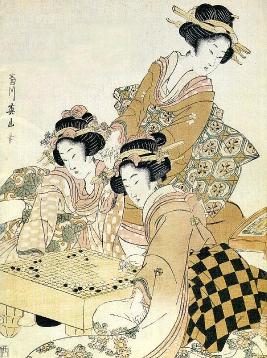
I played 4 games of Go with Vox last night, which we split two games a piece. Over the past couple months we’ve managed to split most evenings of play evenly. Last night there were no big kills, unlike the previous time out. There were, as Vox pointed out, some significant kills though. When we say no big kills, we just mean that no huge groups fell.

I felt I didn’t have good focus in the last of the games, which I lost even though the score was close. I  don’t know if this will make sense to people who don’t play the game, but I found myself seduced by the rhythm of play, unable to slow the pace. There is a Go proverb that says “play away from the sound of your opponent’s stones”, but some games that is easier said than done. Perhaps I was just getting tired. It takes a lot of mental energy to maintain good creative focus over a series of games.

Last night was also characterized by a variety of opening approaches. We’ve had long series of games in the past which all stubbornly start out the same way. Last night we were mixing it up. I even tried starting a game playing stones on two 3-3 points with black, something I rarely do. From time to time, I like to mix up the openings and try to create new complications. I like to get involved in battles and one way to do that is to force my opponent to look at new situations and try to force a mistake.

Next time, look out, he’s really in trouble.

Filed under: Go
comments 7

Das Boot

Last night we watched Das Boot, the 1981 Wolfgang Peterson film, on DVD. I had never seen it. For others in that boat, the film is a long depiction of a single mission by a captain and crew of a German submarine during the WWII. The crew is young and inexperienced, with little idea of the realities of war. We are in the cramped submarine with them through life and death battles but also through long periods of waiting and suspense.

What a crazy idea, to put humans in an armed underwater sardine can and get them to hunt down enemy ships. We’re with the crew as they live that reality. Powerful business, beautifully filmed acted and directed.