comment 1

Moonbeam Tickseed

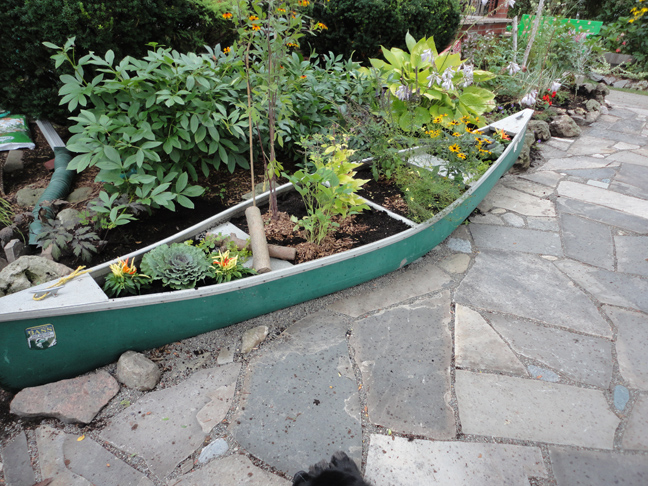
Great band name: Moonbeam Tickseed and the Rhythm Aces. Nope. It’s Coreopsis verticillata. We have some in the canoe garden. The seeds are apparently sterile but the plants can be divided after a couple years if they last. Had I researched instead of buying on impulse, I would have bought any other Coreopsis. I don’t mind a short-lived perennial if the things self-seed some. On the plus side, they’re light and airy and colourful. Happy plants.

comment 0

Melodica

Tonight’s Daily Dose takes us to the world of the melodica.

Of course the melodica goes goes great with a uke…Tequila!

Fantastico indeed…

Not sure what to say about this next number…

And one more for all the melodica freaks out there, here’s Augustus Pablo

comment 0

The Fool’s Progress – An Honest Novel by Edward Abbey

Settling into this book was tough for me. The main character, Henry Lightcap, presents as a self-indulgent anarchist crank, gun-toting and sexist and not very likable. His wife packs him in, leaving him broke. He shoots his fridge full of holes, and along with his sick dog (and in his sick truck), starts on a road-trip east from Arizona to Stump Creek, West Virginia to see his brother and his mother and the farm on which he grew up. Along the way, Henry washes down opiates with beer (while driving) and tosses the cans out the window. I know Abbey has been embraced by environmentalists, but they must have had a challenging time swallowing the contradictions afoot in this character.

There is a finality about this trip east. Henry searches out some old friends he needs to see and then heads east to West Virginia. As he drives toward his childhood home, we learn about Henry’s life, his family, various wars and Henry’s great loves. We learn of his love for the West, for the desert and the forest. Henry’s happiest times with his wife Claire are associated in the novel with the land (they even go mushroom picking together).

Henry makes a choice early on to work as little as possible. He is not built for the work-a-day world, which is simply madness to him. The low-paying seasonal job as a park ranger is one of few roles that suit him. It’s a job in which he can work on his own, be on the land and as a bonus get laid off at the end of each season. He has little concern for lack of money or security.

In Henry’s mind, America is rapidly heading for ruin. On an earlier trip east, he talks with his brother about “progress” and comments that it is overtaking the West too but they are perhaps 30 years behind. Although Henry and his brother Will are different in many ways, they share a distaste for the modern world, which Henry believes will be destroyed by overpopulation. Will lives without an indoor toilet, without running water and without electricity. The brothers agree – America is in trouble.

I found myself becoming more sympathetic to Henry as the novel unfolded. He is way more sensitive than he would like to let on and he’s suffered more than he would tell you. Henry’s not just an anarchist crank. He’s a romantic, trying to make the best life he can in a crazy world, on his own terms. If those terms don’t suit anyone else, he accepts that. Henry’s not big on compromise.

I can’t imagine The Fool’s Progress being set anywhere but America. It is a long rant about freedom and wilderness and doomed America, bleak and powerful with an underlying dark humour.

comment 1

Ornamental Grasses

We haven’t messed with ornamental grasses much in the past, but this year, we’re establishing a new garden that is mostly made up of them.

Hakonechloa macra “Aureola”  This grass forms a low mound of stems that arch gracefully in cascading layers. This is a slow growing grass that doesn’t require a lot of sun. It does like moist soil, though, so we’ll have to be sure to water it. This grass can be divided in early spring once it gets large.

Variegated NOrthern Sea Oats or Chasmanthium latifolium “River Mist”. This plant is fine in sun to shade. It grows about 3 feet tall. It has green and white variegated foliage with dangling oats in late summer and fall. Like the previous grass, this one likes moist soil.

Feather Reed Grass Calamagrostide “Karl Foerster” We’ve planted two of these beside the new path. Ours are small but these can apparently grow to 7 feet tall. This grass is fine in sun to part shade, and it likes to be well watered. I read that the more moisture this one has the taller it will grow. The seeds from this one are supposed to be sterile. These plants, once they obtain some height, are going to partially obscure the view of the canoe from the street. Looking at our little specimens, it seems unlikely they will grow to anything like the spectacular heights they are supposed to reach, and I guess I’m a litte skeptical.

Blue Fescue “Elijah Blue” This is a small clumper with a distinctly blue colour. I bought some of them cheap at Home Depot. The label tells me it needs 3-6 hours of morning or late afternoon sun, and where it is planted, it should get that in the morning. Further reading tells me that the more sun this plant gets, the more likely it is to retain the blue colour. We’ll see how it does. This plant needs to be divided every few years. It is the only one of the grasses we have that are very drought tolerant.

Carex “Bowles Golden” This sedge will grow up to 2 feet tall and features golden leaves with narrow green margins. I have this one planted in one of the back gardens. It’s fine in part-shade to shade conditions and it likes plenty of water.

Juncus filiformis spiralis This is the lesser corkscrew rush. This is a crazy-looking spiraling grass. Although I planted it in a garden that gets lots of water attention, I may have been nuts to plant this one because really it loves scads of water. It doesn’t do much. It more or less sits there and looks funky. Let’s see how it fares.


comment 1

Two Hostas

Hostas do well here. I’ve previously posted photos of the phenomenal giant lime green hostas we now have in three places in the garden (and we’re going to split one or perhaps two of them again later this summer). Gradually, I’d like to expand the variety of hostas we have growing. We added two new ones, one on either side of my little rainwater trough between the canoe and the driveway. These are Hosta Dorset Blue and Hosta sieboldii. Both have relatively small leaves. There is some room for both of them to spread.

comment 0

Clematis heracleifolia “Cassandra”

Clematis heracleifolia “Cassandra” is a shrubby, easy to grow clematis – not a climber. It can bloom through the summer and into fall, and it is apparently very fragrant in bloom. We bought one of these (in bud) at Lost Horizons and planted it in the canoe. This plant can handle part shade to sun. Where it is in the canoe, it gets more sun that you might expect between the house and the locust tree. Very close to this location, peonies and poppies have done very well.

comment 0

A blog and garden project

This year we’ve created a few new gardens and expanded existing ones and we’ve added quite a lot of new plants. Although I’ve been gardening for a long time, my plant knowledge is more basic than I’d like it to be, and sometimes I find that a year or two after planting some perennial or another, I couldn’t tell you just what it is that we planted, or in some cases I’ll know the plant family but won’t know the variety. I’ve kept the labels or names of every plant we’ve added to our gardens this year and in an effort to learn about them, remember the names, and get better at plant identification in general, I’m going to make posts about each of the plants we’ve added to the garden in 2012 until I’ve written a little about all of them. I’m not sure how I’m going to go about this yet. I may group them in some cases, but I’ll figure all that out as I go along.

I’m going to tag all the posts in this project as Garden Additions 2012


comment 0

Pee Wee King

Pee Wee King was born Julius Frank Anthony Kuczynski in 1914 and lived until 2000. He was Polish-American from Milwaukee Wisconsin and he is best known as the co-writer of the Tennessee Waltz. His co-writer on that tune was Redd Steward. They wrote the tune in 1946 when King led the Golden West Cowboys, and then recorded it in 1948. Here’s the original recording:

Slow Poke – hey look, an accordion

And here’s the Ten Gallon Boogie