comment 0

Bear’s breeches and a scarlet tanager

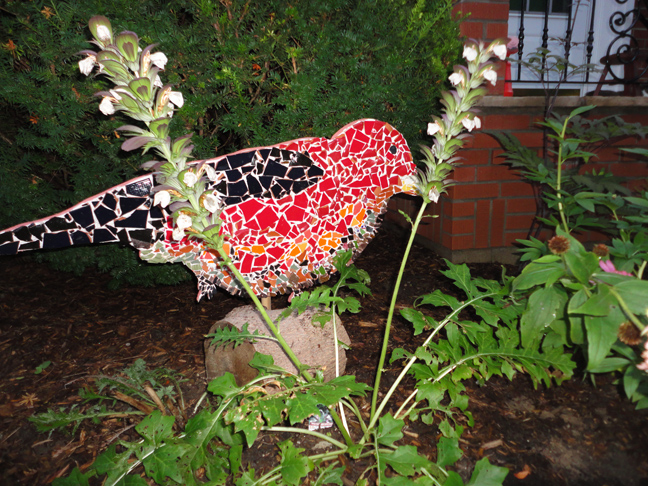
I like the latest bird mosaic sitting in the garden behind the bear’s breeches because you don’t see it right away when you walk into the gardens. Eventually, those bear’s breeches will expand. We’ve seen them with many spikes. When that happens, the scarlet tanager will fly out of the garden, circle around and look for a new place to perch.

comment 1

Canoe Garden

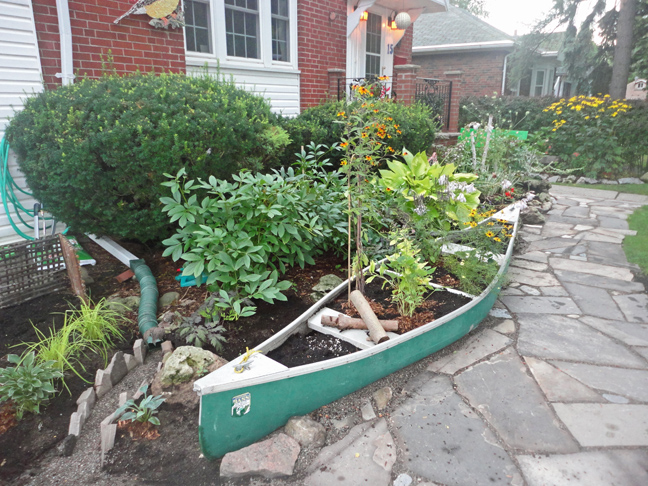
After taking the dogs for their Sunday morning walk, I snapped a few shots of the canoe garden. Strange sky. Is it going to rain? It’s still so humid my camera lens fogs up when I start taking pictures. A few notes on the new gardens. New gardens are new gardens. They look stark and too empty. I want to fill them up, but I know that they will grow and fill in and be just fine. Patience. The bow and the stern of the canoe are empty. We’re going to use the two ends of the canoe for annuals. The middle area of the canoe is wider and I’ve taken the bottom out – I think it’s more likely we can get perennials to winter in the centre than on the ends where the canoe still has some bottom and where it narrows right down. As soon as we see them around, we’re going to put an ornamental cabbage on each end.

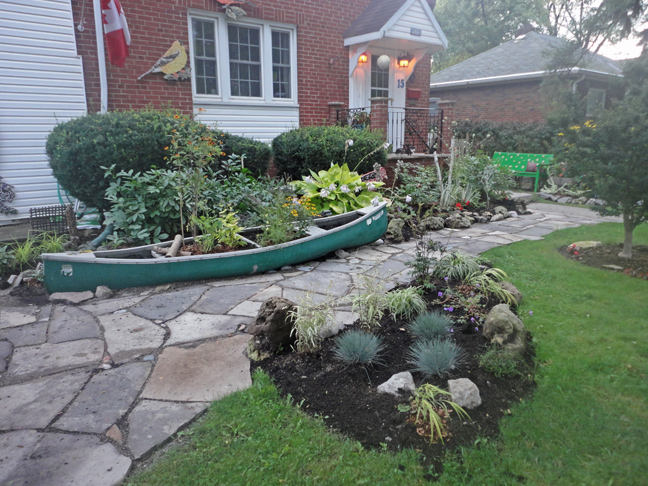
We had a rain that created a water path through the new garden behind the canoe. I used some pieces of flagstone and some pea gravel to strengthen that path so each rainstorm doesn’t erode away the gardens. The garden behind the water path is not yet fully planted. We’ll get to it…

The garden on the near side of the path is mostly an ornamental grass garden. Some of those grasses will grow quite tall and will partially obscure the path and the view of the canoe from the street. Hey, what’s that in there, behind the grasses? Is that a canoe garden? There may even be another garden in front of the ornamental grass garden at some point in the future, but let’s not get ahead of ourselves.

I suppose a front yard canoe garden will seem unusual to some folks but it’s no more unusual than having a six foot tall mosaic owl stuck to the front of the house.

The canoe is sunken into the ground a bit on the stern side, runs along ground level for most of it’s length and on the bow comes just above ground level. We wanted it to sit as naturally as possible in our little landscape, just as if it belonged there.

The giant lime-green hosta from another planet is such a striking element in the garden, it seems to explode over the bow of the canoe. You can see the paddles, which came with the canoe, lying against the canoe. That’s temporary. We haven’t decided how we’re going to use them yet. The folks who sold us the canoe commented that we can’t go canoeing without paddles. I neglected to tell them that this canoe would never float again.

comment 0

Lost Horizons

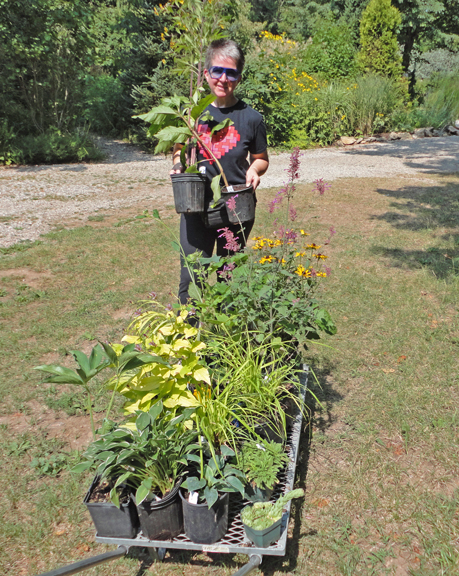
Most people around here do most of their planting in the spring. Our circumstance is a little different in that this season we have expanded our gardens mid-summer – and added a canoe garden. The new gardens are partially planted but we saved some room because we were planning to visit a nursery called Lost Horizons today.

We drove out to the nursery this morning. It’s located just west of Acton, less than an hour’s drive from here.

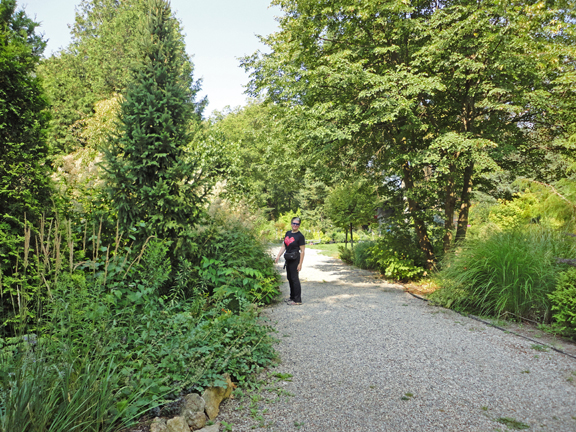
Lost Horizons doesn’t look like your average garden centre. It features extensive display gardens that in themselves are worth the drive.  They call themselves a small nursery but it’s large enough that I lost Tuffy P for 20 minutes. Early on in our venture, somebody armed us with their catalogue. Most garden centres have extensive labeling but at Lost Horizons, for many plants you need to look them up in the catalogue for some specifics about plant characteristics, size, light requirements and so on.

You can check out their extensive catalogue on their site. Just their selection of hostas was really extensive. I will say that the more unusual plants are expensive, but I suppose that is to be expected. For bargain plants there’s always the No Frills garden centre.

We loaded up the car with quite an assortment of plants and headed back to the city (stopping at a nice yard sale along the way).

If you live in the GTA and you love gardening, I recommend a trip out to Lost Horizons. They have put a huge amount of effort into their display gardens, and you’re likely to find a few unusual gems for the garden.

comments 2

Ellie Mae

Ellie Mae, one of our Newfoundland dogs, has been experiencing a mysterious problem with one of her front legs. Twice in the last couple weeks, inexplicably, she’s started limping. Within a day or two, the limp has disappeared. Our vet examined her this morning, but was unable to locate any specific problem beyond some arthritis in her joints, which we knew about. They’re running a test to see if she has Lyme Disease as that can cause lameness. If the problem persists, once we’ve ruled out Lyme, may be X-rays to try to get a picture of the problem. We would like to isolate specifically where the issue is before doing X-rays though because right now it isn’t clear. If it happens again, we’ll shoot some video of her limping when it is most pronounced to show the vet. The last episode happened yesterday evening. She was still limping quite a bit this morning but by the time we left the vet’s she was walking just about normally.

comments 4

Lobster mushrooms in the forest

Hypomyces lactifluorum, AKA the lobster mushroom, is one of the more common choice edible wild mushrooms in the Southern Ontario forests I visit. I’ve written about lobsters a number of times before. They’re unusual in that the mushrooms we pick as lobster mushrooms are in fact host mushrooms that have been attacked by another fungus. The attacking fungus contorts the shape of the host and coats it with a red crust. It also makes the whole item delicious.

Some people will not eat lobsters because they cannot identify the contorted host and they are concerned that a poisonous mushroom has been attacked by the known to be quite edible Hypomyces. Many articles suggest that the hosts for this parasite are are always Russula brevipes or Lactarius piperatus, two mushrooms that are not palatable prior to attacked by the parasite fungus. Can the parasite attack other possibly poisonous hosts? As Tom Volk suggests on his website, lobster mushrooms have been eaten for hundreds of years without known problems. In fact, I’ve seen dried lobsters in some grocery stores. I’ve been eating them with some regularity for a few years now without any issue.
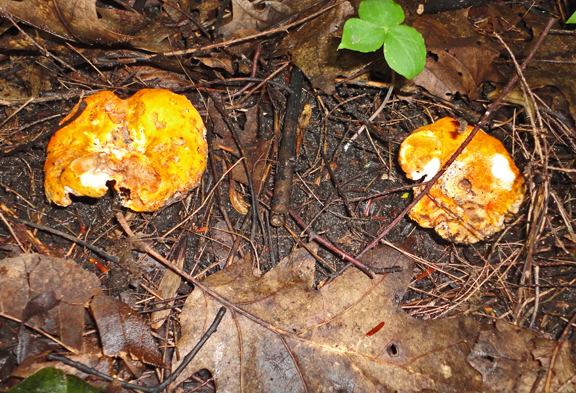
This is how lobster mushrooms look in the forest. They tend to be lumpy and contorted and sometimes partially covered or filled with material from the forest floor.
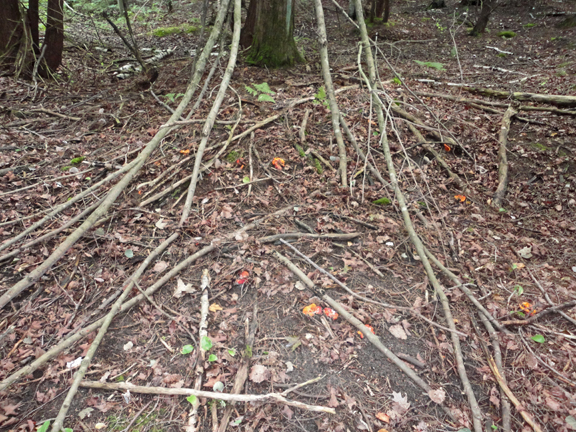
There are at least a dozen lobster mushrooms visible in this shot, which was taken in a hemlock forest. You can see a couple of the specimens are a rosy red while others are more orange. Orange, red-orange or washed out red-orange are all good colours. By the time they get rosy in colour, they are almost always past their expiry date. When you see them in the forest, look for specimens that are firm. Don’t worry if there are  a couple holes in the mushroom.

The only negative to lobster mushrooms is that they are a pain to clean. I start by cutting away anything that looks soft or pulpy or too red. Then clean the mushrooms under cold running water. These are dense mushrooms and will not be compromised by being washed in water. You might find a toothbrush is helpful in getting the forest floor off your mushrooms. Then slice your mushrooms up in slices that are about an eighth inch thick. Once you’ve done that, cut away anything that is not firm, white or orange-red-organge. If I don’t like the looks of it, I cut it away. The cleaned, sliced up mushrooms keep well in the refrigerator for a few days.

When you cook Hypomyces lactifluorum, they retain their firm texture and can even add a bit of crunch. Of course I know you will not be silly enough to collect, cook and eat wild mushrooms. If you decide to do so, remember that it is against my advice. Do as I say and not as I do.