



comment 0
After the Zombie Apocalypse
A bonus that comes with being a retired guy is that you can plan to go fishin’ during the week when most piscators are busy with the work-a-day world. Today I fished two rivers. This was not my intention. My intention was to catch plenty of trout at river numero uno and never contemplate bailing for another stream. 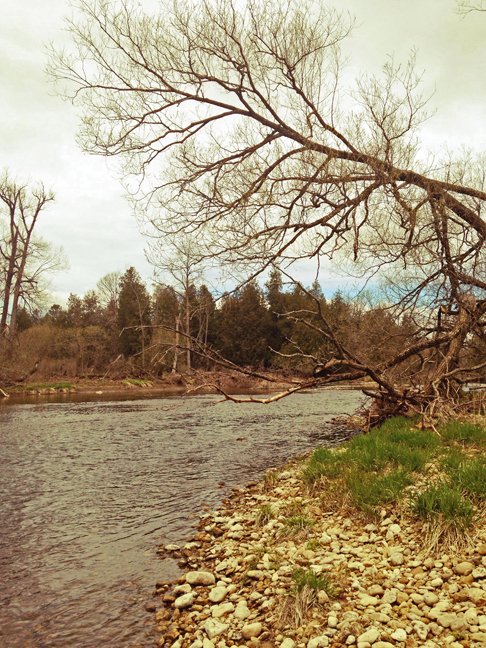
The first river is a well-known tailwater. For the non-fly fishers out there, this means this ought to be a warm-water stream with plenty of bass and pike an all that jazz, save for a bottom-release dam, which releases cold water from the bottom of the lake above into the stream, bringing the temperature down to trout range. Many years ago, some folks realized this and started stocking the stream with brown trout. Add some special regulations and you have a stream full of big honkin’ browns.
Although we’ve had some rain, the stream was low and clear. This isn’t always the case. There is a side-effect to this tailwater and that is a summer algae bloom, which causes the stream to get somewhat murky at times. For that reason some of my friends and I started referring to this river as The Muckhole, many years ago. During times of really bad algae bloom, we sometimes add a nasty adjective.
However, as I said, today it was low and clear and inviting. Unfortunately, there was no sign that trout lived there. I saw a few blue-winged olives (little olive coloured mayflies) in the air but no risers, so I worked a number of nymph and streamer patterns but all I had to show for my efforts was one sad chub. Now I know when I’m beat (and when I’m hungry) so I walked back to the car, took off my wading gear and headed to town for some lunch.
After lunch, I abandoned ship on the tailwater and headed over to another stream I’ve fished for many years, which I often think of as simply The River. I parked at a bridge, a popular access, yet I was the only car there. The water looked good. From the bridge I could see a large trout nymphing in the deep run on the upstream side. I suited up and headed upstream.
I wasn’t in the river 5 minutes when the Hendrickson emergence started. Lots of bugs coming off the water. For the non-fly fishers out there, Hendrickson is the common name of a species of mayfly which emerges in the spring. Suffice it to say these bugs are basically trout ice cream. What happens is this. The bugs live as creepy-crawly nymphs underwater until the appointed emergence time. Then each day for as long as the “hatch” lasts, they emerge to the surface every afternoon (except when they don’t). When they get there, the ones that aren’t gobbled up by trout on the way up shuck their skin, revealing a set of sail-boat like wings. Then the adult Hendrickson takes flight, offering the swallows a dinner opportunity along the way.
The trout were interested in gobbling the bugs at that second when the nymph transforms into the adult or dun mayfly. There were quite a few trout rising including some big ones, many in difficult spots, tucked in near logs or sheltered by overhanging trees. Before the emergence stopped (about 3 hours after it began) I caught and released a couple good trout and hooked and lost a very large one, a trout in the category “alligator”.
It was great to get out on a river again after an entire season with no fly fishing (after breaking my ankle last year, wading was out of the question last season). Experiencing a splendid Hendrickson emergence made for an excellent afternoon. When these bugs come off the water, the stream comes alive and even some of the larger trout come out of their bomb-shelters to gorge on the mayflies. On many days this stream does not give up trout very readily, and days like this remind me there are many good trout in the river.
Tickets are now available for the first ever Long Branch by the Lake Garden Tour, which takes place in our community on Saturday June 18. Tickets are $10 – your ticket booklet gives you access to 14 beautiful gardens in our community and all proceeds go to LAMP Community Health Care Centre.
Tickets are currently available at the following Long Branch & Toronto businesses:
Silver Lion Framing – 3305 Lake Shore Blvd. W.
Purrfect Pets – 3313 Lakeshore Blvd. W.
Lakeshore Organic Foods – 3323 Lakeshore Blvd. W.
Porritt Real Estate – 3385 Lakeshore Blvd W.
Thrive Organic Kitchen and Cafe 3473 Lake Shore Blvd. W.
Evans Hardware 3445 Lake Shore Blvd. W.
…and for those in the downtown area looking for tickets, they are available at Yumart Gallery at 401 Richmond Wednesdays to Saturdays.
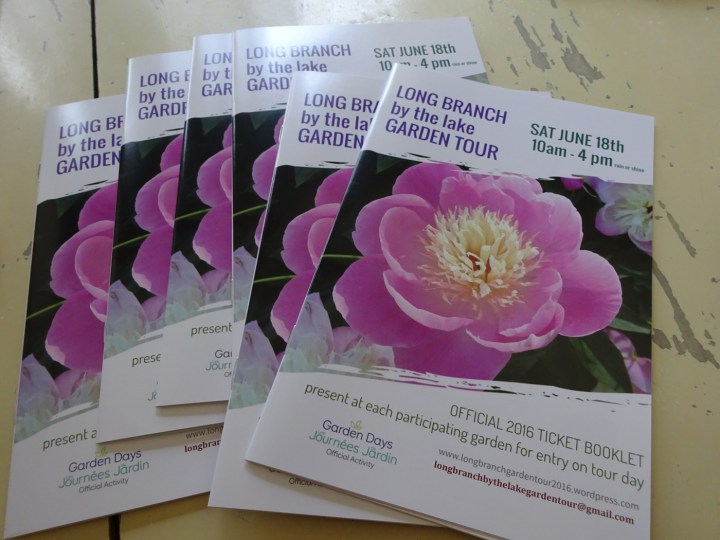
Please support these local businesses when you pop in to get your garden tour tickets. If you run a local business and you would like to be a ticket seller, let me know. For more information about the garden tour, visit the Long Branch by the lake Garden Tour site. This garden tour is an official Garden Days activity.

There is a great selection of books right now at the 27th Street Book box. It’s in front of our home on 27th Street (near all the construction madness). Books are free to take. You can keep them or borrow them, and if you like, add new books to the collection. The contents are constantly changing so you never know what you’ll find there. Right now there is a wide variety, everything from John Irving to kids books to a scholarly work on the polka.
I’m very pleased the book box continues to be enjoyed in our community.
I had a fun time last night at the monthly open mic at Fair Grounds, a coffee shop here in Long Branch. Mostly I play my banjo in isolation (for my own amazement), so it’s an opportunity to play for some people for a change. Old time banjo is a bit of an oddity at this open mic, as most people who come to perform play guitar and sing songs, both originals and covers of pop tunes. There was a poet last night and that was a welcome twist.
For my part, I started off by playing the Forky Deer, a tune I know pretty well – with my friend Bill playing washboard with me. For the next tune, I decided to try Banjo Tramp, a tune I like a lot but only recently learned. Note to self: don’t play a tune in public until you can play it in your sleep. I did a butcher job on this one last night. Arghh! I finished off on a higher note with another tune I’ve played for quite some time, Julianna Johnson.
There was a good crowd out last night and quite a few performers, some of the usual suspects plus some folks who haven’t performed there before. I like the friendly community atmosphere of this open mic. The people there are not judgemental (did I mention I butchered The Banjo Tramp?), and there is quite a variety of performance, including some excellent original material. There is quite a range of skill level and that seems to work out just fine.
I had a chance to play one more tune later in the evening, so I changed to Sawmill tuning and played Bonaparte’s March, one of my faves. The open mic is a monthly event. It has been on Thursdays, but may be changing to a different day in the future.
I took the partners for their early morning walk this morning over by the filtration plant. We were walking along the crest of the hill where the kids toboggan in winter, when I heard a car horn. I looked down where the filtration plant folks have some kind of temporary operation going on and saw a coyote a few yards in front of a pick-up truck. The guy in the pick-up honked his horn 2 or 3 times and it looked to me as if the driver was honking at the coyote. The dogs and I were watching this, confident the coyote was both far away and behind a high fence.
Coyote then trotted toward the corner of the filtration plant fence nearest the leash-free area, and continued right through the handy hole in the fence to the other side. It then looked up at us and decided to come check us out. By that I mean it trotted directly toward us. We backed away as Coyote crested the hill appearing maybe 40 feet from us. Coyote was lean but aside from a mangy coat, appeared quite healthy. It stood its ground as we walked away and didn’t follow us further. Unfortunately I didn’t have my phone with me on the walk, but even if I did, I’m not sure I would have taken the time to take a photo. The dogs were pretty excited and wanted to go chase Coyote, but I just wanted to get us out of their without any trouble.
This marks the second time a coyote has approached us in the very same spot. Coyote was neither shy nor scared of us. Instead, I would characterize its behaviour as curious. Look at the big dogs! Better keep these characters out of my space.
There are a number of coyotes around. I’ve seen them several times in the park and also occasionally on neighbourhood streets. I suspect they wander the streets more often than we know. As far as I know there have not been any nasty interactions with these animals around here. I’m none-the-less cautious around them, conscious of the incident a few years ago when a hiker was killed by coyotes in Cape Breton. These are after all wild animals who kill for a living, and while Sam Smith Park offers lots of food opportunities (mice, possum, water birds, bunnies and so on), avoidance seems the sensible approach.
Once upon a time, dusters were made of feathers, but these days they are made of some kind of miracle plastic crap that apparently attracts dust. I know this because there is one sitting in a bucket near my fly tying station. I barely noticed it – ok I confess I don’t do a lot of dusting – until today when a little light bulb went off in my ever so tiny brain, and I thought, I could make trout flies from this stuff.
And so The Duster was born….
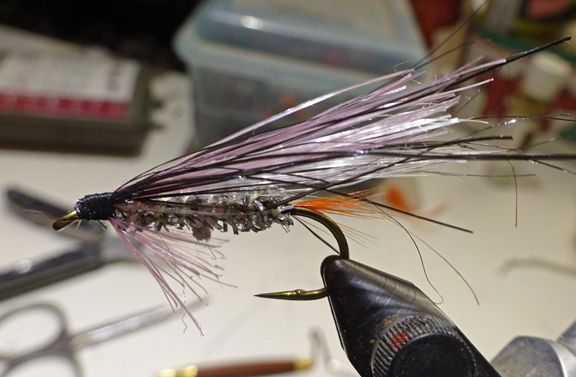
I made two versions, one with a tinsel body and the other with an orange sparkle yarn body.
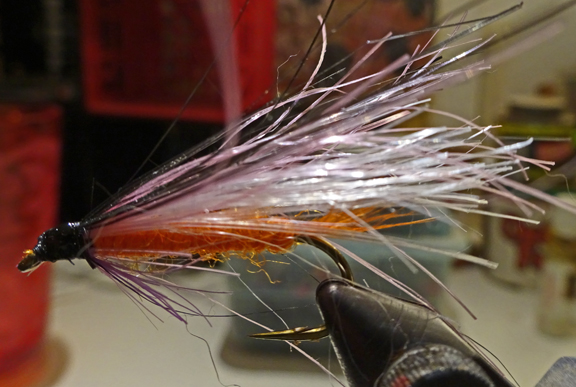
I’m betting it will be an attractive fly for Troutis maximus rex. I think, scientific trials are required. I will undertake these Monday at The River.
I subscribe to the “meredithantraxelrod” YouTube channel and it’s always a treat when Meredith Axelrod uploads some tunes because she is a really great singer. Here she is with Craig Ventresco performing You Done Tore Your Playhouse Down.
Here are Clawdaddy and the Fire Ants with a fun version of Cluck Old Hen….
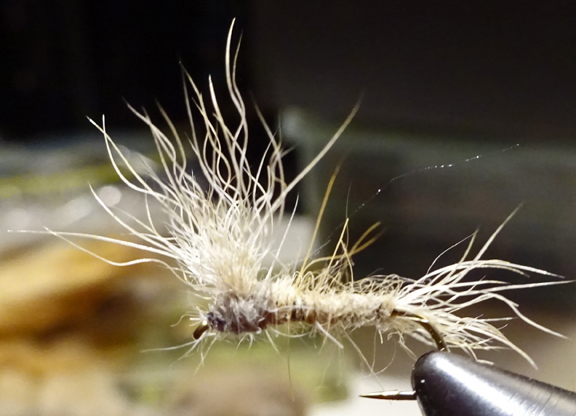
Upwing Usual
I’ve been a trout fisherman as long as I can remember. I count among my earliest joyful memories the days my father took me to trout streams and showed me where the trout lived and how to catch them. He was an unrepentant bank-napping bait plonker, and a good one. He used spinning tackle, a light line, a small hook and a big dew worm, which he drifted weightless under logs and deep into the bomb shelters where the big trout lurked.
My father taught me to love and respect nature, to love the trout we caught and ate (back then nobody talked about “catch and release”). What a gift he gave me.
At some point along the way, I became a fly fisherman exclusively. It was more interesting to me technically and I enjoyed watching what was going on with the bugs on the water, figuring out what bug and at what stage in its life cycle the trout were eating. I learned to tie my own flies from fur and feathers to imitate the bugs I saw in nature. At one point I tied quite a lot of flies – and I fished quite a lot too, far more seriously than I do today.
Last season I broke my ankle in March and at no time during the trout season did I feel I had healed to the point that wading a trout stream was anything like a safe activity, so I was not on a stream at all. In anticipation of changing that this season, I’ve been sitting down at the vice and tying up some trout flies.
There are a lot of fly patterns. Each year there are new ones that the fly fishing magazines promise are the cat’s meow. Although I’ve tied many different patterns, over the years I’ve pared down considerably to maybe a dozen go-to patterns. I tie an emerger pattern called a Usual in both upwing and downwing styles and in colours and sizes to match various mayflies including Hendricksons, olives, sulphurs and grey foxes.
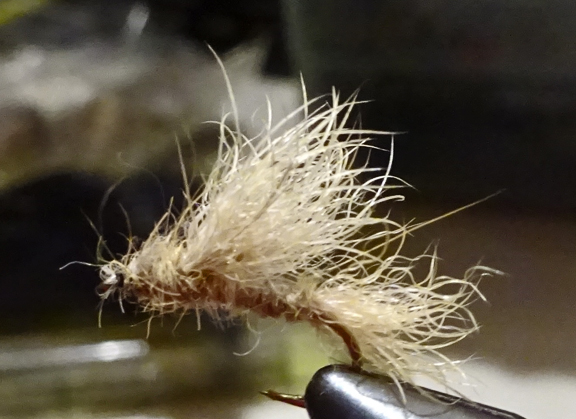
Downwing Usual
I guess I could have only one pattern in my fly box it would be the Usual. The ones in the pictures are tied to imitate Hendrickson emergers. Although you can match the hatch with Usuals quite well, they are also very impressionistic and, well, buggy, so they make great searching patterns as well. In fact I tie some “messier” to use as searching patterns. Around here, the Usual is a popular pattern and I suppose it is in the Eastern US too. It is just as effective on western rivers but last time I was in the mountain west I didn’t see any in local fly shops.
To tie Usuals, you need a snowshoe hare’s foot. This unusual material is used for both the tail and the wings of the fly. They are very simple to make. Tie in a little tuft of snowshoe hare foot as a tail. Next tie in the wings, either up or down wing. I’m not convinced one is better than the other so I carry both and use them interchangeably. Add some dubbing material to your thread and wind on a body. The Hendricksons I tied tonight have a tan body. You can use a synthetic dubbing if you like. I have a bit of red fox fur and I use the underfur from that for my Hendriksons.
Tonight I tied half a dozen Usuals, a couple parachute ant flies (they look like black ants but have hackle tied on a post in the parachute fashion), a couple deer hair beetles, a few soft-hackle emergers and half a dozen streamers.
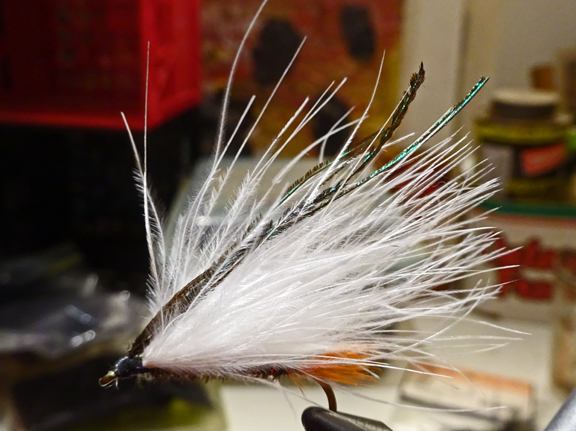
White Marabou streamer
The white marabou streamer is an old pattern, but one that continues to be remarkably effective in various conditions. I have some white marabou plumes that my brother gave me decades ago. Who knows how long he had them. The pattern is simple. I use a bit of something red at the tail end, and in my imagination this makes the fly more effective (or at least makes me more confident in the fly, even though minnows don’t have red butts). The body is peacock herl, wrapped around the shank of the hook. I run a wire through it in the opposite direction to add strength. Then I tie in the marabou and add two or three strands of herl on top. Simple, easy to tie, visible in the water, and effective.
I fill my fly boxes with the basic patterns I like to use, and if I’m traveling, I like to support the local fly shop (especially if they tie flies in-house) and I typically buy a dozen or more flies to supplement what I’ve tied up myself.
UPDATE: a note on spelling. A friend has suggested I should have spelled vice as VISE. I thought VICE was correct Canadian spelling for both vice meaning clamp and vice meaning bad habit and that using VISE for the gripping device is strictly American spelling. Right or Wrong?
 27th Street