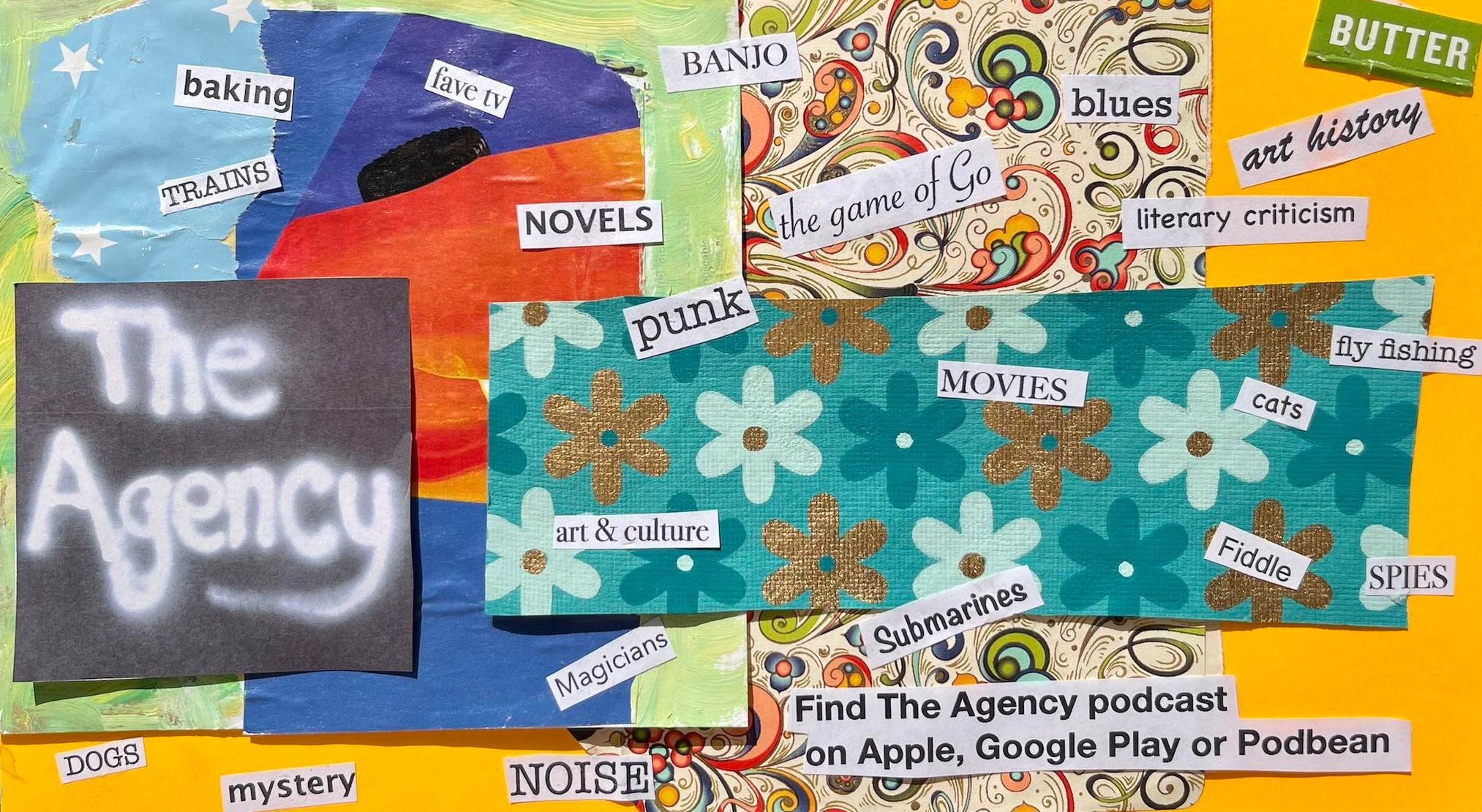
The new episode of The Agency Podcast is now available. Listen here or find us in all the fancy podcast places.
This week, the Agents talk about the economy, culture and desire for truffles. Eugene watched The Truffle Hunters: this week, setting off a train of thoughts on “tradition ” and “initiation.” They both watched Melissa McCarthy’s new series “God’s Favorite Idiot.” Eugene fermented something special and Candy has been taking sewing lessons.
This is turning out to be a good season for hot chiles in our garden. We have a few plants, different varieties and they’ve been ripening faster than we can eat them. I thought this year I’d have a go at making some fermented hot sauce. I’ve done lacto-fermentation before – a couple years ago I made some fab fermented dill pickles and it was really easy.
I roughly chopped up some chiles from the garden and dropped them into a sterilized mason jar. I also added several cloves of garlic. The brine formula I used was 1.25 teaspoons of fine sea salt for each cup of warm water. Warming the water helps dissolve the salt. Folks who do this all the time often have fancy glass weights to keep their chiles submerged. I improvised using a piece of tin foil and a pestle, and I think that will work just fine.
I expect that the brine will start getting cloudy after a few days. This is a good thing. After about a week, the chiles will have fermented enough. After that, I’ll blend them up with some of the brine and a splash of cider vinegar. At this stage, I can also add some sugar or honey or any herbs I want to include.
Fermented hot sauce does not get “canned”. That means it has to be stored in the fridge. I’m going to see if I can get a few squeeze bottles at the $$ store for this purpose. Fermentation will continue very slowly in the fridge, and that’s ok. The flavours will deepen and become a little more acidic over time.
The goal in doing this process is to create an environment that promotes lactic acid bacteria. Harmful bacteria won’t be able to survive in the salty, acidic environment. All veggies have lactic acid bacteria on them. The brine needs to have enough saltiness to kill nasty bacteria but not so salty that the good bacteria we’re trying to promote dies.
By the time this batch is ready, I’ll likely be overwhelmend with loads more fresh chiles in the garden. Maybe I’ll make a second batch at that time and make friends.
Listen to the latest from The Agency Podcast right here or find it at all the good podcast hiding places.
This week, The Agents go to the movies for BULLET TRAIN. They also watch a pirate treasure hunt on Netflix. Who doesn’t like searching for pirate gold?
Candy encourages Eugene to watch the Ethan Hawke produced THE LAST MOVIE STARS.
We want to hear from you about cultural representation, treasure hunting, Joanne Woodward, what you’re cooking…or is 45 going down with stolen documents? Or just about anything! Email us anytime.
I could watch these fab Métis dancers all day. On piano is Patti Kusturok, one of top fiddlers around, and on fiddle is Morgan Grace, a wonderful teen-aged lefty fiddler to watch for, and her dad on guitar. The dancers are Arnold Asham and the Asham Stompers.
Special thanks this week to our guest, Lauren Willette. Lauren is a doctoral student in the Heritage Studies Program at Arkansas State University. Many of us know little about the region known as The Ozarks, beyond what we see on the Ozark TV show. Lauren takes us down an Ozarks rabbit hole and gives us a much better picture.
Also this week: We visit the Comfort Food Diner to talk brownies. Walnuts, yay or nay? Reality TV: from F-Boys to home cooks The Gray Man Shania Candy’s sewing update
I’d like to thank our faithful listeners who keep coming back for more! If you’ve never listened to The Agency Podcast, please give it a try.
I grew plenty of basil this season, with the intention of making pesto. Somewhere I read that the flavour of basil is at its most intense when it starts going to seed. When I first see that happening, I cut it back and that extends the life of the plant some, but when the basil gets insistent about going to seed, I know it’s pesto time.
I make pesto the “normal” way – that is by using a mortar and pestle. After all, the name pesto comes from pestâ, a verb meaning to pound or crush. It is far and away faster to instead use a food processor, but in my little mind, that produces a sauce involving chopped or processed basil along with the other ingredients, pine nuts or walnuts, super-good olive oil and a strong hard cheese. There is no doubt it is great. To me though, it’s not pesto if you don’t pound it. Pesto not made the normal way is like using a gas bbq instead of charcoal to grill a steak. Sure it’s pretty good, sometimes even excellent, and you might try to convince yourself it’s as good as using charcoal, but in your heart you know it just isn’t so. Besides, I hate cleaning food processors so I only use one when I can’t find another way to get the result I’m looking for (that means rarely).
I intended to use pine nuts but couldn’t find them in 2 stores, so I went with walnuts. This is not a consolation prize. Walnuts are insanely good in pesto. The same two stores that didn’t have pine nuts also only had Parmesan cheese in the pre-grated “shake cheeze” form. Is that even cheese? Is it even a food product? I don’t know. Instead I opted for a big wedge of Grana Padano. This is an excellent cheese, which comes from the Po River Valley in northern Italy. It’s yummy and works great in pesto.
Traditionally, I ought to have used only Italian basil for my pesto, but I also had lots of Thai basil growing in the yard as well as Italian basil, so I threw caution to the wind and pounded both kinds. As well, I did not skimp on the garlic. The resulting pesto is really intense, with a hot edge to it. Fantastic!
Episode 160 of The Agency Podcast is now available. I can hardly believe we’ve made so many episodes, and we haven’t missed a week since we started! Thanks for sticking with us. Listen to Hack the System here or find it at all the best podcast places (sorry no Spotify :))
This week The Agents welcome documentary filmmaker Nico Edwards to discuss outlier travel, adventure and filmmaking on a 120 foot sailboat going to Antarctica. That’s a mouthful. The agents saw two documentaries directed by Nico Edwards and found them both compelling. The conversation with Nico stands out as one of their favorites.
The 2017 feature documentary “Sea Gypsies:The Far Side of the World” is the center of the discussion but both the film and Nico’s conversation are generative. The documentary follows ” a small group of modern seafaring gypsies as they strike out across the largest expanse of of uninhabited geography on earth, in search of adventure, awe and whatever else lies at the far side of the world. The vessel is Infinity,a 120-foot hand-built sailboat crewed by a band of miscreants. The journey, an 8.000 mile Pacific (crossing from New Zealand to Patagonia with a stop in Antartica.” IMDB)
Here’s the trailer for Sea Gypsies: The Far Side of the World.
I’m sure I’ve share this one once upon a time in this space, but I love it so much, I want to share it again. This is Mac Beattie and his Ottawa Valley Melodiers featuring Reg Hill on fiddle.




 27th Street