
Graham Townsend on fiddle and Kevin Hickey dancing….this one is for Candy Minx
Graham Townsend on fiddle and Kevin Hickey dancing….this one is for Candy Minx
Each year as the weather warms and people start thinking about foraging for wild mushrooms, 27th Street gets quite a few visits from people searching for this or that variety of mushroom. Over the past couple weeks for instance, there was quite a bit of activity from people thinking about getting outdoors to chase down some elusive morels (I went on one morel hunt and came back with a decent bag)
Today somebody landed here after searching Lobster Mushrooms Ontario. Lobsters – Hypomyces lactifluorum – are plentiful in some of Southern Ontario’s forests, but absent in others. However, we’re way too early to think about these beauties. Lobsters are summer mushrooms around here, not spring mushrooms. I usually start finding them sometime in July, but they really come into their own in August, and least in the forests in which I find them.
Among the places I find a lot of lobsters is a forest with trails that get a lot of use from hikers and bicycle riders. These tasty edibles like to grow close to the trail in this forest, so much so that when I go there, I simply walk the trail, grabbing mushrooms within plain sight.
Granted, they don’t look so appetizing. Often partially hidden in the forest duff, they appear to be contorted, dirty, and sometimes parts of them are bug-eaten. Only pick the firm, scarlett-coloured ones. Once they get a deeper red, they’re usually past their expiry date and should be avoided.
If you come across some lobsters this summer (presuming you can positively identify them – DON’T GUESS), you’ve found yourself a real treat. Clean them under running water. A toothbrush might work for this (so I keep thinking – I never actually use one). Slice the mushrooms into eighth-inch slices, then simply cut away anything that isn’t white or red.
I love eating these mushrooms because they maintain their firm texture through cooking and they’re really tasty too. As well, they’re common enough that even when I can’t find anything else, I can usually come home with enough lobster mushrooms for a couple dinners.
As for where to go to find some H. lactifluorum this summer, you’re on your own. The best thing to do is get out and explore some different forests, When you find something good, look around at the forest you’re in. What trees are there? Is it open or brushy? Start paying close attention, especially to the trees. Are you in an oak forest? Maple? Hemlock? What else is around?
Finally, I can’t stress enough, be careful with wild mushrooms. There are some nasty ones, including some deadly ones out there. Invest in a good field guide. Don’t ever eat any mushrooms you are not 100% sure of please.
Let’s listen to Sonny Terry & Brownie McGhee, singing Rock Island Line…
 First, go find some fresh wild morels. Then….heat your pasta water and while that is happening, roughly chop up a pile of morels and more finely chop up some garlic and a few sage leaves.
While the pasta is cooking….
…..heat up a big cast iron pan, add a little oil and the garlic and the sage and the morels and let them cook up for a while.
While the morels are cooking….
…grate some cheese (I used Parmigiano but I bet several other choices would be tasty too).
Before the pasta is done….
add some white wine to the morels, garlic and sage. I also added a cup of milk. Heavy cream would have been way richer but I try to stay away from it. Stir it all up and let it simmer.
When the pasta is cooked, strain it then add it right into the morel/sauce mixture and toss it around. Let it all cook together in the cast iron pan for a couple minutes.
Shut off the burner, then toss in the cheese, a sprinkle of salt, some fresh ground pepper and if you like a few chile flakes. Add some fresh parsely. Toss it all together, and enjoy.

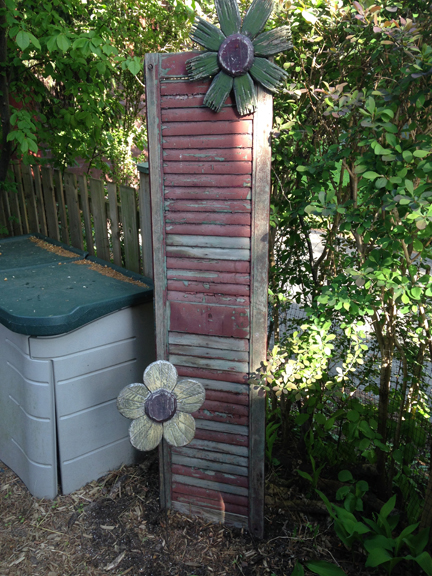
Tuffy P suggested the other day that we have so many things going on in the back gardens, it’s like a mini-putt. Shutters from the Christie antique show appeared in the garden today, followed by some seashells.
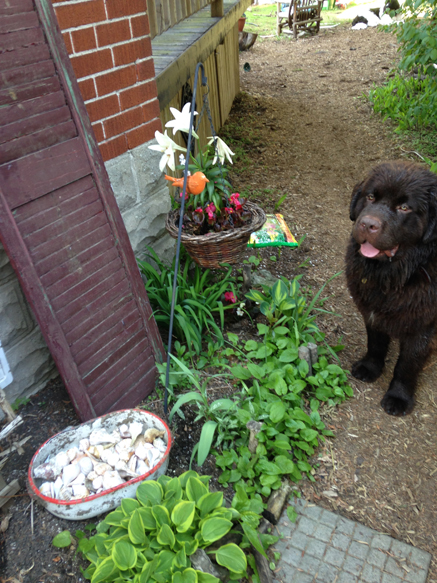 Of course George has to be in the picture.
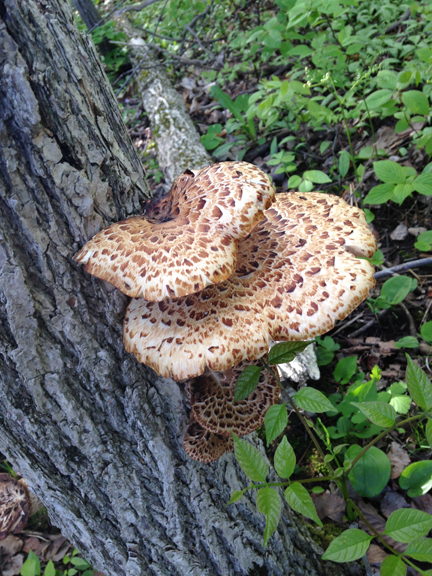 Polyporus sqamosus is commonly known as Dryad’s Saddle. I saw a lot of it while I was out foraging for morels today. It is quite distinctive and often has a watermelon-like odour. Apparently the young tender specimens are edible, and some people say they quite like them. I know one person who claims he ate some and became ill. I think most foragers do what I do and ignore them.
If any readers have eaten Dryad’s Saddle, did you like it?
 I don’t recall where or when we got this smiling character, but he’s been out in the garden for years. He’s in pretty rough shape these days, so he’s taken refuge behind a trellis where a clematis will offer some protection from the elements.

I headed out early this morning in search of some morels. I first visited a spot that has been reliable for me in the past, but didn’t find a single morel. I was disappointed because I have heard reports of some finds in our area and I really hoped to find some this season.
I decided to go for a hike on a nearby trail, but I wasn’t hopeful – I had looked there in the past and had never struck gold.
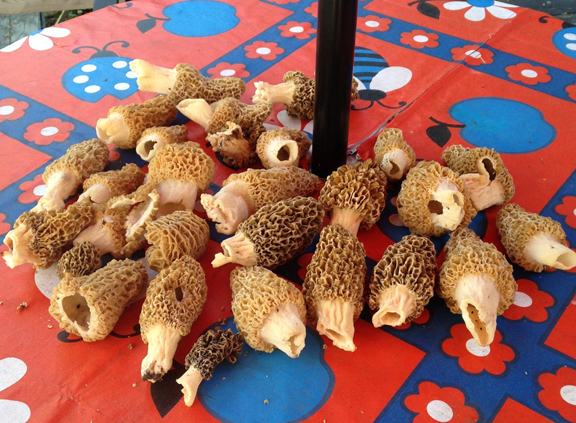 I was surprised to find several nice yellows right beside the trail, just a two minute walk in from where I parked my car. I thought, wahoooo, I’m going to come home with bags of tasty mushrooms, but then nothing. I walked and I looked and I looked and I walked, and found nothing for the next 3/4 hour – until I came upon a number of trees that I thought looked promising. In this spot I started to find mushrooms again. They were not concentrated. I’d find one here, one there. Some trees had two or three mushrooms under them; others had nothing at all. In all I found about 30 morels – not a huge haul, but nothing to sneeze at either.
 27th Street