
Here’s a lovely schottische Istumbled upon on YouTube, played on a two-row diatonic.
Here’s a lovely schottische Istumbled upon on YouTube, played on a two-row diatonic.
Regular readers know that I have a music student. I’ve been teaching him to play the triple row diatonic button accordion, and he’s coming along well. The button accordion is a folk instrument and in many cultures the normal way of teaching and learning it is by ear. However, I’m teaching my student to read music because it seems to me it is a simple and easy to learn skill that makes it easy to share music. I can play a tune for my student and show him how it should sound, then send him off with the written music which he can use as a reference. We share that reference and we can agree that “this is how it is written”. We can also agree on the language. For instance, “play an alternating bass with an F chord over these two bars and then switch to a C chord as you begin to pull air back through the bellows.” The notes all have names and when we use them, we know what we’re talking about. Of course, that’s only part of the learning. The other part is about making the music come alive, adding feeling through the bellows work, adding embellishments, triplets, grace notes, slurs, chords and so on.
I was contacted by a fellow yesterday who wants to learn the instrument, but he wants to learn it the “normal” way, by ear. He plays the single row diatonic button accordion and he has a triple row box, but he doesn’t know how to go about playing across the three rows to take full advantage of the possibilities of the instrument. There are two problems. One is that I haven’t really considered how to go about teaching someone without using the language of reading music. The other problem is that his triple row accordion is in ADG and mine are in GCF. The accordions are in different keys but the relationships between the notes are relatively the same. In other words, you have to learn the same fingerings, but the music will sound different as it is played in different keys on the different boxes.
I’m not one to back away from a challenge, so I’ve agreed to spend an hour or two with this fellow to explore the possibility of my teaching him. This gives me a week to figure out how to go about it. I think he will have to play one of my accordions when he comes over so we can play together. As well, I’m going to have to figure out a language that doesn’t depend on reading music. Maybe it will be something like position 1, position 2 or something like that. I have no idea if I will be successful in teaching him that way or not. He’s worked out tunes on the single row instrument. Maybe he just needs to garner an understanding of approach to the triple row instrument and then he can simply let his ears guide him. In any case, it can’t hurt to spend some time trying to find out. Certainly I would like to have one more student. I’ve been enjoying the activity of teaching and it’s very gratifying when my student makes progress.
Plenty of rainfall has led to many wild mushrooms in New Jersey forests, but officials say don’t eat them.
The center says there’s no easy way to tell the difference between poisonous and harmless mushrooms
Wayfaring Stranger is a British folk tune from the 18th Century. There are countless recorded versions. Here’s some I enjoy.
Jack White
Bill Monroe, solo
and finally, Tennessee Ernie Ford
Thanks to East Texas Red for sending me this article from the L.A. Times.
Scientists have found an elusive yeast in a forest in Argentina that is one of two yeasts that together formed the yeast used for making lager beer. Who knew?
Yeasts are quite mysterious to me. For a while I was keeping a sourdough monster in a jar in the kitchen, which I used to make bread each week. Every couple days, I’d feed it by emptying half the contents, adding water and flour and stirring it around. When I was ready to bake bread, I would use half the contents of the jar to proof the dough. One morning, the monster tried to take over the kitchen. It expanded out through the holes in the lid, flowed down the jar, across the counter and down the side of the cupboard to the floor. I’m not sure if aliens were involved.
To steal a line from the Merle Travis, “like a fiend with his dope, and a drunkard his wine…” I’ve found my way back into the little studio I’ve been calling The Anchovy Can. It seems I’m unable to stay away indefinitely.
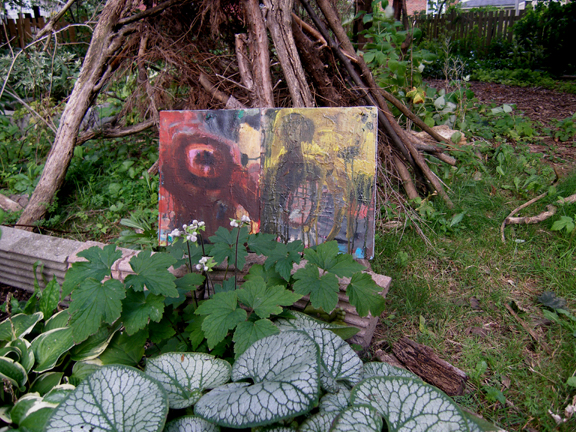
Here is another new painting, a small diptych called Lost Forest. It’s made with acrylic paints on canvas if that matters.

Just for kicks, here’s Lost Forest out in the garden…
We received a letter from the City of Toronto today. How unusual. It started like this:
We are pleased to inform you that your property/garden has been nominated for the City of Toronto Etobicoke York Great Gardens Contest 2011. Unfortunately, it was after the nomination deadline; July 6th 2011 and therefore was not listed for judging.
How nice.
Tuffy P (aka Sheila Gregory) asked me to post some pictures of a bunch of her paintings online, so I set up a blog for her and posted them that way. Please go have a look. Comments are disabled over there, but if you want to comment over here, I’ll tell her what you think.
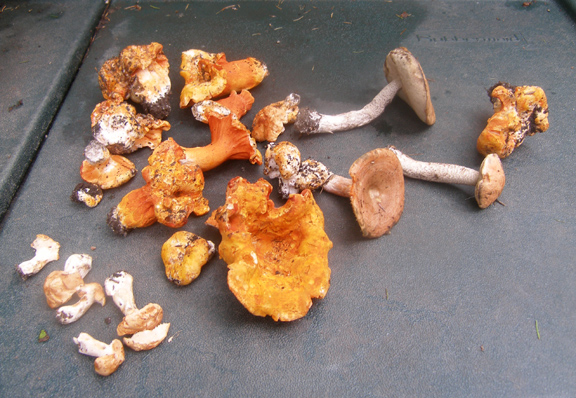
The highlight of this assortment of mushrooms are the little hedgehog mushrooms in the bottom left. They are Hydnum repandum, but small ones. These mushrooms have little teeth underneath the caps. They’re very distinctive and they are a choice edible, on par with chanterelles. There were others there as well that were still the tiniest buttons. I’ll go pick those in a week or so. This is from a spot that consistently fruits these mushrooms. It’s um, in that forest, you know the one, just down oh what’s the name of that road?
 This looks to me like pear-shaped puffball, Lycoperdon pyriforme. Usually when I see one of these I see quite a number of them, but this morning, I only spotted the one. These are good edibles when young and completely white inside. If you aren’t very familiar with small puffballs, slice one in half. It should be pure white all the way through. If it isn’t, beware. You might be looking at an immature amanita.

