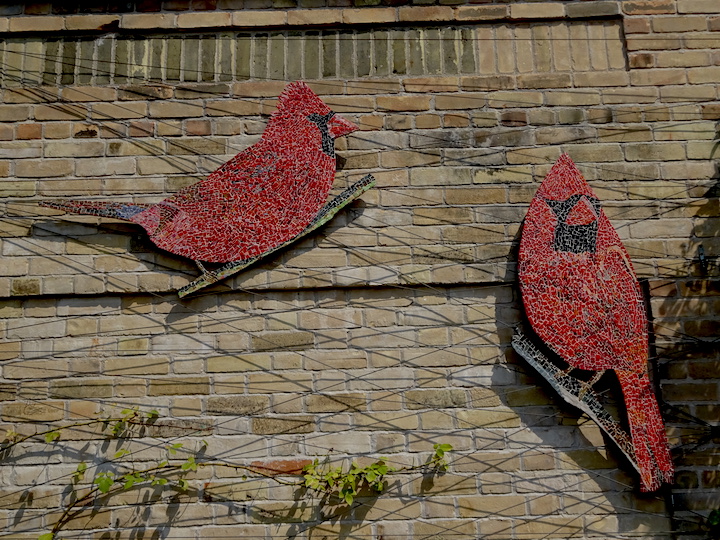
We recently installed these two male cardinals at a home in Paris Ontario. They’re hanging on a set of wires which are designed for roses and clematis to grow on. As the plants mature, they can grow around the mosaics.
These cardinals are traditional mosaics made with smalti glass tiles.
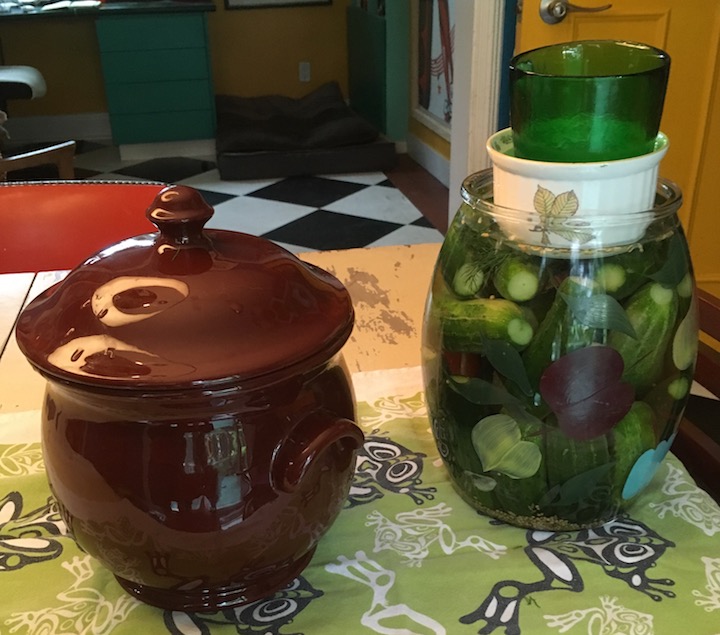
I’ve got my pickles fermenting in two containers. One is our bean crock, which lives in the basement because we simply can’t eat a whole crock of beans. The other container is a cookie jar. It reminds me of the cookie jar which sat for many years on the counter in the house where I grew up, the cookie jar from which I snatched many a cookie in my day. In fact it may even be the same cookie jar. This container lives in the basement too and I dug them both up looking for something to ferment pickles in.
You can see there is an improvised weight in the cookie jar, keeping the pickles submerged in the brine. I’m using the actual lid for the cookie jar in the bean crock to keep those pickles down. As the cukes ferment, I’m expecting a white mold to appear on the surface, and I understand the pickles should be kept below that surface film. From my reading, some people skim this scum off the surface and others just leave it be until the pickles are pickled.
Around about day 5 or 6, the pickles should have reached the half sour stage and I’ll likely sample one at this point to confirm. I’m not going to stop at half sour though. Live the dream, that’s what I say, full sour or bust.
Regular readers will recall that a while back I make a batch of dill pickles – the preserved kind, not the naturally fermented kind. We gave away several jars of these, and I’ve been gobbling up the ones we kept for ourselves. We’re down to about half a jar and there are still some very good pickling cucumbers available, so I thought what the heck, I might as well try to make a batch of the fermented ones. These are usually known as kosher dills, and while I know nothing to speak of about Jewish dietary law, it seems to me the name refers to the traditional, naturally fermented approach, rather than being actually kosher. (if you know about these things, please comment and teach me a thing or two).
What do I know about fermenting dills? Why, nothing at all of course. At one time making pickles would be something we would learn from our elders. In today’s insta-society, it’s easy to simply refer to the squillion videos up on YouTube, with instructions to do anything at all.
Still, I suspect YouTube might not always tell me everything, and I’m hoping those of you out there with some experience with this kind of fermentation can offer up some tips, and let me know what pitfalls to avoid. On the surface, it looks easy, but I have questions.
Is tap water ok or should I be using water that has no chlorine?
Can you use any salt that is not iodized?
Is it true that adding bay leaves helps keep them crunchy or is that a myth?
Is it true the ends of the cucumbers should be cut off because there is an enzime there which will make your pickles mushy?
How often do you need to skim the surface of the croc?
I’ve read some people don’t add pickling spices to their kosher dills, and just use the salt, garlic cloves, hot peppers and peppercorns. Anyone have any experience with this? Somewhere I read to avoid cloves.
Any other tips?
I will report on progress. If this goes well, maybe I’ll try making kim chi next.
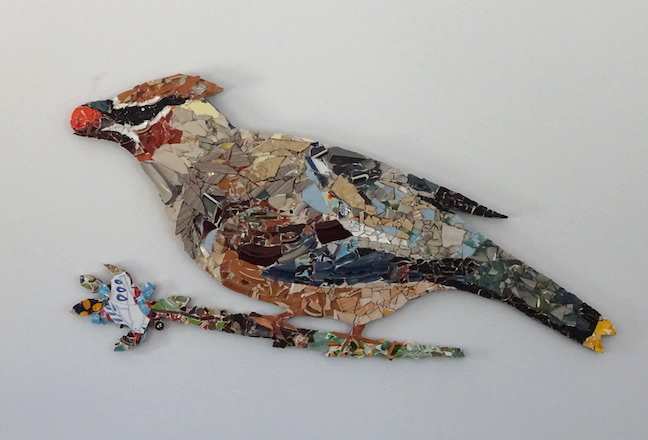
This Cedar Waxwing mosaic, made from a combination of broken crockery and floor tiles, now hangs at its new home near Perth Ontario. You can see more pictures including details at the Long Branch Mosaics site.
The David Bromberg Quintet is one terrific live outfit. They know a huge number of songs and tunes – a remarkably eclectic mix, and they don’t use a set list. Mr. Bromberg plays what he feels like playing. He shifts from electric to acoustic guitar, and he has a bass player, fiddler, drummer as well as another guitarist who also plays mandolin. There’s a lot of joy happening onstage and the audience can feel it, as the group plays each song as if reinventing it.
By the way I didn’t take any pictures or shoot any video of tonight’s show. Instead I focused on enjoying the performance. I will add in some samples of The David Bromberg Quintet from YouTube. For those who were hoping to see some visual document of tonight’s show, I hope you can adjust. I’m just tired of all the phones at shows taking pictures and recording and decided I didn’t need to do that.
Most performers find a style or a groove and stick with it but Mr. Bromberg has defined his career by doing just the opposite. Tonight he said something like, what are we, a blues band a country band? It’s confusing as shit and it’s going to get worse. In a music business which thrives on marketing formulas, this does not make for mega-success. Back in the days of records, I think stores simply did not know what section to put the David Bromberg records. Back then, marketers had not yet thought up “Americana”, which is perhaps one category his work settles comfortably within.
Here’s a YouTube video featuring the group from a show in the spring of this year…
Mr. Bromberg gave up music for over 20 years. In an interview I heard, he said he was burnt out and needed to find another way to live his live. He learned to make violins, became an acknowledged expert on American-made violins, and opened his own violin shop, David Bromberg Fine Violins in Wilmington Delaware. Eventually, a few years ago, he returned to music, and in my opinion, at 72, he’s on top of his game.
Here’s the group playing, I’ll Take You Back at a show in Atlanta, also from the YouTube…
After playing one 90 minute set tonight, the band came back for an encore. Mr. Bromberg noted he forgot to play some Canadian content, and launched into Ian Tyson’s masterpiece, Summer Wages. Here’s a performance of that tune from 2014…
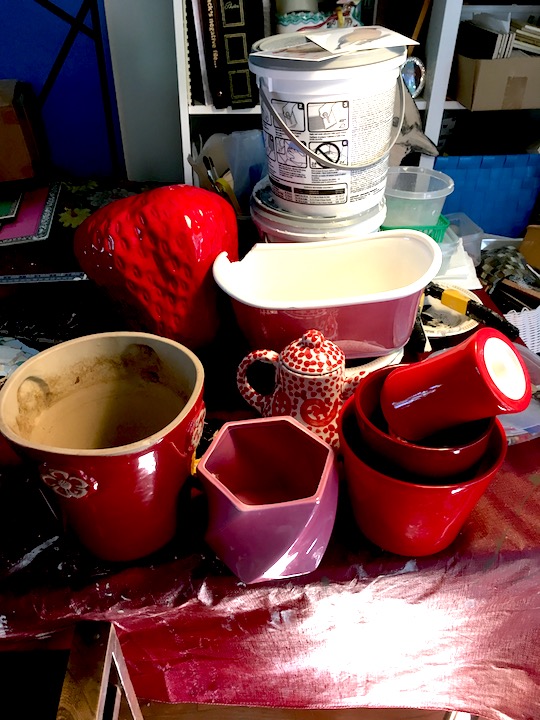
I visited Value Village yesterday – the mosaic artist’s best friend – shopping for raw materials for our next mosaic commission. When I saw the giant fire-engine red strawberry on the shelf waiting for me, I nearly jumped for joy. It has both amazing colour and great texture going for it. With the inventory of crockery and tiles we have on hand, I think we have plenty of material ready to go for the project.
Next step is to figure out the image and draw it up on the ground, which in this case will be Russian birch plywood. Once the image is drawn and cut to shape, the fun begins.
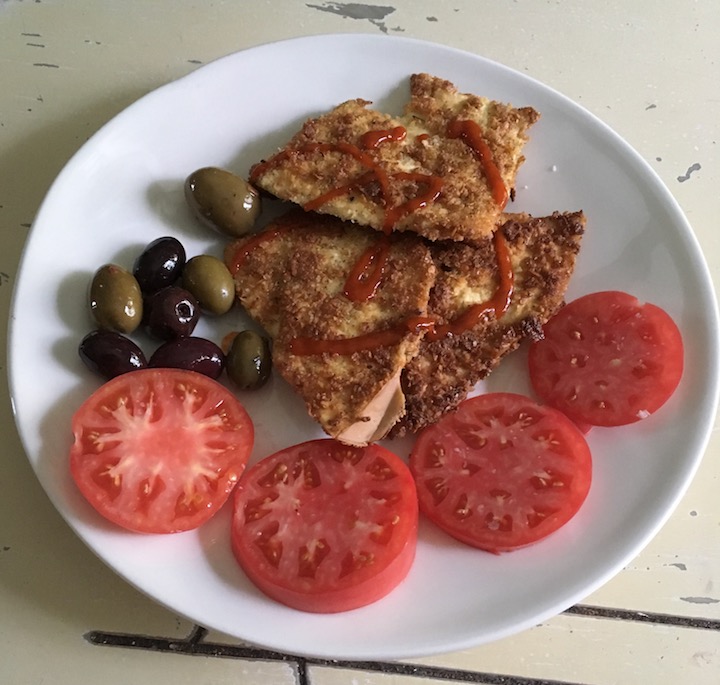
These days I don’t eat a lot of fried foods, but when a neighbour brought us a perfect giant puffball, I had to make an exception. There are plenty of ways to prepare puffballs but this is far and away my fave.
I cut up some of the puffball into half-inch thick pieces. Then I prepared two containers, one with egg and the other with a combination of bread crumbs and crushed up bran flakes, with salt, pepper, cayenne and a spice mix I like. I bathed the puffball steaks in the egg, then got them nicely covered with the crumb mixture – then splashed some vegetable oil in a non-stick pan and fried them up for a couple minutes on each side.
Perfect drizzled with sriracha served with olives and tomatoes picked from the garden this morning.

 27th Street