comment 0

Improvised roasted butternut squash scones

I don’t know if roasted squash scones are a thing, but I had a butternut squash in the kitchen and any day is a good day for scones, so I whipped some up.

IMG_7145.jpg

I cut up the squash and tossed the pieces with salt, pepper, a few shakes of cayenne and a bit of oil, then roasted it until it started to brown nicely. Tip: start with a big squash because when you taste the roasted squash you’ll want to have a wee bowl of it before making the scones. I know I did and it rocked.

It seems to me that scones are best made with buttermilk but I didn’t have any so I added some lemon juice to 3/4 cup of milk and let it sit for a while. That creates a potion that passes quite well for buttermilk (try it you’ll see).

While the squash cooled I started the dry ingredients. I used a couple cups of all purpose flour. I added a generous pinch of table salt. I knew I needed some baking powder but I wasn’t sure exactly how much so I made an executive decision and used a teaspoon. I didn’t know if I should use baking soda or not. I know that baking powder is baking soda + some acid. I also know that too much baking soda can leave an aftertaste if there is no acid in the mix, but I had lemon juice mixed in with my milk so I figured ok I’ll add a half teaspoon and see what happens. Now I was making savoury scones and I didn’t know if I should add any sugar or not, so I added about just a wee bit, maybe a teaspoon. I also added some fresh coarsely ground pepper to the mix.

I learned to make scones by chopping up very cold butter into little cubes and cutting it into the flour with one of those pastry cutting tools. However, somewhere along the way I learned a little trick. Freeze half a cup (a stick) of butter and grate it with a cheese grater. Add it to the flour about a third at a time and mush it around with your fingers until the whole deal has a grainy feel about it. Works great.  I added my sorta-kinda-buttermilk and mixed it up, then added in my cooked squash. You might ask if you could boil the squash instead of roasting it and I would say you could do that if you wanted boring scones. Some people might prefer boring, I don’t know. Roasting is about a million times better.

I mushed everything together quickly, then placed the blob of scone dough on a floured cutting board. I suppose I should have rolled it out but I didn’t. I flattened it with my hand, cut it in half, put one half on top of the other and flattened it again. Then I cut the edges off with a scraper, put them on back on top and flattened it again. With my scraper I cut the dough into 8 squares and turned the squares into 16 triangles, and placed them on a piece of parchment on a cookie sheet and in the oven at 375F. If you are way more fancy-pants than me, you might use a cutter to get identical perfect shapes instead of making crude triangles, but I like crude triangles. I heard a recording of U. Utah Phillips (the Golden Voice of the Great Southwest) once on which he said, “I prefer a rude vigour to a polished banality”. Har! I baked my scones until they started browning on top and looked spectacular, about 18 minutes.

Rockin’ Good.
 

comment 0

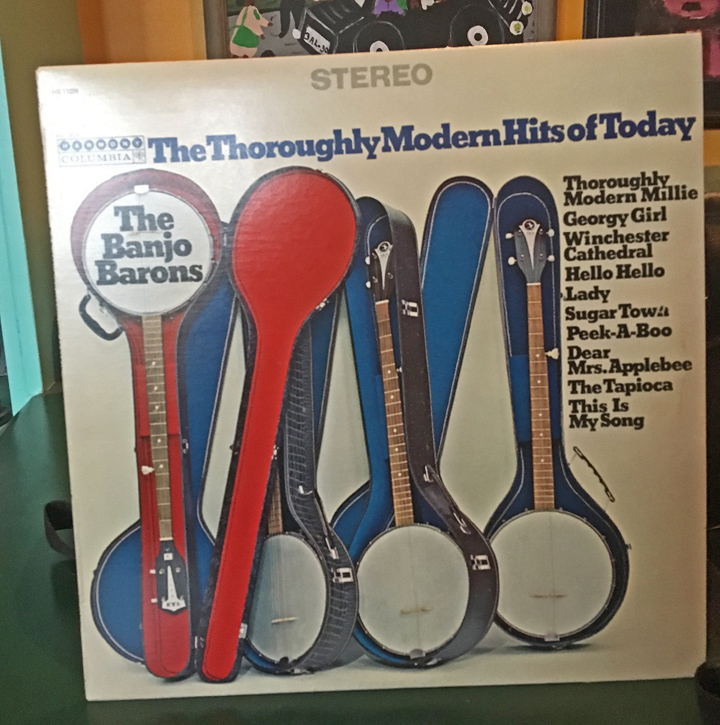
The Thoroughly Modern Hits of the Day

That’s where it’s at.

IMG_7138.jpg

The photo on this album cover has been reversed, likely so that they could put the band name over the head of the banjo on the left rather than the right side. It’s difficult to see in the photo but on the actual album you can see by looking at the head-stock that the name of the manufacturer, Kay, is backwards. I’m guessing that whoever was hired to do the album got hold of whatever banjos were readily available for the photo. I’m sure a group with such a lofty name as The Banjo Barons would be using swankier banjos.

This record was a thoughtful gift from a friend (thanks Bob). I’ll have to set up the old turntable to play it. Meanwhile I thought I’d check out The Banjo Barons on the YouTube machine.

Here they are playing Mama Don’t Allow. They seem to be kind of a ragtime band. As you can see they not only play banjo, they also wear great outfits.

comment 0

Now that’s a funny looking banjo….

In my early 40s I had this idea that I should learn to play diatonic button accordion. I was living in a Portuguese-Canadian area of Toronto and from time to time I heard some of the old Portuguese folk/dance tunes – corridinhos, viras and so on. I loved the sound and thought it would be fun to learn some of those tunes. I also enjoyed cajun and zydeco music and I guess you could say the sound of the squeezebox resonated with me. Triple row button accordions only have 31 buttons on the right side (OK, some of them have a couple more buttons). How hard could it be?

I bought an old but well-maintained Hohner Corona II button accordion after contacting a woman who played German polkas on a different sort of buttonbox. She had this thing sitting in her closet and she agreed to sell it to me at a modest price if I was serious about learning to play. It turned out to be a beautiful instrument and I still have it today. I’ve replaced the bellows tapes and I also did a modification to the buttonboard so the buttons didn’t sink so deep (in my opinion it was a Hohner design flaw I was correcting).

There was a storefront music school on College Street and I went to see a guy named John. He’s an Italian guy from Argentina who was teaching Portuguese kids Portuguese folk music on piano accordion. What an interesting fellow He also did voice-over work, such as Spanish voice over for video games and he could speak Spanish in several different dialects.

John didn’t play much button accordion but he assured me he had a system for teaching it. It turned out this strange situation worked well for me. I had to work out a lot of the fingering myself but John taught me the feel of the music. I’d work on a tune and play it for John and he’s say mmhmmm. Then he’d pick up his piano accordion and he’d say, this one should go like this, and he’s play it for me. I’d go back to the drawing board and work on getting it right.

Along the way, I did learn a lot of Portuguese music, but all kinds of other music too. The instrument had a steep learning curve because each button played a different note depending on if you were pulling or pushing air through the bellows – in other words it was bi-sonoric, sort of like 3 harmonicas stacked together on the right side, with a rudimentary bass system on the left. Once I got the hang of it, I learned fairly quickly. The instrument is set up to make it easy to play folky-dolky dance music and that was what I wanted to learn.

I happily played button accordion just for fun for years and would have continued to do so if it weren’t for the dreaded banjo. My brother had started playing clawhammer banjo. This amazed me because he had never talked to me about music and I kind of thought he didn’t even like music. I really enjoyed old time music and thought it would be fun to maybe learn some clawhammer banjo. How hard could it be? I made an instrument from an ebay neck and an oil can and taught myself to play, eventually buying myself a nice banjo (ok a few nice banjos).

I fell hard for the banjo and the more I played, the less I touched my accordions. Eventually they sat around, sadly gathering dust. It couldn’t be helped. I was determined to learn clawhammer well and I put a lot of time into it. I’ve decided it’s time to devote a bit of time to the accordion again so I’ve committed to pick it up every day, even if just for a few minutes.

A lot of the tunes I used to play have fallen out of my memory and my chops are rusty, but I discovered with a little effort, it comes back quickly. Here’s a tune called The Leaving of Liverpool. It’s also called Fare Thee Well my Own True Love. It’s been recorded many times and was a hit for The Clancy Brothers and Tommy Makem in the 60s. It’s a fairly simple tune, so a good one for a guy with rusty chops.

comments 2

The Recipe Vault #7: Swiss Steak

Going through my mom’s vast collection of hand-written recipes, I came across one for what she called Scrumptious Swiss Steak (it was).  I remember my mom’s Swiss Steak very well, and how the braising meat and other ingredients created a wonderful and comforting aroma throughout the house.

I don’t know why Swiss Steak is called Swiss Steak. I’m pretty sure it’s got nothing to do with Switzerland. A Google search suggested there is a kitchen technique known as Swissing in which you pound a chunk of tough beef before braising in an effort to tenderize it. Who knew? This doesn’t make much sense to me, since the slow cooking of meat in itself creates tender cuts regardless of what you might do to it first. I’m certain Mom didn’t do anything like that for her Swiss Steak.

One of the ingredients Mom listed in this recipe is chili sauce. This is a condiment she made and jarred just about every year. It was a sweet sauce which I enjoyed from time to time, but I can’t recall what we did with the many jars of the stuff Mom would can. One of the great things about braises is that you can put whatever you want in the cooking liquid to create any flavour character you feel like.

I like braises. I still find the wonderful aroma intoxicating, and it makes the most of even the toughest cuts of meat. There was a time those tough cuts were inexpensive but that doesn’t seem to hold true in today’s supermarkets. Cuts like short ribs or flank steak, for instance, can be as expensive as the more tender cuts.

Today I don’t think of braises in terms of particular recipes. There are lots of ways to go. I like to make braises in a Dutch oven. I don’t use a slow cooker. The reason is that with a Dutch oven I can brown the meat in the same pot I braise it in and I think that’s an important step in building up flavours. The other thing I think about is how I’m going to finish the braise and make the cooking liquid into an amazing sauce. Often I’ll skim any fat from the surface and reduce the liquid by something like half, which usually takes about 20 minutes simmering the sauce with no lid.

Some of these recipes my mom collected – and this is one of them – are like paper time machines. They transport me back to the bungalow I grew up in and my mom’s tasty family cooking.