comments 2

Made to be played

A book arrived in this morning’s mail, from my friend CB. He’s had this kicking around his place for many years and when he saw my oil can banjos, he decided to send it my way. It’s called Musical Instruments made to be played by Ronald Roberts. It comes with a big fold out sheet of plans inside the front cover. Here’s a list of instruments it covers:

Unpitched percussion instruments such as shells, pebbles, castenet type blockes, coconut shells, claves, shakers, maracas, bamboo shakers, jingles, lagerphones, milk rustles, Resonated jingles, simple drums, drum sticks, drums with real vellums, ptch fiber drums, slit drums and Rasps or Guiros

Pitched percussion instruments such as plant posts, glass tumblers, simple xylophones of softwood, smaller zylophones of softwood, two-note xylophone on a cord, resonated zylophones, tubular glockenspiel, bar glockenspiel or metallophone, sansa or Kaffir pianos.

Simple string instruments such as a set of fiddle cramps, simple psalteries, one-octave and two-octave zithers, nordic lyres, bowed psalteries, and chordal dulcimers.

This is going to be a fun read.
comment 0

Starting a new banjo

I’ve made a neck blank for the next oil can banjo, but I’ve decided to put that aside for later and instead I’m going to try to make a mountain banjo similar to those described in the FoxFire book, a much different design than either the can or gourd approaches. Here are a couple examples of musicians playing this style of banjo.

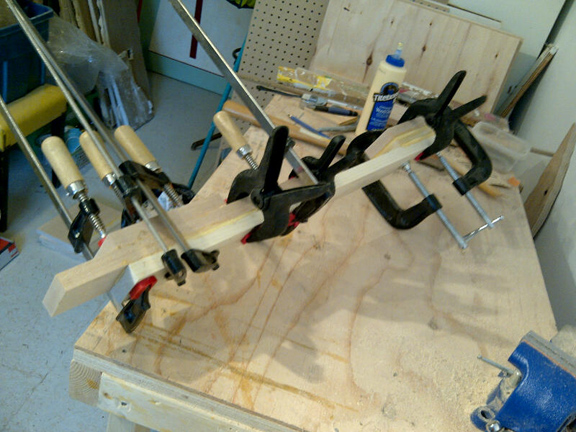
Today I laminated maple for the three rings and I glued up maple 1X3s to form the neck. I also bought a piece of stovepipe. This is used to stretch the goatskin in place.

IMG-20130327-00489

comments 8

Multi-tasking

Here’s Aubrey Atwater, clogging and playing banjo at the same time.

Speaking of folk dancing, if you ever get a chance to see April Verch, the Ottawa Valley fiddler, don’t miss it. Not only is she a great fiddler but she dances up a storm too.

comment 0

New Painting – The Source

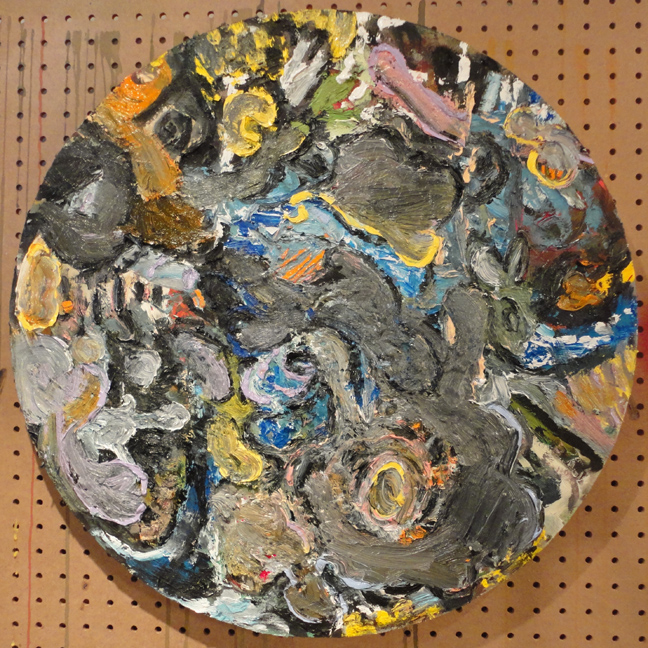
Here’s another new painting. This one is a round painting, a tondo if we want to get all Renaissance today. Here is The Source.

The Source

The Source

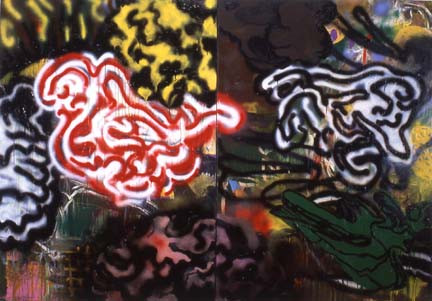
This painting is oil on panel and it is 2 feet in diameter. This is by no means the first time I’ve made a painting called the Source. The first one was in 1998. I exhibited it in an exhibition I co-organized called Canadian Shield. This painting is a large diptych which I still have. It still holds up as far as I’m concerned, although I should say this painting was not well received when I made it.

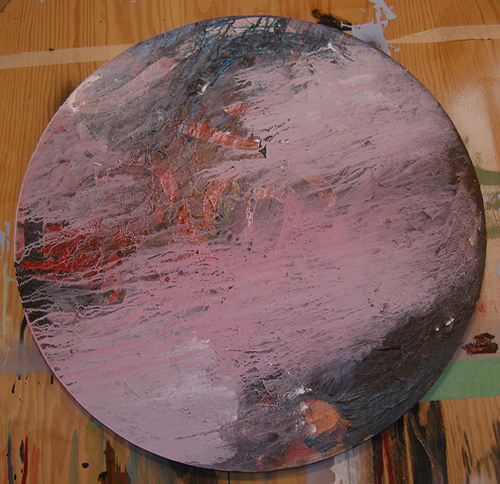
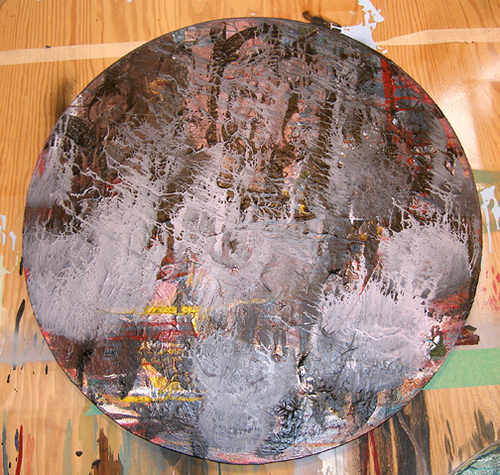
the-sourceI revisited the theme in 2005 with 3 round paintings. Here are two of them…

The Source, 2005, acrylic on panel

The Source, 2005, acrylic on panel

The Source, 2005, acrylic on boardThe 2005 paintings were made with acrlyic paint, also on panel. I had 4 panels made at the time and did 3 in the series in 2005. The painting I just completed is on the 4th panel. I exhibited the earlier round ones at NSCAD in Halifax a few years ago. I don’t have any plans to exhibit any of the new paintings.

Over the years I’ve made paintings with all kinds of different titles, but there are a small number of titles that I’ve used a number of times, The Source being one of them. The others that come to mind are Underground, Lost Forest and The Forest of No Return, and Sky Dragons.

comment 0

New Painting – The Sky is Falling

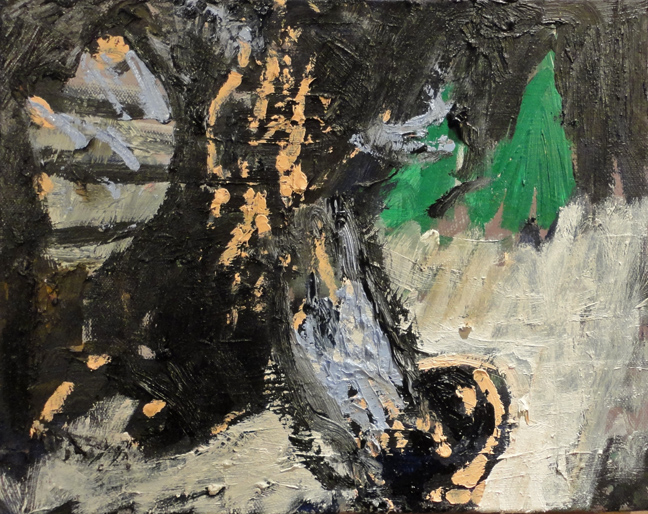
This is a small oil painting – I think it is 12″X9″. This one was kicking around my studio unfinished for a really long time. I left it up on my painting wall but I had stopped working on it ages ago. I thought I had reached some kind of painterly cul de sac on this one but I left it up anyway. This morning I was working on some other things when I started seeing this one a little differently and went to work on it. This sparse little painting is called The Sky is Falling.

The Sky is Falling

The Sky is Falling

I was very conscious of not over-working this one. My thought was that a painting that sat unfinished for so long should retain some of that quality, so I worked up the image keeping it as gestural as I could live with. This one is oil on canvas by the way.

Filed under: Art
comment 0

That’s my rabbit

My dog caught it.

Here’s the Walter Family. It says on the info with the video it was recorded in 1933. I’ve read elsewhere it was recorded in 27. It’s a really good tune regardless of when the recording was made.

Here’s a hot version by Old Sledge

I’m trying to learn this tune on the oil can banjo now. It’s a really fun one to play.

comment 0

Punxsutawney Phil charged with fraud for early spring forecast

With a snow storm expected to batter the Plains, Midwest and East Coast this weekend, a spring-deprived Ohio prosecutor is taking out his frustration with the long winter on a famous prognosticating groundhog.

“I decided it was about time we indicted Punxsutawney Phil for fraud,” said Mike Gmoser, prosecutor in Ohio’s Butler County, in an interview Friday.

That’s a quote from a Reuters article by Kim Palmer. Click on the quote to read the full article. Some folks will think this action is drastic, but just step outside. Where is spring? Something had to be done.

A big thanks goes out to my brother the trout, Salvelinas Fontinalis, for pointing me to this breaking news.

comments 2

Road trip?

At one time I used to do long road trips with my friend East Texas Red. Our destination was the mountain west. We would spell one another off driving across the US getting out to the west as fast as we could. I remember one trip we made it to Cody Wyoming near the east gate of Yellowstone in 36 hours. By the time we got there I was bleary-eyed and exhausted, in need of food that didn’t come from a gas station and in need of a good night’s sleep to recover. We found a motel room and walked over to the Irma, apparently once Buffalo Bill’s joint, for prime rib. At that time the prime rib in that place came in three sizes, the smallest bigger than any human ought to tackle. We recovered from the crazy drive there in Cody and fly fished our way wherever it was we were going that particular trip. The destination didn’t matter. We were in the mountains with nothing better to do than chase trout and life was good.

Once I made the trip west on my own. I was headed for a button accordion camp in the Sierras with stops along the way in Idaho to enjoy a little fishing with Ken. Funny the things that stick out in your memory. We camped at Box Canyon on the Henry’s Fork and went off fishing for the day. A crazy wind came up and a brief rainstorm appeared out of nowhere. At the very same time, mayflies started emerging from the stream. The storm drowned the bugs as they struggled to dry their wings and fly off and the trout went crazy feeding on the injuried mayflies. The problem was that the wind became so intense, casting was impossible. The entire surreal event lasted just a short few minutes. Later, at dark, we pulled into the campsite to find my tent missing in action. Ken’s was there but mine had vanished. The same wind we experienced on the river blew my tent off the pegs and into the trees. Amazingly, it was fine, just relocated.

I’m thinking of a more modest solo road trip this year. This isn’t set in stone. For now let’s say it’s an idea for a big circle. The idea is to drive to Sarnia, cross into Michigan and head up the lower peninsula to Grayling. Maybe stop at Grayling and fish the Holy Waters then continue north to the Mackinac Bridge and the UP. On the UP, west to Escanaba, maybe fish the Sturgeon or Whitefish Rivers and up to Gwinn, Robert Travers country, over to Munising and east to Seney to fish The Fox and a couple other streams I’m aquainted with in the area. Then east to Sault Ste Marie and back into Canada, across to Sudbury and back south.

I have a fondness for those trout streams on the Upper Michigan Peninsula that is hard for me to explain. I’ve fished through there a few times and always really enjoy myself. I think of them as literary fly fishing waters because two well-known authors wrote about fishing there. Hemingway wrote The Big Two-Hearted River back in the 1920s. The Big Two-Hearted is an actual river. I’ve been there. Apparently it was The Fox though that Hemingway liked to fish. That’s understandable. The Fox is a gorgeous stream. West on the UP, Robert Travers wrote about fishing his beloved Escanaba and other local streams in books like Trout Madness, a personal fave.

I’m hoping to go in early summer, as soon as the black flies are more or less done.

comments 4

That little crick, you know the one…

     My father was full of stories, too many to remember all at once. Some of them I store away until I need them. Then one day some little thing triggers something way back in my memory. I had, for instance, forgotten all about Aub.

I never met Aub. I’ll have to ask big brother Salvelinas if he ever did. I remember Charlie a little. Charlie was my dad’s other fishing buddy from way back. I remember that every time I saw Charlie he was smoking a different pipe and I remember that he used wooden strike-anywhere matches that he liked to spark off the bottom of tables. I also remember Charlie’s legendary love for the drink. My father claimed that Charlie converted the glove compartment of his car into a bar, complete with mixes, so he could pour himself a drink while driving. Today I’m sure they would lock him up and throw away the key.

However, I never met Aub, or at least I have no memory of him outside of my father’s stories. They used to fish a little stream north of the city that my father claimed was full of big brown trout. Legend has it they would camp out and fish most of the night. My father, as I have already told you, was a bank-napping worm plonker of the highest order. Aub, on the other hand, preferred a long fly rod with a tiny Williams Wobbler spoon. These tiny spoons were very light and if you gave them a little tug in the water they would flutter like crazy downstream.

     My father claimed that Aub would reach out with is long fly rod and gently flip his Williams into the water and flutter it under logs. This is difficult enough in daylight. Believe me, I’ve tried it. The first thing that happens is the wobbler gets hooked behind a log and snap it’s gone. At night it is impossible. But Aub was the stuff of legends. The big browns would emerge from their bomb shelters to attack the little lure. There were stories of 6 pound browns, 8 pound browns, 5 pound browns from this little stream. I suppose my dad simply made up a weight whenever he told the story.

     When I was about 12, my he took me to the stream on the way back from yet another stream on opening weekend of the trout season. There was a big pool just downstream from the bridge. I set up a forked stick and let a worm drift deep down into the pool. I think I caught 6 suckers in a row and then nothing. Meanwhile, my father had high-tailed it way way upstream. He must have remembered a special spot. I was sitting on the bank day-dreaming when the trout hit. It wasn’t 5 or 6 or even 8 pounds, but it was a full 16 inches and just a beautiful brown trout. Supper. In those days nobody ever heard of catch and release. It was always catch and cook. I put my trout in the cooler in the car and started walking upstream trying to find my dad.

     The stream was slowish, tree-lined, with some deep holes and undercuts. It wasn’t a stream you might think about wading. Instead, you walked the banks looking for good spots, spots that looked trouty, spots where you could cast a little bit. I walked and walked and there was no sign of my father. In fact I was half-way up to the next concession before I found him. As soon as he saw me he said, “Quiet…” I got the picture and snuck up slowly.

     He was at a place where the stream flattened out. This broad flat ran for about 40 or 50 feet, strewn with logs along the bottom. I knelt down beside my father, eager to tell him about my trout but he motioned for me to stay quiet and pointed out in the water. I can tell you my father was not exaggerating when he said big brown trout inhabited this stream, for that afternoon I saw one cruising that flat. How big was it? I don’t know. Trout grow in memory, don’t they? It was a trout that you would measure in pounds instead of inches, 4 pounds, 5 pounds, maybe even bigger. Hard to say. We watched the trout move in amongst the logs, dropping its head down, feeding. We watched for about 20 minutes until the trout moved to a place that satisfied my dad. He didn’t stand up. From a kneeling position, he flipped his line upstream from the trout, baited with a worm, no weight on the line. We watched the worm waggle in the current toward the trout, closer, a little closer, and then just past the trout, and just as my dad raised his rod tip the trout turned and struck the worm.

     And then it was over. The trout tangled the line behind a log in a second or two and was gone.

That was 40 years ago. We went back a few more times and caught a few browns, but caught nothing else as big as the trout we ate that night for supper, and never again saw a giant brown in that stream the likes of the one we saw that day feeding in the flat.

     In the twilight of his life, my father asked me to take him back there and I did. We parked at the bridge. His knees were shot but with my help I got him to the big pool downstream, except that the pool had become a shadow of its former self. This stream never looked great, even in its day, but now it seemed there was less water and it was murkier. Maybe there are still some trout in the stream. Maybe it has just changed and is still worth a look. Or maybe like so much else it has been ruined by development. There didn’t seem to be much point in fishing it.

Instead we drove into town and I found us a fish ‘n’ chip shop and we enjoyed a good lunch and I listened to the old man talk about Aub and the days when they’d fish the stream all night, and Aub would tie on his little Williams Wobbler and let it drift deep under the logs. I loved that story.