comments 2

Cooking in the Kitchen

I’ve been suggesting to one of my button accordion students that he should try to feel the rhythm of the music through his whole body. I found a delightful video of a Fogo Island kitchen party that illustrates exactly what I mean, and I showed it my student today.

There is so much joy in this music!

comments 5

The Two Kings

It’s storytime here at 27th Street. Get comfortable, maybe pour yourself a little something. A wee dram of Scotch? Yes I’ll join you, thank you very much. Let me take you back in time a little bit, back to 1982. This is a true story, or at least as true as my memory will allow. It’s the story of the Two Kings.

I was studying fine arts at York University. By that I mean I was making paintings. At the time, I was hanging out with another young artist named John McCartney and I recall the two of us were really working hard at developing our skills and ideas. One day one of our teachers, maybe it was Michael Davey,  asked us if we wanted to be part of a crew creating a Sol Lewitt wall drawing.

Now Sol Lewitt was one of the kings of conceptual and minimalist art. One of his wall drawings was to be created at the David Bellman Gallery in Toronto. This really meant that the artist had created instructions for carrying out the work. He sent an assistant to Toronto to supervise the crew of volunteers. We never saw Sol Lewitt and I have no idea if he came to Toronto for the exhibition or not. John and I were happy to volunteer and take part in the creating of a work by such a big name in the art world. The idea was that we would create the work in the gallery, but if a museum or a private buyer wanted to buy the thing, Mr. Lewitt would arrange for it to be recreated in that space. At the time it didn’t bother me that we worked for no pay. Instead, each of the participants received a postcard from Mr. Lewitt on which he made a little geometric ink drawing. I still have my postcard around the house somewhere.

It was going to take several days to execute the drawing. The gallery was in a large space – I think it must have been on the second floor of a building – on Peter St. in what is now called “The Entertainment District”. John and I showed up for work, not knowing what to expect. The drawing was to be created on several walls and on each wall there were to be three large shapes. I think they were triangle, circle and square. I don’t remember if the order changed or stayed the same. On some of the walls, we were to apply an ink wash inside the shapes and on other walls, we were to apply an ink wash outside the shapes. I think there were three shapes on each wall. It was a long time ago, but that’s how I remember it. Finally, a pencil grid was to be applied over the entire drawing.

Each day around lunch time, various people appeared at the gallery to see how the project was coming along. Mr. Bellman would take everyone out for lunch. I recall he treated us to some really excellent lunches. I was an art student and was easily impressed by a good lunch.

Once the shapes were drawn up on the walls according to instructions we had to start in on the ink washes. These had to be done in a certain way and the wash had to be a certain percentage of ink and a certain percentage of water, mixed up in particular buckets. The way I remember it, the idea was for us to use rags dipped in buckets of the ink mix to apply the wash to the wall. There could be no drips. Soon after we started in on the washes, something very strange occurred. Letters forming words became visible once the ink was applied. We watched in amazement as the washes began to reveal words all over the gallery. This could only mean one thing – Lawrence Weiner.

Lawrence Weiner is another pioneer of conceptual art in America. His work, often consisting of words applied to walls, is very recognizable. Weiner must have previously exhibited at David Bellman’s gallery. I can imagine that his work was applied to the wall and then painted over after the exhibition with a couple coats of cheap gallery latex. When we started applying the wash for the Lewitt drawing, the lettering from the Weiner became visible only where there was ink wash. In other words the letters were visible either inside the shapes or outside the shapes depending on the wall. Either way, the borders of the shapes cut off the lettering.

I was beside myself with delight. Here we had the two kings of conceptual art, Sol Lewitt and Lawrence Weiner, and through the unforeseen consequences of a bad paint job over a previous exhibition, we were enjoying an accidental dialogue between the artists. This was not in the plan. The work was by Sol Lewitt. What was he going to say when he found out? Lawrence Weiner was invading his wall drawing. Lewitt was in Europe and his assistant had to frantically try to track him down. He needed direction.

Apparently, Mr. Lewitt was not as delighted with the situation as I was. Or perhaps he just had no sense of humour. I don’t know. What I do know is that we had to get rid of the Weiner. We brought in five gallon pails of a white alcohol-based sealer that we understood would properly cover up the Weiner. Then we had to start from the start and do the drawing all over again. I recall being somewhere between drunk and sick from the fumes of that sealer. It was nasty stuff – but it covered the Weiner.  The test came when it was time to once again apply the ink wash and the test was successful. The Lawrence Weiner work disappeared once again.

The last part of the drawing was the 9H pencil grid over everything. At this time it is necessary for me to write a little about pencils. We refer to pencil lead but pencil leads are made with graphite with a clay binder. There was a time when it was possible to get lead poisoning from pencils and that was when lead was used in the paint that pencils were coated with. Pencils use a system to describe how hard or soft they are. The hardest pencils are 9H and the softest are 9B. HB is in the middle. H stands for hard and B stands for black. In my experience, anything harder than 4H is just silly. A 9H pencil is so hard it makes the lightest possible mark. We were to use 9H pencils to draw an even grid over the entire drawing.

During this process, Lewitt’s assistant approached me and gave me hell because I was not twirling the pencil as I drew the line to ensure the line was even. I looked at him and I looked at the barely visible line I was drawing and I smiled and said OK. Sometimes, there is just no point in bothering to argue.

One of the strange things about these wall drawings is that after the exhibition, they simply get photographed and then painted over. If a buyer is interested, the drawing is simply recreated. We got a call when the show was almost over from Mr. Bellman. Would we be interested in painting over the wall drawing? He offered to pay us $7/hour. Today that seems like nothing but at the time, it was a big deal. Strange though, that we were paid for destroying the art but not for executing it.

To this day, I think we should have left the Weiner in the work.

There is a book that documents all the Lewitt wall drawings. When it came out, years ago, I wandered up to Mirvish Books to have a look at it. Buried deep in the book I discovered I was credited as part of the crew who created the 1982 drawing at Bellman’s. Unfortunately, my name was spelled wrong.

comment 0

Miss O’Dell by Chris O’Dell

I just read Miss O’Dell – My Hard Days and Long Nights with The Beatles, The Stones, Bob Dylan, Eric Clapton and the Women They Loved. For a music-lover of my generation, it’s a page turner, or at least it was for me, because I couldn’t resist catching a glimpse of the inner world of rock ‘n’ roll.

It isn’t a very attractive world, if you ask me. Most of the rock stars don’t come off very well in the book, although Chrs O’Dell was clearly fond of most of those guys. She was an insider who worked for performers like Beatles and the Stones and Dylan at different times and was good friends with many of those characters (mostly men) and their wives. It seems this all happened because she was at the right places at the right time and because she was persistent in trying to be an insider.

The book describes endless parties, vast quantities of narcotics and the dysfunctional love lives of a bunch of rock stars from the late 60 through to the 80s. It also describes her own struggles with alcoholism and drug addiction. O’Dell was at the right place at the right time for all kinds of events we consider to be important in rock ‘n’ roll history and she gives us a glimpse of what those events were like from a different perspective.

Music lovers should know this book is not about the music. In the end, the book satisfied my curiosity about those music icons and how they lived their lives, but by the time I was three quarters through, I was done with those characters and with the author. I didn’t want to know any more about how much drugs she ingested or which rock stars she jumped in the sack with.

comments 5

Hiking and Baking

This has been such a bizarre early spring, with many things in the garden greening up way early, it’s difficult to judge when the morels will show up. I see on Twitter that it is turning into a great season for morels in many places down in the US. I think it’s still early here but there is only one way to find out.

I happened to be near, oh what’s that place called…um, oh I forget – this morning and decided to go for a hike just to see if there were any early mushrooms making an appearance. What a beautiful morning for a long walk (translate: no mushrooms around yet). Fortunately mushroom hunting is always good even when mushroom finding is slow. It’s kind of like fishing that way.

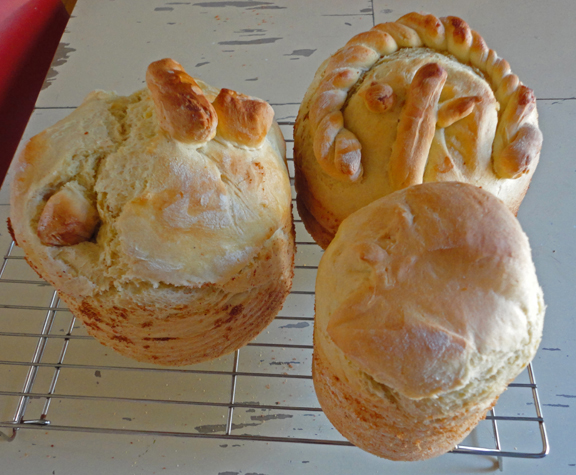
Meanwhile back at the ranch, I prepared some paska dough before heading out and left it to rise. Tuffy P punched it down at the appropriate time and by the time I got home, it had risen again. Easter bread has just emerged from the oven.

Some people do all kinds of fancy braids and crosses on their paska. I usually dispense with that (at least partly because I’m not very good at it) but you can see my half-hearted attempt on one of the loaves in the picture. Fortunately they taste great, decoration or not.

comment 1

Hammered?

The word dulcimer derives from the Latin dulcis, meaning sweet and the Greek melos meaning song. Yesterday I featured the mountain or Appalachian dulcimer, but that isn’t the only kind of dulcimer around. The hammered dulcimer has been around a number of different musical traditions going back a long long time. For tonight’s Daily Dose, I’d like to feature a couple samples of the hammered dulcimer in action.

Here is Dick Glasgow playing a set of Scottish tunes

And here’s John McCutcheon playing the Woody Guthrie tune Pastures of Plenty.

Strange as it may seem, another instrument that can be “hammered” is the fiddle. Here’s a clip from Yasha Aginsky’s documentary “Les Blues de Balfa” – fiddlesticks. I really love this performance!

comment 0

Cuckoo

Tonight’s Daily Dose features the mountain dulcimer, sometimes also called the Appalachian dulcimer. This is a fretted instrument that normally has either three or four strings. It belongs to the zither family of instruments.

The Cuckoo – this is Jean Ritchie

Here’s one of my favourite tunes – Hard Times, written by Stephen Foster in 1854. This is Dave Haas

comment 1

The Morel of the Story

At some point this month I think it is reasonable for us to expect black morels to make their appearance in Southern Ontario, followed by yellow morels. In fact there have already been some vague reports of early black morels showing up not far from Toronto. Last year I picked yellow morels in the third week of May but given the freaky warm early spring, I would not be at all surprised if the mushrooms were long gone by that time this year.

Many people ask the question, where do you find morels? I can only say that they appear where they damn well please, but they do like some kinds of places much better than others. Sometimes they appear where the books say you should never expect them. In some areas they seem to like certain kinds of trees but in other areas, a different strategy is needed. One thing for sure, it is rare for an intrepid morel hunter to give up a spot.

Now I’ve been fortunate. I inherited a couple spots. By that I mean, my brother inherited a couple spots, but they’re out of his normal hunting range and he was kind enough to bequeath them to me. Although from time to time we might have our disagreements, it’s very hard to be cranky when your brother offers up a morel spot. That is very special indeed. This is a serious responsibility. Morels fruit just once each season. If somebody finds your spot – guess what, it isn’t your spot anymore. And so the ritual starts. I find the hardest thing is driving out to my spots while blindfolded. That’s just dangerous. And then there is the matter of finding a parking spot several miles away from the picking grounds, covering the Anchovymobile with camo-netting, sweeping away the tire tracks, and making the long hike in and out. You can never be too careful when it comes to morels.

I suspect that mycological societies everywhere have spring forays that are really morel hunts in disguise. This must be a real problem for the foray leaders. You know anyone with the experience to lead forays has some morel hotspots in the bag. And you know there is no way he or she is going to share them with 40 foray participants. That would be madness. And so, on the theory that there are a few morels everywhere, they go to productive forests, turn their charges loose, and hope for the best. Every now and then I imagine a few morels are found.

Not only do I now have the responsibility to protect a couple morel spots, to complicate matters even more, one of those spots also has ramps, tasty wild leaks ready to pick at the same time. I take this responsibility seriously, mostly because I’d like to be able to harvest a brimming basket of morels and a bag of ramps every year.

So, where are my spots? Just drive east to the Quebec border…you’re almost there. I’ll send you a map.