comments 5

Edwin Boyd #tiff

Edwin Boyd is the title of a new film by Nathan Morlando. It’s also the name of a notorious Canadian bank robber. The film tells the story, set in post-war Toronto. We attended the gala premier of this movie at TIFF this evening at the Lightbox.

It’s a compelling true tale of a WWII veteran experiencing hard times back home after the war. Desperate to make a better life for his family, he robbed a bank and then another and then another. Boyd became a famous name in Toronto, even more so when he escaped from prison twice.

I enjoyed the film, particularly the first half. Both Tuffy and I felt the story dragged toward the end in it’s effort to tell the complete story. There were side stories going on of Boyd’s retired policeman father and the policeman who was pursuing  the Boyd gang but these were not explored thoroughly.  The use of music was interesting. It seemed as if sometimes the music came from the future, from a time later than the film was set. It was used as a device to highlight the wild times, with mixed success.

We all make choices about how to live our lives all the time. Boyd felt alive robbing banks. He treated it like a show, wore make-up and hammed it up while robbing banks. Once he started his life of crime, it seemed there was no turning back, no working for the man. And yet Boyd did continue on, living as a model citizen in another place under another identity. after his prison time was served.

If this film makes it to general distribution, it’s worth seeing, even if it does go on too long.

comments 3

Coral

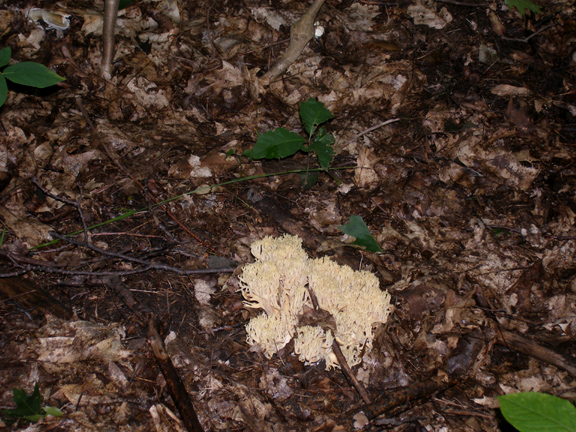
I noticed there was a lot of coral fungi appearing in the forest on the weekend. I understand that some of the corals are good to eat and that others don’t sit so well with your digestive system. I confess I haven’t tried to identify any to species. Mostly I take an occasional photo because they look really interesting and move on.

comment 1

The Hunch

Some days, my usual diet of folky-dolky music won’t do.  Here’s the late Hasil (pronounced Hassle) Adkins performing his not so big tune, The Hunch.

Mr. Adkins, known as The Haze, was a one man band tour de force, often considered to be the father of that musical genre affectionately known as psychobilly.

comments 3

Search Terms

Of course I appreciate regular visitors to this blog. Also interesting though, are some of the search terms people type into whatever search engine they fancy, and end up in my little corner cyberspace.  Here’s a recent sample:

diagram of button accordion
puffballs found in ontario canada
27th street
boletes ontario
new condos marie cutis park
pierogi polka
parlez nous a boire
types of ontario mushrooms
most popular edible wild mushrooms ontario
preparing lobster mushrooms
edible mushrooms ontario
accordion diagram
if the ocean were whisky and i were a duck
patychky marinade


comment 1

Hydnum umbilicatum

I stopped briefly at a forest this afternoon which I know to be a good producer of Hydnum umbilicatum, and this forest didn’t disappoint me. I only spent about 20 minutes there and came out with around 30 of these choice edibles.  I’ve come to know a couple or three spots in there where I’m likely to find these mushrooms if they’re fruiting, so when I’m there, I check the hot-spots, take a general look around, then move on to another forest. Sometimes I find lobster mushrooms in the same forest, and earlier in the season, a few chanterelles, usually in the very same spots time and again.

There are two so-called “hedgehog” or “sweet-tooth” mushroom varieties, Hydnum umbilicatum and Hydnum repandum. In our area, there are a number of differences between the two species, but both are excellent if you like to eat wild mushrooms. The H.umbilicatum I’ve found are normally a more intense orangy colour than the H. repandum, which are more distinctly tan. H. umbilicatum sit lower to the ground, don’t grow nearly as big, and in this forest they are usually close to hemlock. Of course the H. umbilicatum typically have a “belly button”, hence the name. Both varieties have teeth on the underside of the cap, rather than gills or pores.

Cook them as you would chanterelles. They have a similar texture and taste.

comment 1

Ab Ex

I’ve been meaning to check out the Abstract Expressionist New York exhibition at the Art Gallery of Ontario all summer, and realized that this weekend was my last chance as the show is coming down.  Although I am very familiar with the work of most of the featured artists, this is a strong collection from the Museum of Modern Art and an opportunity for another look at this work here in Toronto.

There are no big surprises in the show. It features many of the big names of the period, lumping together not just the work we call Abstract Expressionism but also some samples of what became known as colour field painting along with a little bit of sculpture. Missing are a good sample of David Smith’s sculpture and also the massive Pollocks, the big in your face, signature Pollocks.

The exhibition has some highlights in my mind, and the greatest of those is a painting done by Philip Guston after he turned his back on Abstract Expressionism and started making his powerfully strange late figurative paintings. The exhibition has Edge of Town, one of the “hood” paintings Guston made in that period.  There is a room full of Guston’s work, the last room of the exhibition and I think it is also the best room in the exhibition.

The Franz Kline black & white pieces held up for me very well in this show. I’ve known his work and liked it for many years, but in this show, in the context of a broad range of work from the period, I thought these stark paintings really flexed some muscles. Another black & white painting was a highlight for me as well, a single painting by Richard Pousette-Dart. I hadn’t been thinking about his work at all when I considered what work I might see in the exhibition, and this painting surprised me with its singularly powerful presence.

If there is one artist besides Guston who really comes off well in this show, it’s Mark Rothko. There are several excellent Rothko paintings in the exhibition, hung in one of the larger rooms. I don’t really know what to say about Rothko’s work except that it is quietly, stubbornly captivating. Even with a crowd of people at the show milling about, I found it hard to leave those paintings behind. What I find fascinating about his work is that his mature paintings defy explanation, and yet, I can’t take my eyes off of them. They aren’t loud but they are insistent.

Overall, with a few limitations, this was a strong survey of post-war American art with an emphasis on painting. This was a period when American artists started making a lot of noise in the art world. It was a big, bold, loud noise. Although there were some small works in the show, on the whole, this “movement” wasn’t about easel painting. Painters like Pollock worked on the floor. The gestures were bold and uncompromising. I suppose it represents a break from a tradition of work that was strongly influenced by surrealism in Europe.

I was happy to see a crowd at the exhibition, happy to see people out considering these ideas. Outside of my friends in the art scene, for many people I know, Abstract Expressionism represents some difficulties, even though these works were being made in some cases over 60 years ago. Pollock remains to some “Jack the Dripper”, and painters from this period are often compared still to art jokes such as painting monkeys. I’m sure most readers have seen the occasional art quizzes that circulate on the internet, the ones that compare “real” art, residing in famous museums, with computer generated random images and so forth.  Here in Canada, many will recall all the noise made when the National Gallery of Canada bought a large Barnett Newman piece called Voice of Fire. Many said, “oh, my child could do that…how much did they pay for it?” and yet how different Newman’s expression was, troublesome as it may be,  compared to the interests of children. Maybe an exhibition like this one, putting these works into context all these years later, will change some minds and create more interest in the painting of this period.

I’m glad I was able to make it out and see this show before it closes. It was well worth-while to have another look at the Ab-Ex and related artists.

Filed under: Art
comment 0

for the readers in the house…

I found this posted over at the Presurfer, a place where you never know what you’re going to find. It’s a literature map. Type in an author and you get a moving cloud of related authors. I wish the list in its database was more exhaustive.