In 1987, I was living and working in a storefront studio on Ossington Ave. here in Toronto. It was once a hardware store and had pegboard walls, which made for excellent walls for a painting studio. I fixed up the place so I had a work space and a living space. There was a second studio in the back and in between, there was a shared kitchen. Bathroom and painting storage was down in the basement.
Ossington was much different at that time than it is today. This was before all the Vietnamese Karaoke joints moved in. There were some Portuguese kitchen carpentry shops, and there was a big hardware store and a detox centre and a booze-can. A handful of artists lived in various spaces between Queen and Dundas. I liked it there and made a lot of work in that studio.
I had made a large painting in 86 or 87 called The Bad Inventor and that sparked the idea to make a series of woodcuts (that painting no longer exists). When I pulled the four editions from the vault here at Anchovy World Headquarters, the first of the woodcuts, The Bad Inventor, was not among them. I’m not sure where it is, or if I even still have the edition. I unpacked several editions I produced at that time, and the four I’m going to show you are the ones I think stood the test of time best. I’m happy to report that after all these years, these prints remain in perfect condition. They are all printed with block print ink on Japanese rice paper. For the paper afficianados out there, I’m sorry I don’t recall specifically which papers I was printing on. I used to buy my paper at the Japanese Paper Place, which had a fantastic selection of papers. I recall the place was run by a friendly and knowledgeable woman named Nancy. I didn’t know much about paper and I’m sure she gave me some very good advice at the time.
I showed some of my woodcuts in an exhibition at a small gallery that used to be on Harbord St. It was run by a fellow named Juan. I don’t recall now how we met, just that I was fond of him and his partner and the gallery was an excellent intimate space for the kind of work I was doing. I know I sold a few of the prints around that time – I don’t recall if they sold at the show or after. Since then, though, these prints have been packed away. I think I’ve looked at them every time I’ve moved over the years, but as far as the public is concerned, they haven’t seen the light of day.
When I pulled these out of the vaults the other day, I really enjoyed looking at them again. There is a sense of humour about these prints. I recall trying to work the blocks as spontaneously as that print process would allow. At the time I was really charged up about these and I thought I was going to make loads of woodcut in the future. As it turns out, I wasn’t so good at predicting where my work would take me. Years later I considered making another series of block prints but I couldn’t settle into the process. I wanted the directness of painting and I wanted the ability to paint over, to adjust, to create and destroy forms and images all as part and parcel of the process of painting.
I hope you enjoy these. I’d love to find homes for some of these. It seems a shame to store them for another quarter of a century. If you’re interested in these, I’ll make them available at very good prices. Just contact me and we’ll talk.
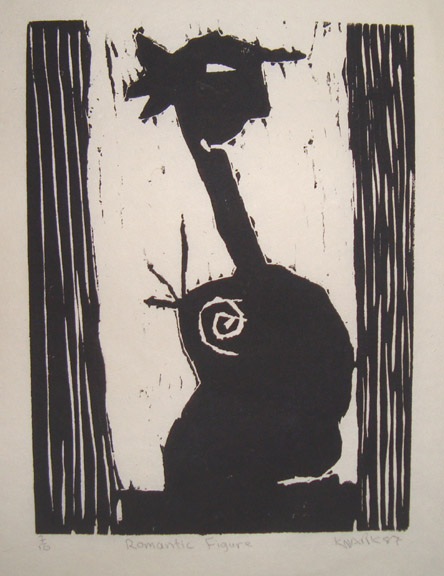 This one is called Romantic Figure. The image is 9 inches tall and 7 inches wide. This is an edition of 10 and I still have #s 7,8,9 and 10.
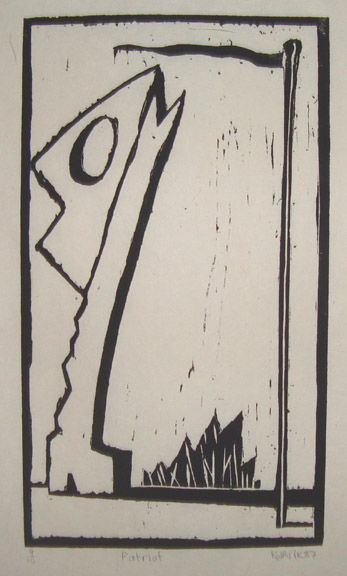 This one is called Patriot. The image is about 7X13″. It’s an edition of 10 and I still have #s 5,6,7,8 & 9.
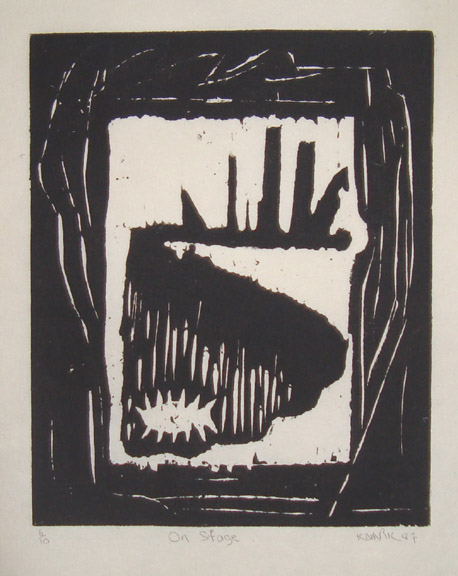 This woodcut, called On Stage, was my favourite at the time I made them, and remains my favourite today. It’s 7X9″ and I still have #s 6,9 and 10.
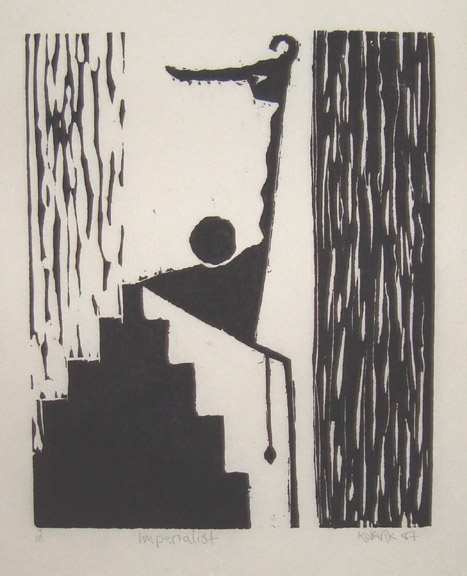 This one is called Imperialist. It’s 7X9″ and I still have #s 3-10.


