
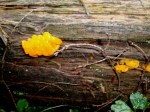
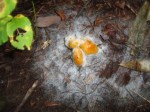
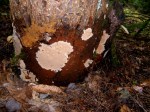
For me, these are curiosities I notice while I’m out looking for some tasty edible mushrooms in the woods. I’d like to learn more about them one day. Not today though. For now, I’ll just share some photos of these strange items.
comments 2
For me, these are curiosities I notice while I’m out looking for some tasty edible mushrooms in the woods. I’d like to learn more about them one day. Not today though. For now, I’ll just share some photos of these strange items.



I’m going to take a break from the deluge of fungi photos and turn to the news and municipal politics for a moment. Yesterday Toronto mayoral hopeful Rocco Rossi made an announcement that I just have to talk about. Rossi has proposed an tunnel extension of Allen Rd. to the downtown core.
Torontonians know there is a lot of history involved here, going back to the 1960s. In the end, the expressway was never completed. The Ontario Premier at the time, Bill Davis, stopped it. It became the Allen Rd, and it stopped abruptly at Eglinton in such as way as to ensure daily traffic snarls.
The stopping of the expressway represented a significant change of thinking for Toronto. The expressway represented a city made for cars. No expressway represented a city for people. It could be argued that this change in thinking was the genesis of ideas like a network of bike lanes through the city, dedicated transit lanes, and the narrowing of roads.
Rocco Rossi is trying to capitalize on a backlash to a so-called war on cars in Toronto by presenting a grand scheme for a new way to move traffic. Rossi hasn’t been polling well, and perhaps this proposal is a desperate attempt to change that. The tunnel proposal follows on the heels of Rossi’s proposal to introduce recall to Toronto municipal politics.
The good thing about what Rossi is doing is that he is starting to articulate a vision for the city, in a mayoralty race in which this writer doesn’t see a lot of vision at all. I appreciate the idea of introducing a grand scheme the city can rally around. The problem is that building a tunnel for cars from Eglinton to downtown is full of problems. A project like this will cause construction chaos that will make the mess that is the St. Clair transit right-of-way seem smooth. The cost will be astronomical, staggering.
I would like to see some ideas for improving the way the Allen Rd ends, to ease the current chaos, but to suggest that the solution to that problem is to blow a tunnel to downtown is hard to swallow. Sometimes problems need modest solutions. St. Clair had a pretty good street car run with some rush-hour bunching of cars. We ought to have looked for modest solutions at some key intersections instead of blowing up the entire street. I think the same is true here. It’s worthwhile tackling the problem which is the end of the Allen, but let’s focus on the problem.
I think this city needs to grapple with the challenge of making fast solid improvements to our transit network. I don’t think this is the time to think about new ways to funnel cars into the downtown. That doesn’t mean we need to go out of our way to make traffic worse. Some of the decisions of the Miller administration, such as the narrowing of Lansdowne Ave and bike lanes down the middle of Jarvis St are wrong-headed. We need to think about the problem a little differently. Instead of thinking about how to make barriers for cars, we need to think about how to optimize transit and the movement of cars.
Rocco Rossi has recognized that he is in the midst of an election in which there isn’t a lot of vision, and he’s trying to fill that void. I heard Mr. Pantalone the other night on a debate saying we don’t need a new plan for transit, we just need to carry out the one we have. That’s not going to make him mayor. Mr. Ford is a broken record, gravy train, gravy train, gravy train. He’s latched onto the anger folks have around the sense of entitlement many of our councillors have exhibited. Polls suggest that may be enough to win him the election, but I can’t even imagine Ford as being anything like a suitable candidate for mayor. Smitherman has positioned himself as the guy in the centre and the alternative to Ford. Does he have a vision for the City? In the debate the other night, I heard he was going to freeze taxes and freeze spending. What about Sarah Thompson? Can she win this thing? I don’t think it’s going to happen.
If the election were tomorrow, I don’t know which of these characters I might vote for. Maybe it’s time to take a closer look at the fringe candidates. Is the muffin guy running this time around?
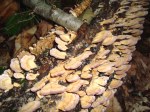
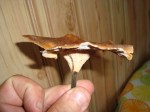
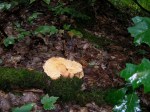
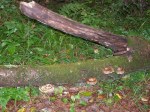
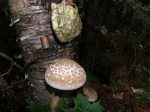
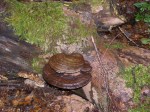
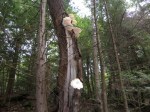
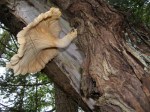
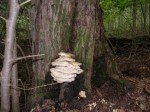
You must be thinking that by now I should be almost out of fungi pictures. I suppose I got carried away last week, but I wanted to create a photo record of many of the mushrooms I observed. This gallery features polypores and shelf or bracket fungi.
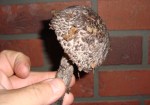
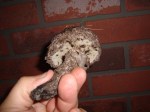


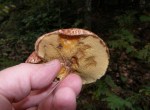


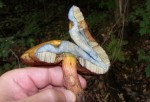


Last week I observed many different varieties of boletes – mushrooms with pores instead of gills or teeth. Here are some examples.
I found some purple mushrooms while I was away.
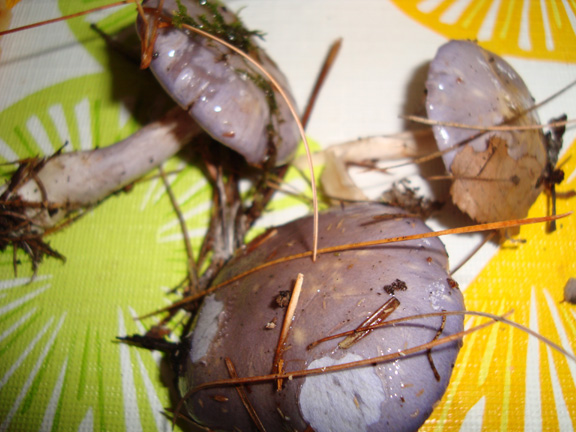 In order to try to figure out what they were, I took spore prints. They turned out to be the rusty brown colour characteristic of mushrooms in the Cortinarius genus. Salvelinas has suggested, and I think he may well be right, that they are Cortinarius iodes, based on the description in Barron’s field guide. Telling is the sliminess of the caps. Michael Kuo’s description fits the bill too and can be found here.
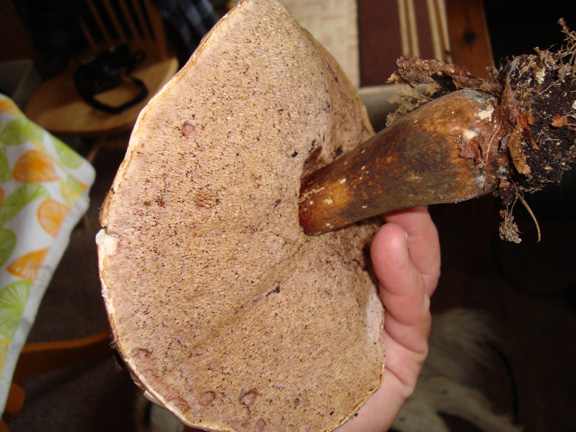
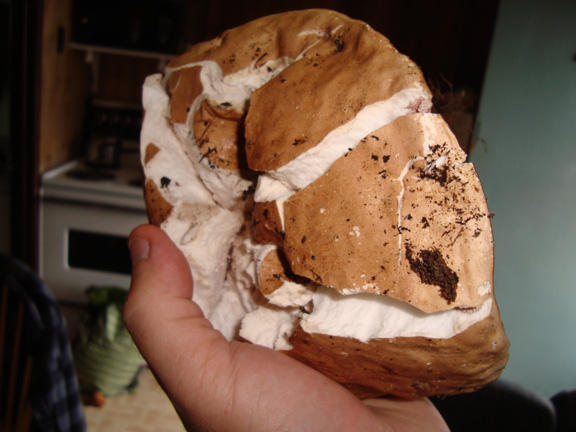 I found this massive bolete and decided to bring it back to the cabin for identification. After carrying it around all day, when I got back to the cabin and took the mushrooms from my basket, this one not only had crushed a few others, it also fell apart under its own weight when I tried to lift it up. This one presented a challenge for identification because it was an old specimen and I didn’t have any young specimens of the same type to see what happened to the pore colour as the mushroom aged. As well, taste is part of bolete identification and I wasn’t going to chew on something that was disintegrating in front of me (would you?). I don’t think there’s enough info to go on to ID this one, at least not with my level of experience. Maybe it’s one of the Tylopilus (?) If there are any experts out there who would like to weigh in, please do. I found it in mixed forest with hemlock, white pine, maple and maybe some other stuff in the immediate area.
Let’s be clear. I don’t want anyone thinking I’m suggesting you go out and pick yourself a bunch of wild mushrooms, compare them to photos of mushrooms I have posted as edibles, and eat them. Here’s the thing. It isn’t too difficult to learn to identify a handful of mushrooms you can eat. The problem is that in some cases the consequences of making a mistake are really big. I am very careful about eating any mushrooms and I’m urging all my readers to be equally careful. Don’t eat any mushrooms unless you’re sure they aren’t going to do you in. Some mushrooms which are known to be good and tasty edibles cause bad reactions in some people, so the rule I’m advocating here is that should you decide to eat a wild mushroom, after identifying the mushroom as a safe edible to 100% certainty, the first time you consume a particular variety, cook up just a bit and see how you do with it before preparing that feast.
I don’t want anybody lying in a hospital bed wretching because they found mushrooms that looked like pictures I posted and cooked them up for lunch. Nuff said on that.
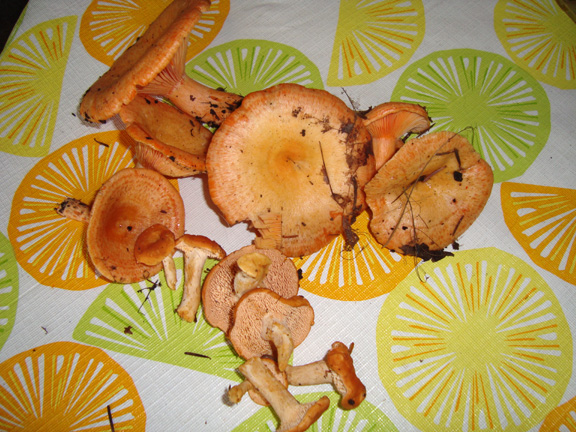 The photo above shows a group of mushrooms I collected for dinner. There are two types here. One is a lactarius, or milk cap. They’re called milk caps because they are reputed to exude a liquid should you break the cap. In fact, they don’t always do so. These ones all exuded a bright orange liquid. Let’s just say that I was confident that these particular ones were an edible lacterius. I’m pretty sure they are Lacterius thyinos. There is a Russula that looks like this mushroom that doesn’t exude juice. According to Michael Kuo’s 100 Edible Mushrooms, it smells like bad maraschino cherries. The mushrooms I picked didn’t stain green like the Lactarius deliciosus (also edible). Kuo also points to other small orange Lacterius that smell like burned sugar, maple syrup or curry, and he cautions readers to avoid those. Let’s just say I was correct with my identification (at least I can say there were no adverse physical affects when I cooked and ate them).
The other smaller mushrooms in the photo I identified as Hydnum umbilicatum, one of the two varieties of what are commonly called Hedgehog mushrooms. You can see that these mushrooms have teeth. You can also see in one of the little mushrooms in the photo, a crater in the top of the cap. In this case, I’ve collected hedgehogs a few times and I was pretty certain of what I had. The other hedgehog, Hydnum repandum, is bigger and stockier and has a stem that is usually off-centre, and the colour seems to be generally paler. Here is what that one looks like:
 In general, you could say that both types are toothed mushrooms with a more or less tan colour. I don’t think I can tell the difference in taste, except to say that with the bigger ones, smaller specimens are better because the teeth pretty much disappear. I read somewhere that older specimens can be bitter but I haven’t tasted a hedgehog that is anything but delicious. I think it is fair to compare them to chanterelles in terms of texture and flavour. If somebody asked me what I collected, I would likely just say hedgehogs and not make the distinction, unless I was talking to someone who would know there are two.
Here’s what I did for dinner one night while I was away (again, don’t try this at home because you read it here….take the trouble to learn what you’re doing).
First I cleaned up the mushrooms with a damp paper towel. Both varieties tend to come bug free, so almost everything I had was usuable. I discarded the stems from a couple of the lactarius because they were not perfect.
My cabin came with a propane bbq, so I started that up. I brought along a cooked ham steak and I tossed that on the grill for 5 minutes. Meanwhile, I chopped some shallots. Shallots love mushrooms and it happens that my brother Salvelinas grows the most amazing shallots and recently laid some of those babies on me. I started them going in the only fry pan in the cabin and after a couple minutes added the mushrooms. I brought along some creole spice so I added a little of that…not too much. I didn’t want to overwhelm the delicate mushrooms, but rather enhance their flavour. The lactarius retain their colour when you cook with them. After a while, an orange sauce appeared in the pan. While the mushrooms and shallots cooked, I chopped up the ham steak into chunks, and when the mushrooms were just about ready, I tossed the ham in with the mushrooms and tossed it all around and let the sauce cook down for a minute.
It was a must excellent supper. For the vegetarians in the crowd, you could simply eliminate the ham or consider adding another vegetable. A green pepper would be good and so would a zucchini, whatever you like.
This is a so-called experimental forest in the Bracebridge area of Ontario.
 As you can see in the photo, it consists of an extensive network of trails near the Muskoka River through a variety of forest mixes. I observed a lot of mushrooms as the dogs and I hiked these trails. An interesting species that immediately comes to mind were found at a picnic area.
 These curious mushrooms had unusual very delicate caps that featured ephemeral sparkley bits. I had never seen anything like these. I guessed they were Coprinus and discovered photos of Coprinus micaceus in Barron’s book that looked just like the ones I observed. These were mica caps. They are apparently edible, but they didn’t look very appetizing to me. There were dozens of them growing from wood chips that were spread around the picnic area.
 Throughout the Bracebridge forests I saw plenty of corals. I suspect I observed perhaps two or three different corals. I find them difficult to tell one from another and I didn’t collect samples to study. That said, my best guess on the one in this photo is the Cockscomb coral, Clavulina cristata. A number of the coral fungi are reported to be good to eat, but I haven’t tried any of them and one of the reasons for that is my uncertainty in discerning one from another.
We hiked a number of trails and the forests around them during the day spent in these forests. This included a detour for the dogs to swim in the river, and it also included both well-groomed and rougher trails. I was the only person in the complex the day I was there. I may have forgotten the posted rule about dogs being on-leash at all times (allegedly and hypothetically). I’ll feature some of the other mushrooms found in this area in other posts in the coming days.
I observed many puffballs on my trip. There are several varieties of small puffballs in our area, and I’m not an expert on telling them apart but my best assessment is that I saw Lycoperdon pyriforme – the Pear-shaped Puffball; and Lycoperdon perlatum – the Gem-Studded Puffball; I may have also observed Scleroderma otrinum – Earthballs. There may have been others.
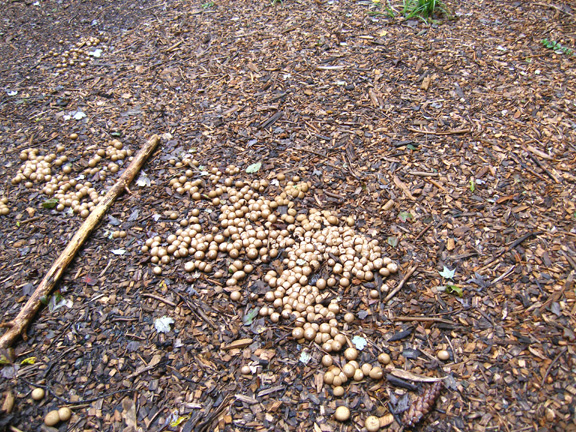

It seems that everywhere I went I saw puffballs. There were even plenty of them appearing on the grass around the cabin at which I stayed. I collected about a dozen young, pure white pear-shaped puffballs to try in an omelette.
Many of the small puffballs are edible. The single biggest mistake to avoid is mistaking Amanita buttons for puffballs. A young amanita button looks kind of like an inverted pear-shaped puffball. Even though I was certain of what I picked, still I sliced each one in half to ensure I was looking at a solid white mass of puffball and nothing that looked like it could be a developing mushroom under a veil.
The best way I can describe them as food is to say that they are like adding tofu to a stir-fry. Is it good? Well, it adds something. It picks up flavours around it. Puffballs are similar. They’re mild and they more or less mind their own business. I wouldn’t go out of my way to pick a bunch but on the other hand, if I stumbled across some nice fresh ones in the woods, and I had plenty of room in my basket, I wouldn’t hesitate to collect a bunch.
…continued from previous post: Limberlost Reserve… The Turtle Lake West Trail becomes the Turtle Lake East Trail when you cross the stream by a lovely cedar bridge.
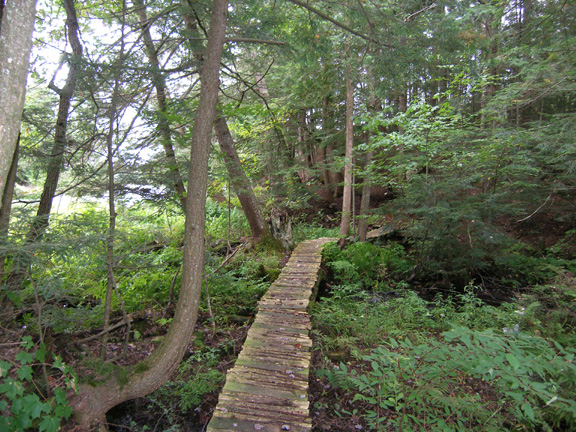 There are actually two of them, but one is blocked off with some ribbon, which I took to mean it was not safe to cross. This one was fine, sturdier than I expected.
The character of the trail along the lake changed as we got into some basswood forest. There was remarkably little undergrowth on the hill to our right and the soil seemed rich and loamy. Oh, and there were plenty of mushrooms along the way.
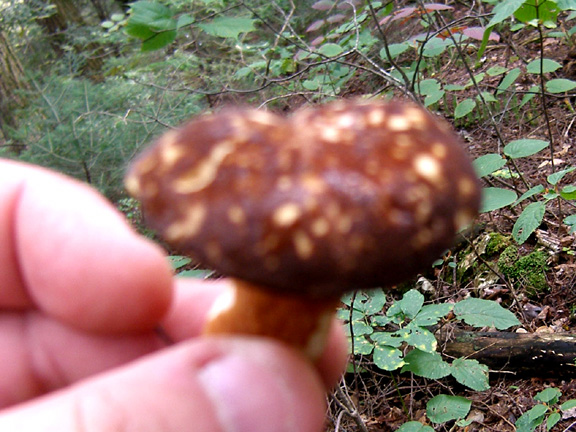 The focus is all wrong on this shot, but it’s such an interesting little bolete that I thought I’d include it. Thank you for being gentle with your photography criticism. I found interesting mushrooms most of the way along this side of the lake. Eventually we came to the narrows between Turtle and Clear lakes and another interesting bridge.
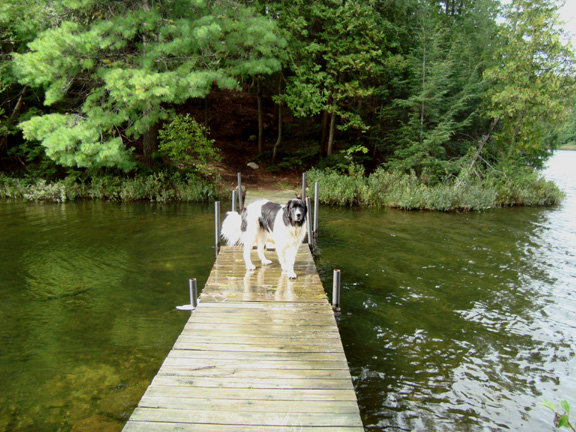 Part of this bridge is right at water level. Behind Memphis, a section of the bridge is actually out, replaced by two boards. Still, it was reasonably easy for me and the dogs to make it across without getting wet. Beyond this point, there is a steep hill, and then we were back at the car. The whole hike was around 5 miles, and was one of the loveliest hikes I’ve made in some time. In other posts, I’ll show you pictures of some of the mushrooms I found along the way.
 27th Street