comments 3

My father and his childhood pal Freddie

Each year at Remembrance Day I think of the stories my father used to tell me about him and his buddy Freddie as rapscallion kids, and what happened to each of them during the Second World War. I’ve told many people at least parts of this and I may have written about it in this space before. Part of the story I’m going to tell is well documented. Other parts may be subject to my father’s storytelling, in which he never let facts cloud a perfectly good story.

They grew up in The Junction are of Toronto in the 20s (my father and Fred were born in 1917), where my grandfather operated the Queen’s City Leatherworks, making gloves for the railwaymen. As my father told it, he and Freddie were always getting in trouble of one kind or another. There was the time, for instance, when they helped out Freddie’s dad with his sad-sack apple tree which never bore fruit. They went down to an old orchard by the Humber and picked a couple baskets of small green apples, and one night they snuck out with some fishing line and tied those apples on the tree so Freddie’s dad could see his tree filled with fruit. There was the day they camped down by the river, and their hatchet was struck by lightning. And there was the time they decided to make root beer. They sent away for a root beer making kit, and mixed up a batch in a demijohn in Freddie’s basement. Somehow it all went wrong, and the concoction filled the basement with root beer foam.

Years later, with the advent of the second war, both my father and Freddie enlisted but from this point on their stories could not be more different. My father was in the army for a while where he somehow or another got involved with doing accounting or payroll-related work at the camp. If you knew my father, you would know this was an unlikely scenerio, but he mentioned this to me several times over the years.  When he talked about this time, he mostly talked about the poker games he organized (it would be several years before my mom tamed the gambler in him). For some reason I really don’t know, he moved from the army to the air force, where he was to train as a pilot. This was not to be.

There was a large forest fire up in Muskoka in an area around Sugar Lake. My father was sent up there to work with a fire-fighting crew. While up there, he discovered the lake was full of large bass. One thing my father was very very good at was fishing. He had a knack for it, and I can say without hesitation that one of the best gifts my dad gave me was a love for fishing and the outdoors. He scrounged up some fishing line and hooks but had no rod, so he cut a maple sapling to use as a fishing pole and caught crayfish to use as bait. Before long, one of my father’s jobs was to catch enough bass to feed the camp (as he told me the food up there wasn’t up to much). Only my father could manage to finish out the war bass fishing.

Meanwhile, his old buddy Fred became a medical orderly in the 1st Canadian Parachute Battalion, which at the time was part of the British Army’s 6th Airborne Division. By the way, Freddie’s full name was Frederick George Topham.

On the morning of 24 March 1945, parachute and glider-borne troops of the 6th Airborne Division landed on the east bank of the Rhine River, not far from the city of Wesel in Germany. These landings were carried out in support of assault operations begun the night before by the 1st Canadian and 2nd British Armies to cross to the East bank of the river. After the 1st Canadian Parachute Battalion landed just north of Diersfordt Wood, Corporal Topham heard a cry for help from a wounded man who was in the open. Two medical orderlies who went out in succession to treat the wounded man were killed. Immediately afterward and on his own initiative, Topham went forward through intense German fire to assist the casualty. As he treated the wounded man, Topham was himself shot through the nose, but continued to give first aid despite the severe bleeding and pain of his own injury. He was then able to carry the wounded man to shelter through continuous fire. Refusing treatment for his wound, Corporal Topham continued to assist the wounded for two more hours, by which time all casualties had been evacuated to safety. Although he finally consented to have his nose dressed, he refused to be evacuated with the other wounded. Later, alone and again under enemy fire, Topham rescued three soldiers from a burning machine gun carrier that threatened to explode, brought them to safety, and arranged for the evacuation of the two men who survived.

For his courageous and selfless effort, Fred Topham was awarded the Victoria Cross.

Fred Topham died in Toronto in 1974. I would have been 13 when he passed. I don’t remember if I ever met him, and I don’t know if he and my father remained in touch at that point.

There is a bit of an epilogue to this story. Years later, my dad became reaquainted with Freddie’s big brother Norm and during my dad’s later years, he and Norm were very good friends (I remember Norm well). I recall after my father’s vision had deteriorated to the point at which he could no longer drive, Norm would come over to my dad’s house from time to time with a bottle of brandy. The two of them would sit in the living room, blast jazz on my dad’s old console hi-fi record player, drink themselves a bit silly, and tell their stories.
comment 0

Free Books on 27th Street

IMG_6902.jpg

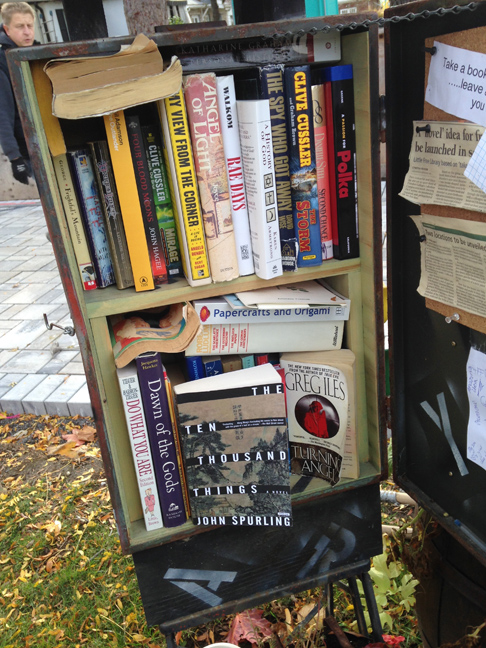
The 27th Street Book Box has been stuffed full of books the last few days. There are some excellent selections. If you’re in Long Branch and you want a good book to read, stop by. You can take some books – to borrow or keep. Normally you can drop off a good book or two, but right now there is just no room.

The Long Branch community has been fantastic, supporting the book box project from the start. There is always an interesting turnover of books and this little library has plenty of regular visitors. You never know what you’re going to find there.

The Book Box is located on the east side of Twenty Seventh Street, in front of #15 – if you’re going south, it’s just before all the construction.

comments 2

Roger Lanteigne on accordion

I think we all need something to get our minds off the American election. I haven’t shared much button accordion music lately, so I’d like to remedy that today. Here’s the excellent Acadian player Roger Lanteigne tearing it up. Might fine, mighty fine.

I believe that is Ivan Hicks accompanying on fiddle. He’s not only a fine fiddler but clearly a fashion giant as well.


comments 2

Doorman

At the front of our house there is a screen door and a wood door. This afternoon I had the wood door open and the window in the screen door open to get some fresh air in the house, since it was such a beautiful day.

George, one of our Newfs, likes to lie down against the screen door. He’s discovered that the latch doesn’t always close properly and he can nudge open the door with his nose or his paw and enjoy the fresh air but sticking his ever so large snout out the door. He was there this afternoon when Jack Shadbolt, one of our cats came to the front door and demanded entry. I was sitting at the computer just around the corner.

George opened the front door to let Jack in. He’s never done that before. Good thing he doesn’t have opposable thumbs or there would be no stopping him.

comment 0

Banjo Practice – Ora Lee

I learned this tune from Bob Carlin at Midwest Banjo Camp back in June. It seems a lot of clawhammer players who play this one learned it from Bob, either at one of his workshops or from his fine recording of the tune on Banging and Sawing. He’s an excellent teacher with a huge amount of knowledge and stories about old time music and players.

I’m playing the tune in standard G tuning – gDGBD (in other words the banjo is tuned to an open G chord). The banjo here is a Nechville Atlas, my first good banjo.

comment 0

The Local Honeys

This performance was shared by someone on one of the facebook banjo groups. I liked it a lot so I thought I’d share it here as well. It’s a mighty sad tune about coal mining by two women from Kentucky. Beautiful performance! Here’s a link to The Local Honeys website.

They have an excellent recording available via their website.

(Verse 1 & 2)
You piss in my boot
And you tell me it’s rain
You smell like money
On land you reclaim
Top off that sludge pond
Run black through our sinks
Heavy on the corn when we
fill up our drinks

Dig out our coal
Turn it into cash
Starve out our homelands
But keep your wallets fat
Shake down our houses
With your big old draglines
And bury our families
deep in them mines

(Chorus)
Why not plant cigarette trees?
They’d burn faster than
You’d log these
Fill up them valleys
Slurry them streams
But big ole king coal
Don’t you lose any sleep

(Verse 3 & 4)
Strip off her top
Knock her to her knees
Disgrace that big ole mountain
With your broad-form deed
Kill animal and human
Every plant and herb
You can’t help but leave the sky
So we can still flip
You the bird

What will we do
With no mountains to climb
When you disappear
And you shut down the mines
Pray God gives you mercy
In the place you should dwell
That you don’t burn like coal
When you’re sentenced to hell

(Chorus)
Why not plant cigarette trees?
They’d burn faster than
You’d log these
Fill up them valleys
Slurry them streams
But big ole king coal
Don’t you lose any sleep

comments 2

New Ground

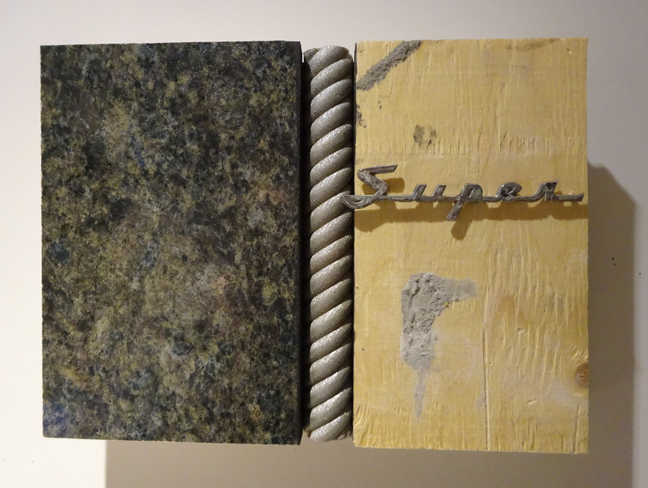
I’ve been making some new work in the studio – let’s call them constructions. Some of you may have seen this one the other day. Here’s another – this one is small, just about 10″ wide.

DSC05903.jpg

Super, 2016, mixed media

It’s way to early for me to talk about this work, except to say for me it’s exciting and fun and scary all at once. More soon.

Filed under: Art
comment 0

15 Stories

From the shameless self-promotion department:

For those who have missed it, I’ve published a group of stories (15 and counting) in serial format at a blog site, eugeneknapikstories.com. These are short-short fiction under the title The Lazy Allen Stories. They are set in 1982 in Toronto and are told in the voice of a character named Lazy. Lazy tells stories about his life working on the line in a bottling plant, stories of an earlier time when he was a musician in polka bands, and stories of a new adventure with his pal Staashu Dudas about a polka-punk band called The New Polka Kings.

I post links to each new story here at 27th Street. I’d like to send out a big thanks to those readers who have been following this project. You know who you are.

I don’t know much about fiction writing or getting fiction published (I’m a painter first and foremost), but I’m writing these things anyway (it seems they’re in me and want to find a way out), and I’m taking the most direct approach I can think of to find some kind of audience – putting them online.

If you like it here at 27th Street, who knows you might like the stories too. You can read them as individual stories or you can read them from the beginning in serial form. For those who want to read them as a serial, I’ve created a menu at the top of the stories page…first one is The Bottle & Can and the most recent story is True North.

I hope you enjoy the stories.

comment 0

2 Seasons

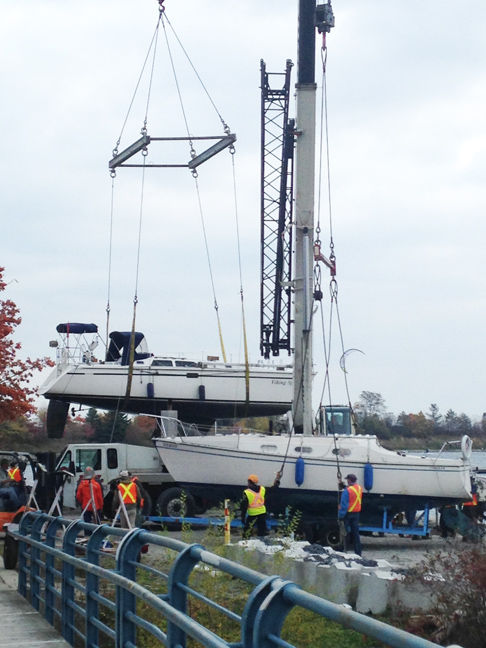
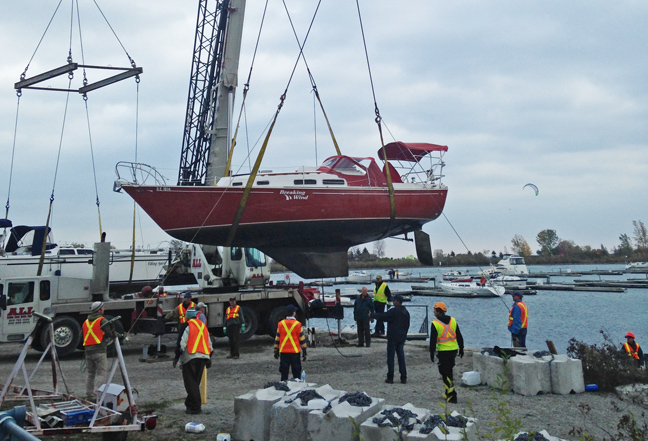
Here by the shores of Lake Ontario, it might be argued there are 2 seasons, not 4, defined by two weekends each year – the weekend they pull all the sailboats from the yacht club in Sam Smith Park – and the weekend they put them back in. You might describe these seasons as enjoy the lake by being on it and enjoy the lake from a distance in front of a cozy wood stove.

IMG_6812.jpg
IMG_6817.jpg