Yesterday, what I consider to be a wrong-headed one page leaflet was dropped into my mailbox and in the mailboxes of my neighbours, criticizing something called the Urban Design Guidelines Template.
What is the Urban Design Guidelines Template?
City Planning has initiated a study for the creation of a “Template” for Neighbourhood Urban Design Guidelines and an accompanying “How-To” Manual. These documents are intended to be used by those communities that wish to prepare neighbourhood specific design guidelines. The Template will enable residents and community groups to develop tailored design guidelines that address change occurring in their neighbourhood, while ensuring consistent content and format with other neighbourhood specific design guidelines throughout the City. It is anticipated that as neighbourhoods develop their own guidelines, they can be consolidated over time, to create an amalgamated guidelines document with neighbourhood specific design guidelines covering neighbourhoods across the city.
Additional information can be found here.
The unsigned letter I received (it was signed off only: Concerned, Residents of “Long Branch Diversified”) framed this as a template “of what you can or can’t do to your property.” The letter suggests the guidelines will “restrict the homeowner’s personal tastes and unique expression and possibly not reflect the owner’s needs.” It calls the guidelines a “subdivision style” set of rules that will “hinder the Diversity, Self-expression and Unique Character of Long Branch.” It goes on to suggest that “we cannot let this controlling behaviour dictate in such a communist fashion.” The letter was also a petition, asking neighbours to not support the Urban Design Guidelines Template, and further suggesting the contract with the firm contracted by the city to facilitate the process and develop the guidelines be terminated.
I believe that the issue at the core of this is lot-splitting in Long Branch. In the past few years, our community has come under extensive development pressure – in particular there has been a sharp increase in applications to sever 50 foot lots, and throughout south Long Branch we have seen pairs of what are being referred to as “soldier houses” popping up. These are very tall, narrow and deep homes, with integrated garages, making them de facto 3-storey structures. As near as I can tell, every successful severance in the area has resulted in a pair of these very similar homes. It seems this is the formula for making lots and lots of money from these properties. They all look basically the same and they’re chipping away at the unique character of our community.
The leaflet referred to diversity, and when I read it, I recalled the hired-gun planner at the last Committee of Adjustment hearing I attended attempt to make an argument that the severance/soldier homes concept was all about diversity. I spoke at that hearing and made the point that these applications could hardly be about diversity when they all look the same. No matter what arcane planning language you couch these applications in, we’ve all seen these developments make the neighbourhood more homogeneous and less unique. I believe these developments are all about profitability, and that’s it.
What is this unique character?
In Long Branch it is not a situation in which there is a particular style of house or size of house. In fact the community is remarkably diverse and has developed organically that way slowly over the years. Long Branch once was a cottage community for Toronto, and was not part of the City until the most recent amalgamation in 1998. Prior to that, it was part of the City of Etobicoke, although most long-time residents I’ve talked to preferred to just call the community Long Branch, or grudgingly, part of so-called South Etobicoke. It is one of a group of lakefront communities, starting in the east with Mimico, then New Toronto, Long Branch, and west into what is now Mississauga, Lakeview and Port Credit. These communities have retained a kind of separateness because of the natural boundary (the lake) to the south, and the man-made boundaries (the expressway and the rail tracks) to the north, and residents still like to use the original names.
One feature of our community is that we have not had cookie-cutter architecture until the recent spate of soldier houses. There are still some of the original cottages around, and many small bungalows on large lots. There are some huge homes along Lake Promenade, the street that runs along the lake front. The homes in Long Branch north of Lake Promenade (with the exception of a couple sets of apartments) are mostly single-family dwellings of various sizes, styles and configurations, mostly (but not entirely) modest homes, many of which are on large lots in the 50X150 foot range. There is plenty of green space and lots of mature trees around the homes. When we first came to Long Branch to look at the home we ended up buying, I parked in front of the little bungalow across the street (where a pair of soldier houses is now being constructed) and thought, “It’s like Muskoka in the city.” That quality was one of the things drawing us to this community.
The amazing canopy around here is also a big draw for migratory birds. Col. Sam Smith Park, down the street is known as a “migration trap”, a resting spot for birds migrating north or south. It attracts birders from long distances. The appearance of the soldier homes has without exception meant significant loss of mature trees. In fact at 2 Twenty Seventh Street, 6 mature trees were destroyed without a permit. Further up the street at the site of a pair of soldier homes, it took a couple years for the magnificent mature tree in the front yard of the property to die off, but die it did – it was cut down this year.
A Perfect Storm
Long Branch was a stable community for many years. The current system of addressing variances – the Committee of Adjustment with the Ontario Municipal Board there for any appeals, worked fairly well during that period of stability. This system successfully dealt with applications from homeowners for a bigger deck or an addition that might be a tad bigger than than the by-laws allowed. I don’t think anyone imagined the sharp increase in development pressure which was to come.
I believe a number of factors contributed to the development pressure. There are a lot of homeowners in Long Branch who have been here for 40 or 50 years or longer, and their circumstances are changing. At the same time, housing prices have been rising sharply and interest rates have remained low. There are a remarkable number 50 foot lots in the community, and it seems these have become irresistible to the builder/developer community. There is a lot of money to be made by splitting lots in Long Branch and builders and developers are snapping up houses in an effort to grab a piece of that tasty Long Branch pie. I regularly receive calls from real estate agents who tell me they have clients looking for a property in the area. Some homes in the area have been sold without ever being listed.
Learning to Fight
When we moved to Twenty Seventh Street, I naively thought our community was protected by the Official Plan. It specifically directs increases in density to the main streets in Toronto communities – in our case that means Lakeshore Blvd – and not in the neighbourhoods. We are now seeing a sharp increase in density along Lakeshore Blvd, with hundreds of new units opening up a few blocks west of here. I think there are benefits to that development for business along the Lakeshore business strip. Yet we are seeing the planning bodies approve increased density in the neighbourhoods.
I was surprised when we started to see applications to split lots around here. Again, I confess I was naive. We didn’t know how to fight. We didn’t know the ins and outs of the official plan. We didn’t understand planning language. These are things my neighbours and I began to learn by necessity along the way. When we started attending and speaking at the Committee of Adjustment we learned there were “hired gun” planners and city hall insiders and lawyers involved, people who make their living making these planning arguments. We learned that even things like the word “minor” as in “minor variance” did not have a clear meaning.
We learned to frame arguments in language the Committee of Adjustment would listen to. We learned that letters just were not enough, and that objections had to be raised in person. Neighbours are now better connected and better organized, and at the Committee of Adjustment level at least, have become more successful in fighting severances. At the same time, the number of severance applications continues to increase.
Some residents have banded together to form a neighbourhood association, in an effort to bring an organized voice to this and other issues. I’m not part of that group, and I can’t really assess how successful they’ve been so far – but I’m hopeful that this kind of organization can only help.
One member of our community introduced another way to fight. He had “stop the lot splitting signs” made up and he has distributed them to interested residents. They are now on lawns throughout south Long Branch. Will the signs help? I don’t know. If nothing else they show a remarkable solidarity in our community on the lot splitting issue.
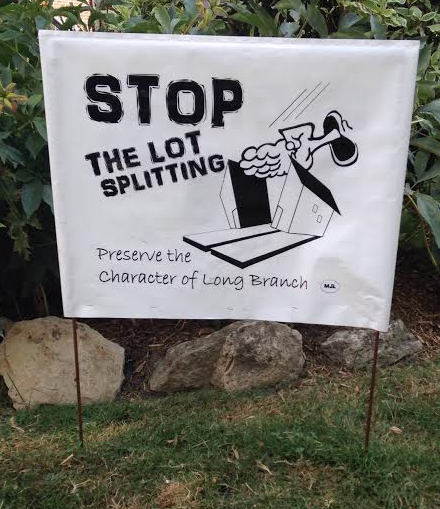
On my morning dog-walk, I stopped to chat with a neighbour who says he has been followed around when delivering signs and that his home has been egged. Other neighbours have reported finding their signs ripped from the ground. It’s hard to believe but true. Looks like the signs are making some people very unhappy.
The current system is broken
The current system, as I mentioned, worked fine when Long Branch wasn’t under development pressure. Now, residents who oppose severance applications are expected to take time off work and attend hearings and are expected to be versed in the appropriate by-laws and language, and even when they do it very well, some decisions just don’t make much sense.
At the OMB, concerns of neighbours are heard, but from the decisions I’ve read it appears they are not given a lot of weight. On a number of more recent files, Councillor Grimes has directed planners and lawyers to oppose appeals of Committee of Adjustment decisions at the OMB. The very fact that the OMB often finds against the City at these appeals is an indicator that the system is broken.
Inject some Planning
When a community like ours comes under serious development pressure, we need to see some planning that goes beyond the individual hearings. The Urban Design Guidelines Template is an effort to inject greater planning into the process. I think it is a useful and positive exercise to look at what is important in our neighbourhoods. What is worth preserving? It looks to me that this process gives residents a greater voice in the planning process and forces a more careful examination of what makes up character in a neighbourhood.
I support the Urban Design Guidelines process. I don’t believe this initiative will hinder the diversity, self-expression and unique character of Long Branch. Instead, I think it is a step towards saving it.
What do you think? This topic is open for discussion.


 27th Street