
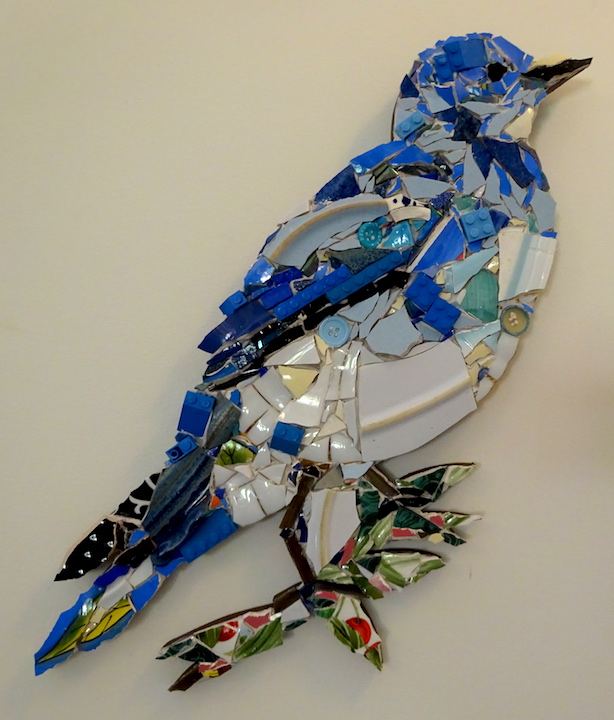
Tuffy P is in England right now, for a wedding – which was yesterday. She brought this mosaic over for the happy couple.
You can see lots of our mosaics at the Long Branch Mosaics page. We do all kinds of custom mosaic work.
Tuffy P is in England right now, for a wedding – which was yesterday. She brought this mosaic over for the happy couple.
You can see lots of our mosaics at the Long Branch Mosaics page. We do all kinds of custom mosaic work.
Here’s more Canadian fiddle music. This is Mac Beattie and his Ottawa Valley Melodiers, featuring Reg Hill on fiddle performing the Pembroke Centennial Breakdown.
I’ve been reading my way through that series of books by Patricia Highsmith known as the Ripliad – 5 novels all featuring the Tom Ripley character, written over a span of many years. It’s easy to see why she continued to return to Ripley. He’s a fascinating character, charming but amoral, capable of murder at any time.
This is the 4th in the series, written in 1980. The first, The Talanted Mr. Ripley was written in 1955 and the final book, Ripley Under Water was written in 1991. Of the 4 I’ve read so far, The Boy Who Followed Ripley is the weakest. Some of the writing is clumsy, and while there were some interesting ideas in the book I don’t think Highsmith carried it off nearly as well as the others I’ve read.
The Boy Who Followed Ripley is about a 16 year old rich kid named Frank who murdered his billionaire, wheelchair-bound father. He takes off to Europe and meets up with Ripley. I found it difficult to buy into just how the Frank character became aware of Ripley and why he decided to seek him out, but I understand why the author did it. The young man reminds Ripley of Ripley. The book brings out an almost compassionate side to the Ripley character presented along with an unresolved sexual tension between Tom and Frank.
Highsmith introduced some characters of convenience for this book who help out Tom. The young man is kidnapped in Berlin and these characters happily get involved with Tom because they have a mutual shady friend who appeared in the other novels. I couldn’t figure out the motivation for these characters and at one point I was convinced Highsmith was going to try to surprise us by revealing they were behind the kidnapping. In fact I think it was simpler than that. Tom needed helpers to drive the story and Highsmith provided them.
I expected or maybe I wanted, a greater depth of complexity in this novel, either in the characterization or the story. What I was looking for was perhaps hinted at but withheld. For instance, we know the boy killed his father because that’s what he told Tom and we believe it since he seems to be pretty much messed up. At one point I starting thinking, hey wait a minute, what if Frank didn’t murder his dad? Highsmith hinted that his mother was having an affair. What if the mother did it and Frank saw. How would that affect him? However, the mother didn’t do it.
If someone wanted to read just one or two of the Ripley novels, I wouldn’t recommend this one, but if you’re going to read the set, it’s a worthwhile read. I can’t speak to the whole set yet as I still have Ripley Under Water to read but so far The Talanted Mr. Ripley and Ripley’s Game are the strongest of the group by far.
I’m going to continue to occasionally share tunes played by great Canadian fiddlers here at 27th Street. I hope you enjoy this music as much as I do. Last time I featured Manitoba fiddler Patti Kusturok playing the Red River Jig. Let’s go east to Ontario today and feature the late great Ward Allen. Even if you’ve never heard of Ward Allen, I’ll bet you’ve heard one of his tunes, because his masterpiece Maple Sugar has become a standard, played wherever there are fiddlers.
Here is Ward Allen playing The Maple Leaf Two-Step, from 1953. I could listen to this tune all day!
CBC has been doing investigation into the ticket-selling business. The results are ugly. It seems there are scalpers’ conventions and they allege one major ticketseller has sent reps to recruit scalpers who “cheat its own system to expand its resale business and squeeze more money out of fans”. Apparently this outfit – Ticketmaster – is listing resale tickets on its own site, taking a cut for the second time each ticket is sold. I guess they just can’t resist double-dipping. This kind of bottom-feeding scheme works for them for high demand concerts, where people want tickets badly enough to pay highly inflated prices for them.
I have never bought scalped seats for any show, event, or sports match. I just can’t imagine any event I might want to see badly enough to allow scalpers to profit even by a penny. I’ve heard that some scalpers have taken a bath since the Blue Jays tanked this year and if that is really the case and there are re-sellers out there stuck with baseball tickets nobody wants, I rejoice. It looks good on them.
These days it isn’t very often I want to go see a performer at a venue large enough that the big ticket outfits are even involved, so this profiteering scheme has little effect on me. Tuffy P wanted to see the upcoming Bruno Mars show and bought two seats. She was unable to get two seats together and wound up buying two singles. I’m sure the scalpers had scooped all the good seats. As it turns out she is going to be in Europe and will miss the show (and I can take it or leave it), so she gave the tickets to a friend who is a big fan.
I did buy a pair of tickets for the upcoming Colter Wall show at the Opera House and last year we went to see Shovels and Rope at The Phoenix but those were both general admission deals and we had no difficulty getting tickets. It turns out that when the music you love best resides firmly outside the mainstream, there are advantages.
Although there is plenty of outrage around this story, I don’t expect there will be any oversight which will curtail the activity. I think the only way to put a stop to it is if we all simply refuse to pay inflated prices for a ticket to anything, ever, no exceptions. As long as people are willing to pay to keep the scalpers in business, they will continue to thrive. In my opinion, scalping is a low-life, bottom-feeding activity and I would shed no tears if their business simply dried up and they simply went away.
The fall nature walks with Miles Hearn have begun. I’ll be going each Wednesday. Today we accessed the Don Valley at Beechwood Ave. Much of our walk was in the area known as Crothers’ Woods.
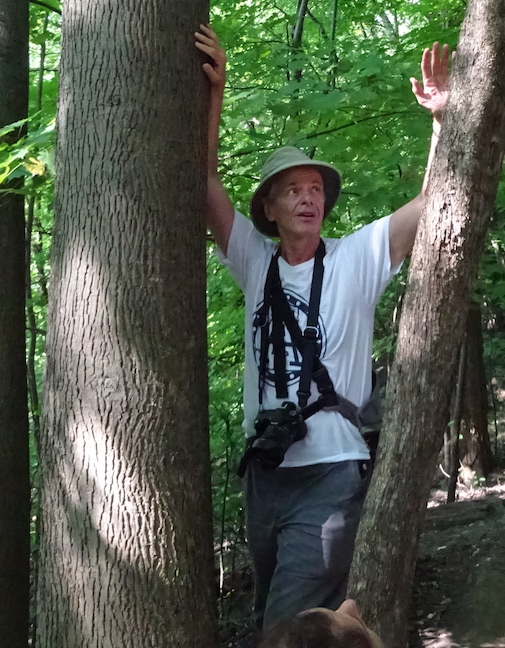
Miles Hearn pointing out a hickory tree (the big one) and a Hop-Hornbeam (Ironwood) beside it
It was early spring the last time we walked this area. This time of year asters are the stars of the show.


Here’s something I learned about red oak. When they are young, the bark is flattish. When they get larger, some flat areas of bark remain as seen in this photo.
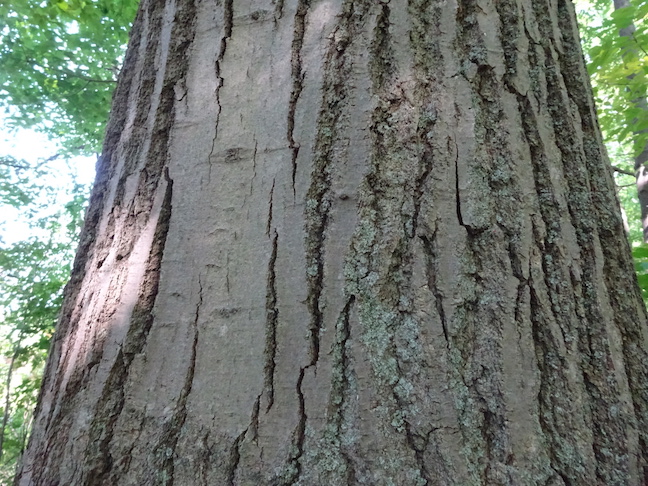
Red oak bark
I’m used to seeing Canada goldenrod, which is very common.

Canada goldenrod
There are other varieties as well, such as Grass-leaved goldenrod
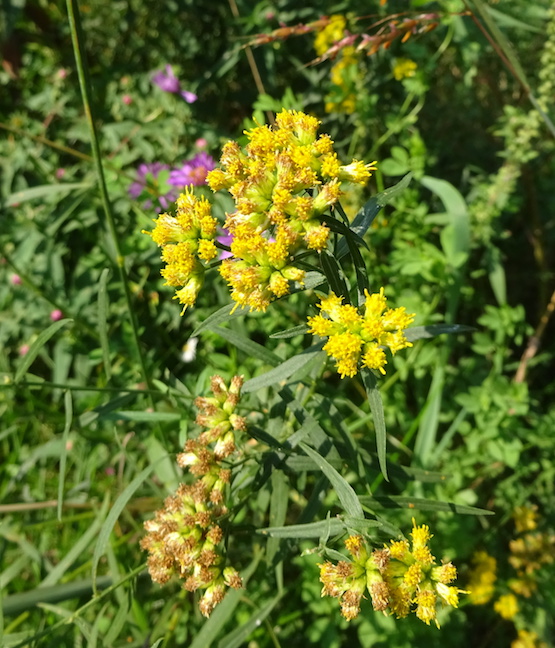
Grass-leaved goldenrod
….and Zigzag goldenrod
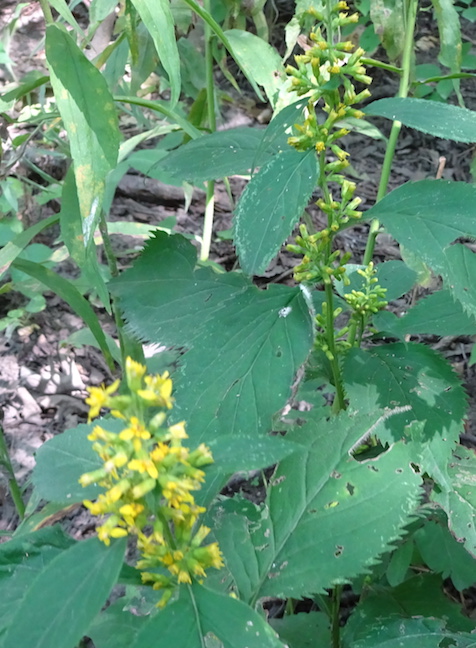
Zigzag goldenrod
Two plants which often grow together in exposed areas around here are Teasel and Tansy.
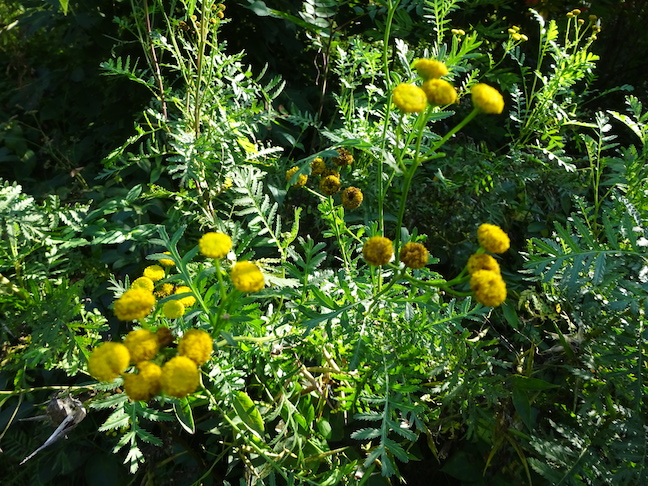
Tansy
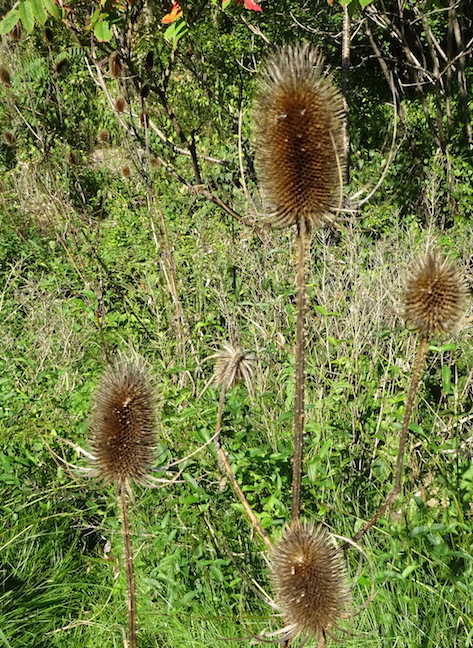
Teasel
This area of the Don Valley was once home to a paper mill. The paper used for the Globe and Mail came from this mill. When it closed in 1989, significant work was done to clean up the area and regenerate plant life. These days it’s a really nice area for a nature walk or a bike ride. Here’s a remnant of the mill.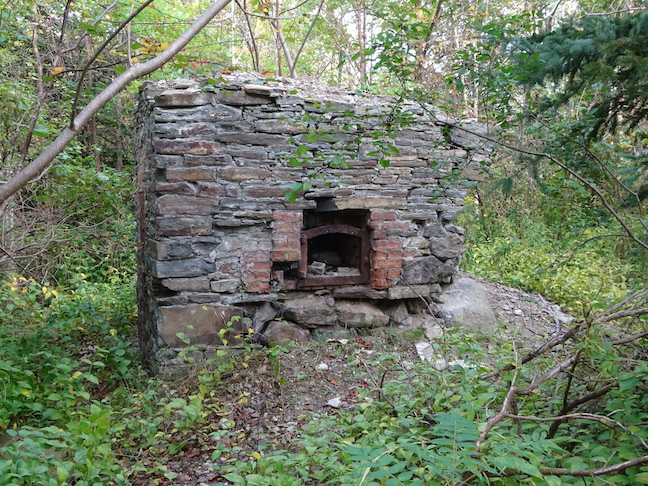
When we were up in the woods, walking a narrow trail, I noticed a very interesting mushroom, which I believe is the Eastern cauliflower mushroom. 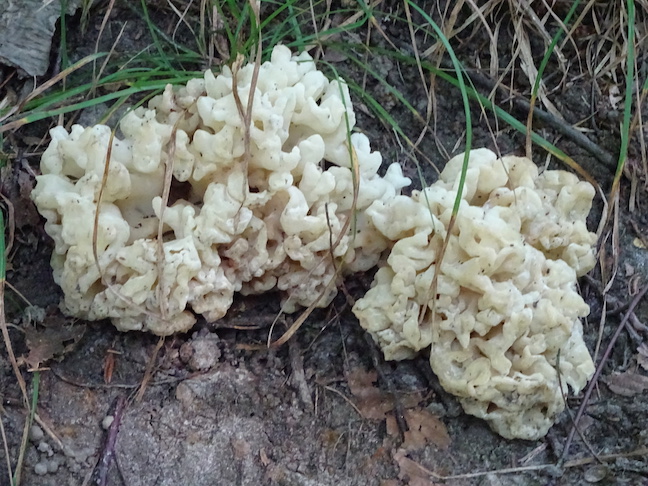
This is a choice edible, although I’m not sure I want to eat mushrooms growing on the site of a paper mill. I settled for a photo.
Next week, we’re at Rouge Valley park in the far east end of the GTA. It’s a beautiful spot and I’m looking forward to going back there. We might even see some salmon going upriver.
I was watching a few of Patti Kusturok’s 365 days of fiddle tunes on YouTube tonight. Since I started to learn some fiddle, I’ve been watching a lot of videos featuring fiddle music. I think the more I immerse myself in it, the better. Here’s day 19 in which she plays two versions of the Red River Jig. This is a traditional Métis dance tune, perhaps the most famous Métis tune . Although it has “jig” in the name, I’d call this one a reel, rather than a jig.
We have some great fiddlers here in Canada and they deserve more attention.
Back when I worked at Canada Post, I made some suggestions to the Stamp Advisory Committee for stamp images, and one of them was to do a series on great Canadian fiddlers. I suppose my suggestions were not the most commercial or mainstream and unfortunately none of them were selected. I thought it would be really interesting (and important) to profile fiddlers who were known for playing in regional styles (such as Ottawa Valley, Cape Breton, French Canadian, Metis).
As an aside, another of my unsuccessful stamp suggestions (I gave up after that) was to create 5 stamps honouring 5 Canadian abstract painters – the so-called Regina 5: Ron Bloore, Ken Lochhead, Doug Morton, Ted Godwin, and Art McKay – on the 50th Anniversary of their ground-breaking 1961 exhibition at the National Gallery of Canada.
There is an excellent selection of titles currently available in the 27th Street Book Box.
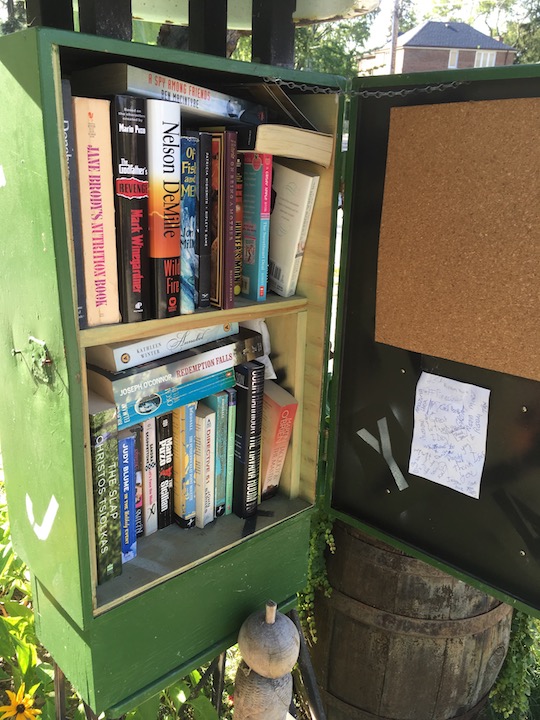
These include Redemption Falls by the excellent Irish author, Joseph O’Connor, a couple of the Godfather books, two of Patricia Highsmith’s novels, and many more.
You’re welcome to take a book or more anytime. You can keep them, give them away or return them. If you have a book or two you think others would enjoy, drop them off in the box. This little book box has been well used in our community and there is good turnover of books during the spring, summer and fall, particularly. It’s located in front of our home at 15 Twenty Seventh Street, where it will stay as long as it is well used and never abused.
If you stop by to drop off books but find the box too full (it happens from time to time), just leave the books in a plastic bag hanging on our front door knob, and we’ll fit them in as there is room.
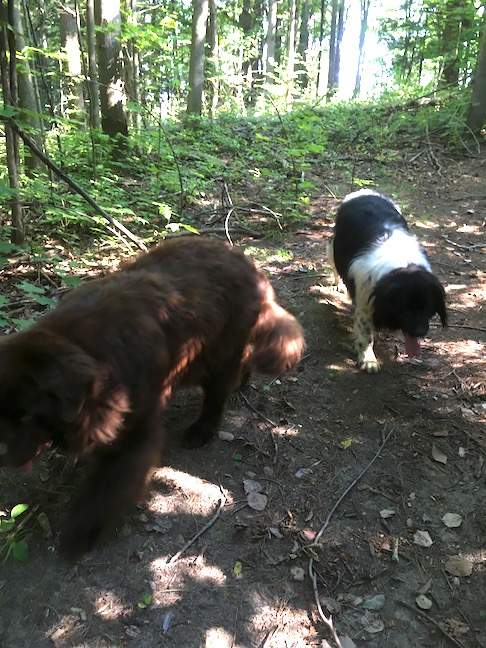
Mention the word car around our place and you’ll see two excited dogs. The Partners love going for car rides, especially if we’re going to the woods. This morning we drove a little north of the city to a forest I know. The dogs had a chance to sniff lots of good forest smells, pick up some burrs and stickers, while I looked around for some mushrooms for dinner.
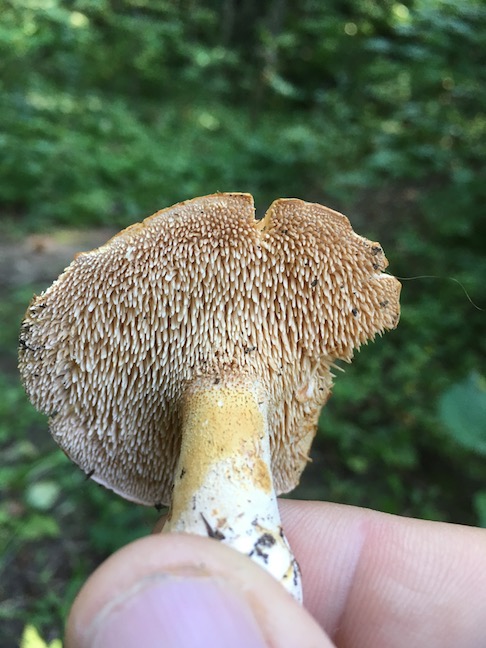
Hedgehog mushroom
There were a few mushrooms around, but this forest wasn’t as generous to me as it was last time I visited, when I picked a big basket of lobster mushrooms. There were quite a few Slippery Jacks around, a variety of bolete which some people love. I’m not one of those people, though. They have a kind or slimy texture which might be an acceptable addition to a stew but are hardly choice. I let them be.
For dinner, I picked a dozen or so hedgehog mushrooms. These are a tan-coloured mushrooms which are distinctive in that they have teeth on the underside of the cap. They are firm mushrooms which are a tasty addition to any dinner. This particular forest starts giving up hedgehogs beginning in mid-August and while I never find them in huge numbers at this spot, it’s quite reliable for enough for dinner.
At the Rockbridge Festival, I had an opportunity to play banjo with some really fantastic fiddle players. They make that instrument seem so easy – but upon my return, when I picked up my fiddle again, I was quickly reminded how difficult it really is. I’m working on improving and I know it will take time and lots of work – it took time to develop some chops and confidence on banjo and on button accordion before that too.
I recall to this day my first attempt to squeeze out a tune on my button accordion. It was that very well-known Newfoundland tune, Squid Jiggin’, and I was pulling my hair out trying to figure out when to be pulling and when to be pushing air through the bellows.
Fiddle has some additional challenges. There are no frets so one challenge is getting the intonation right. Then there is bowing. I think that’s the most difficult part, and I suppose one develops a feel for it over time. On an instrument like button accordion, when you depress a button and air passes through the bellows you get a nice tone. It’s true that the feeling in the music comes from the bellows, but even before you develop that, is sounds like music. When I first picked up the fiddle, it sounded like a macabre industrial accident. It’s getting better, but slowly.
The first time I played banjo with a really good fiddler was at Midwest Banjo Camp. I confess to being in awe. I thought perhaps humans just can’t actually do that. Maybe the really good fiddlers have done the deal with the devil, that’s what I thought.
 27th Street