comment 1

Sunday Go lessons on the YouTube

Go is perhaps not a game for everyone, but I love it, and have been playing for many years. Tonight I stumbled across the Sunday Go Lessons YouTube channel, which has some actual games  with commentary.

In this game, we get to see one of the all time great go professionals Cho Chikun playing a weaker opponent Tanaka Nobuyuki. At various points in the game, we see Cho Chikun mumbling to himself about his own “terrible moves”. There is also commentary – the two commentators go through variations and alternatives to add colour to the match. If you set the video to “subtitles”, there are English captions which appear translating the commentary as well as Cho Chikun’s mumblings.

From the point of view of a weakling amateur player, it’s fantastic to watch players of significantly greater strength. There are some passages in this game in which it is difficult for me to understand why certain moves and sequences are made and others that seem beautifully simple.

Even if you don’t know Go, you might enjoy this unusual theatre.

Filed under: Go
comment 0

Storytime: The Bottle & Can Concerto

As regular visitors know, I’ve been posting some short-short stories here at 27th Street. These are all part of a series of pieces I call The Lazy Allen Stories. They’re set, or at least they’re being told in 1982 in Toronto, and they’re all stories involving a couple former musicians, Lazy and his younger friend Staashu, who work together in a bottling plant. These are works of fiction; I made them up, and so any similarities to any real people living or dead are purely coincidental.

I’ve received some encouraging feedback from the previous stories, so here’s one more….

The Bottle & Can Concerto

From the first day I walked into the Bottle & Can I became fascinated by the rhythm of production.  I suppose all those years playing music for a living, I was extra-sensitive to the relationships sounds have with one another, but I know to most people it was just factory noise.

That first day, I was taken prisoner by the rattling, banging, chugging, sucking, clanging, dripping and popping – so many rhythms and exotic melodies dancing across the expanse of the plant. These sounds, by-products of the work-a-day task of producing sugary beverages, took on their own life in my imagination.

Chook chika chooka cheeka chook chika chooka cheeka
Chookita chika chooka cheekita chookita chika chooka cheekita
Chook chika chooka cheekita chook chika chooka cheekita
Chookita chikita chooka cheeka chookita chikita chooka cheeka
Chickita chookita chookita chookita cheekita chookita chookita chook.

This became the basic background track for my years at the Bottle & Can.

Different areas of the plant added in different sound colours to the main bottling rhythm – the silo in-feed, bottle discharger, filling, cleaning & recycling, the air transfer conveyer. Add the cascades over at rotary rinse, the vacuum whir at blow-moulding, not to mention the rolling and tumbling un-scrambler and the satisfying thumpa-thump of cardboard boxes over in packaging.

At times I became lost in that symphony of sound. Most of the men and women working the line blocked it out or simply stopped hearing it after a while, but I never did. When I wasn’t shooting the shit with my buddy Staashu across from me on the line, I made up dozens of melodies in my head over the complex and incessant soda-pop rhythms.

And then, when we least expected it, the line would stop and the rhythm would disintegrate into a groan punctuated by discordant industrial spasms, and then silence. Total silence. Even those who had long ago stopped hearing the magic rhythms of the line were taken aback by the intensity of the silence when it all shut down.

A stoppage on the line meant a break for everyone, save the mechanics crawling around the system to jimmy belts into place or clear bottle-jams, but it left us restless. It just didn’t feel right not being surrounded by the pulse, the heartbeat of the operation.

Late at night, long after Ruby’s Public House shut its doors, I’d go down to the basement of my bungalow, down to the music room I created long ago out of what was once my parents’ rec room and home bar, and I’d sit amongst my accordions and concertinas and button boxes, my Vox Continental electric organ, my battered old drum kit, stacks of old tube amps, and assorted other instruments I’d accumulated back in my past life. I’d pull the big accordion onto my shoulders and I’d try to imitate the rhythms of the plant with my left hand, and when I got it right, when I could feel the pulse, I’d try to remember those melodies I made up while working the line.

I’m an old polka-man but these weren’t polkas. They weren’t pop tunes either. They weren’t jazz exactly. What the hell were they? Work songs? Factory music? I didn’t think much about it. I just tried to play them the way I imagined them.

I finally saved up a little dough and in 1980 I bought myself one of those 4-track cassette porta-studios and enough egg cartons to staple over the plywood panel walls. I started thinking of my basement retreat as the studio instead of the music room. I began recording The Bottle & Can Concerto, and until today I haven’t told a soul.


comment 1

Man-cold Alert

I’ve been dealing with a cold for the past few days – no big deal – I’ve more or less been ignoring it. Last night though, it hit me like the evening train, emerging as a full-blown man-cold. I didn’t sleep much last night, and spent most of today resting but still feel pretty awful.

Warning: there will be whining, grumbling and general pathetic man-cold behaviour around 27th Street until further notice.

comments 2

The Hateful Eight – mixed reaction

We went to see the much anticipated new Tarantino film, The Hateful Eight, yesterday afternoon. I haven’t seen all of Tarantino’s films, and I confess I’m not one of those fans who hang on every frame of his movies. At the opening of the film, a credit tells us this is the 8th film by Quentin Tarantino, so I did the math – I’ve seen half of them.

The Hateful Eight, a western set after the American Civil War, is in some ways much like a stage play. For the most part there are two sets – out in a blizzard in and around a stage coach – and in Millie’s Haberdashery, a building that might be a roadhouse but certainly isn’t a haberdashery. Perhaps it is called a haberdashery in the film because this is the place where the various threads of the story are sewn together.

The dialogue too seems more like dialogue we might hear in a stage play than in a film. In parts, especially in the first half of the film, which hangs on it, the dialogue came across to me to be somewhat artificial with an underlying cynicism, and it failed to drive the movie forward. At one point during the first half, I thought oh my God, this is a 3 hour film, do I really want to watch 3 hours of this?

The film does pick up, though, and the stilted dialogue of the first few “chapters” gives way to dark humour, a big plot twist and highly exaggerated gory violence.

There are some choice bits for sure. For instance, I really liked the scene in which the Daisy Domergue character (Jennifer Jason Leigh) picks up a guitar and sings Jim Jones to Botany Bay. I don’t know if it is possible that a character in the 1870s could have known this Australian folk ballad, which was first published in 1907, but it was an excellent choice and quite a performance too. The tune is about the outlaw Jim Jones, who would rather die drowning or join a pirate crew than be imprisoned at Botany Bay.

Tarantino offers one nod to past westerns, or at least spaghetti westerns, in that it features original music by Ennio Morricone, who also did the music, for instance, for the 1966 spaghetti western, The Good, The Bad and the Ugly. The music is excellent too, although it should be noted there are long stretches of the film in which the only music is the ever-present sound of the blizzard outside.

You could say The Hateful Eight is very distinctive and stylized and in that way carries Tarantino’s mark. Or you might say it’s excessive and self-indulgent. I’m not entirely sure which side of that fence I’m on. Perhaps this movie surfs that line.

As a whole, I have to say I liked parts of The Hateful Eight better than I liked the whole film. It was an uneven effort but still well worth watching.


comments 2

Tangerine (or what we did on New Year’s Eve)

We typically enjoy a very low-key New Years. Doing as little as possible has become a tradition here at 27th Street. New Years started for us with take-out from a local Thai take-out joint here in Long Branch called Thai by the Lake. This is a fairly new business in our community. I really like the people there – and the take-out is tasty and dependable.

Tuffy P had a DVD ready for some after-dinner movie watching. It was a 2015 film called Tangerine, written and directed by Sean Baker. I guess you could call it a Christmas Eve comedy, but it’s not your usual Christmas fare.

The film is set in Hollywood, but not the fancy-pants star-studded Hollywood. The star is a tranny hooker named Sin-Dee Rella, played by Kitana Kiki Rogreguez. It’s Christmas Eve, she’s been in the slammer for 28 days, and when she emerges back to the streets, Sin-Dee discovers that her pimp/boyfriend Chester has been cheating on her. Sin-Dee is not amused.

Mya Taylor plays Sin-Dee’s best friend Alexandra. James Ransone plays Chester, who works as a pimp and small-time dope dealer out of a donut shop. Karren Karaguilian plays a cab driver named Razmik, a character interwoven into the story.

Here is the official trailor….

I loved this film. Great story, great acting, fantastic cinematography. I read it was shot entirely on an iphone! Tangerine is raw, hilarious, touching – a crazy romp through a side of Hollywood we don’t usually see. One of the top films of 2015!

comment 1

Last book of 2015

Not too long ago my friend East Texas Red sent me an email pointing me to a review in the New York Times of the book Beatlebone by Kevin Barry. The review, which was very positive, was written by songster Steve Earle.

This is the second book of fiction in a row I’ve read featuring a real-life historical character. The last one, Colony of Unrequited Dreams, by Wayne Johnston, was written in the voice of Joey Smallwood, the first Premier of Newfoundland and Labrador. Beatlebone features a much different but equally real historical figure, John Lennon.

The book is set in 1978. John Lennon, at least the character John Lennon, owned a small island of the west coast of Ireland, he had not been to in many years. At the point we enter the book, Mr. Lennon is on his way to his island. He wanted to go there to scream.

There is another main character in the book, Lennon’s driver/fixer, whose job it is to get his employer to the island without the press finding out and following. Of course this is easier said than done, as Mr. Lennon was at this time still a figure of some public interest, being an ex-Beatle and all.

Beatlebone is a lovely book, a lyrical and sensitive portrait of a guy trying to find himself, and trying to rekindle some creative fires along the way. Because we all know who John Lennon was, because we’re hip to the history, author Kevin Barry could dispense with all that and concentrate on a more interior portrait of his characters.

Cornelius is a fascinating foil for Lennon, an equally strong character in this book who we quickly realize has a much bigger role in the novel than that of a driver. Much of the book is in fact a conversation between John and Cornelius.

Beatlebone is funny, sensitive, somewhat surreal and trippy, and also quite clever. Part of the book is actually about writing and researching the book. Very unusual approach. It’s an oddball book and I suspect it’s not to everyone’s taste, but I enjoyed it.


comment 0

The new Long Branch Butterfly

Here is the latest Long Branch Butterfly mosaic, just finished up tonight. Long Branch Butterfly Mosaic Dec.jpg

You can see a detail + more mosaics at our Long Branch Mosaics blog. We also do custom mosaic projects, big and small.

comment 0

The Comfort Food Diner: quick and tasty fish stew

Here’s a quick and easy-to-prepare fish stew that’s perfect for a winter evening.

First put some rice on to cook while you’re preparing the stew.

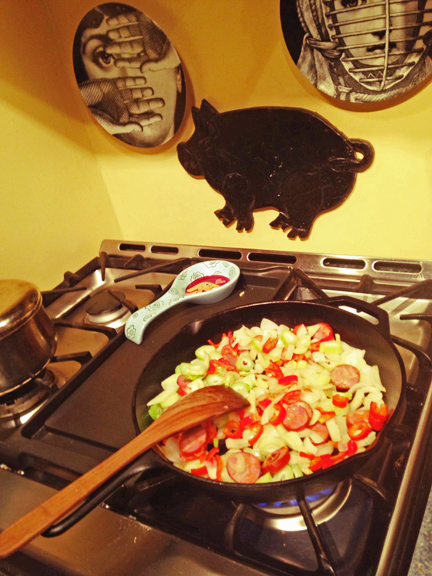
I use a cast iron pan for this, and it works very well. Heat your pan with a little vegetable oil. Chop in an onion. While the onion is cooking, chop up some fennel, a red pepper and some smoked sausage. I had some Portuguese sausage in the fridge and that works great. You don’t need a lot. Your fish is going to be the star of the show. Think of the sausage as counterpoint. Toss these ingredients in with the onions and stir it all around. I happened to have some piri-piri spices handy so I added some, along with some salt and pepper. Let it cook for 5 minutes, stirring occasionally.IMG_4943.jpg

You don’t have to use sausage, or you can use different sausage. Instead of the piri-piri, you could use some thyme, basil and a little cayenne. Try it different ways, depending on what you have on hand.

Add in a small can of diced tomatoes and about the same amount of stock. Don’t over-do the liquid. You’re making stew, not soup. Stir it around.

You can use whatever fish you like for this dish. Tonight I used a chunky pickerel (walleye) fillet. I like my fish cut in bigger than bite-sized pieces. Shellfish are fine as well. Once again, stir it all around.

IMG_4947.jpg

The fish is only going to take about 5 minutes cooking in the stew. Don’t get carried away overcooking it. Serve it over a mound of rice in a bowl.IMG_4949.jpg

Garnish with fresh parsley. This is excellent with some crusty bread and a good ale.


comment 0

John Stensen’s #2

I’ve been learning the tune John Stensen’s #2 on clawhammer banjo. I’ve seen it spelled Stensen’s, Stenson’s, Stinsen’s, Stinson’s and even Stentson’s. I couldn’t tell you who John Stensen (sp) is or was, though. The most inspired versions of this tune, come (in my opinion at least) from Cathy Barton and Dave Para.

This video is from the Midwest Banjo Camp 2014’s faculty concerts. I was there, and heard this live. Cathy and Dave first play Shirley’s Reel then morph it into John Stensen’s #2. I think this is old time music at its finest. I could listen to these two all day.

I’m planning to attend MBC again in 2016, and I’m really looking forward to more banjo classes with Cathy Barton, who is among my fave banjo players.

comment 1

Ellsworth Kelly RIP

American artist Ellsworth Kelly passed yesterday at age 92. I’ve long admired is stark, confident  coloured shapes. At times, when I’ve struggled with painting, unable to create marks I could make stick, I’ve marveled at the power of Kelly’s simple forms, which seem to be just so. RIP.

Filed under: RIP