The first 6 deer I saw on my recent road-trip were carcasses at the side of the I-75 on the lower Michigan penninsula (not to mention an assortment of dead raccoons, possum, skunks, porcupines and various unidentified animals). Later I would see a couple dozen live ones at various times and places in forests and by the roadside. There are a lot of deer on the Upper Peninsula. In fact, I found not seeing deer to be unusual.
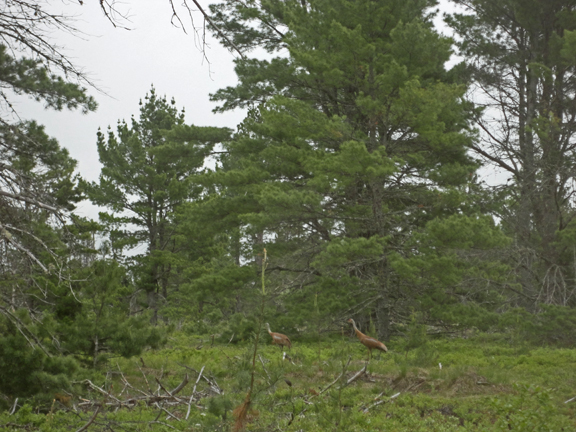
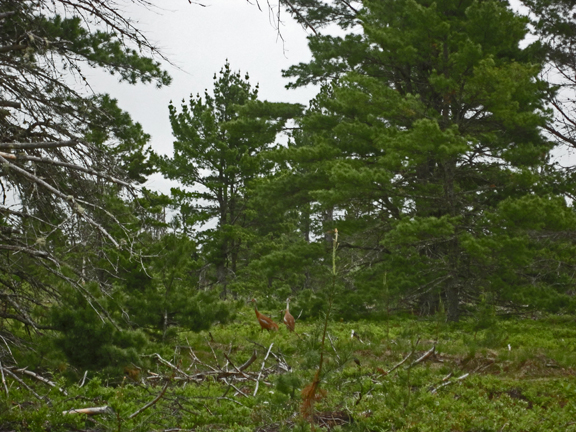
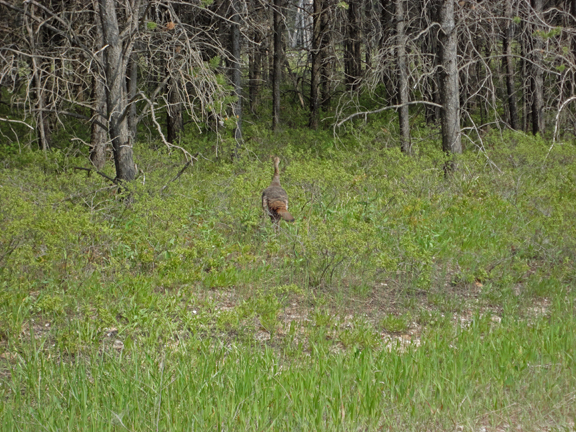
I saw an assortment of birds of prey, as well as crows, robins, swallows, finches, grouse, quail, not to mention birds I heard but never saw, such as the whip-poor-will who serenaded me to sleep nightly. And then there were the turkeys.
I skidded to a stop to take the last two shots. What I missed in the photo were a several babies walking along with mama turkey. They were tiny and I could barely see them through the brush. If I were a little quicker, I might have caught then a couple feet back where there was a little bit of a clearing, but unfortunately, by the time I fumbled for my camera and snapped a couple shots, they had disappeared into the longer grasses.
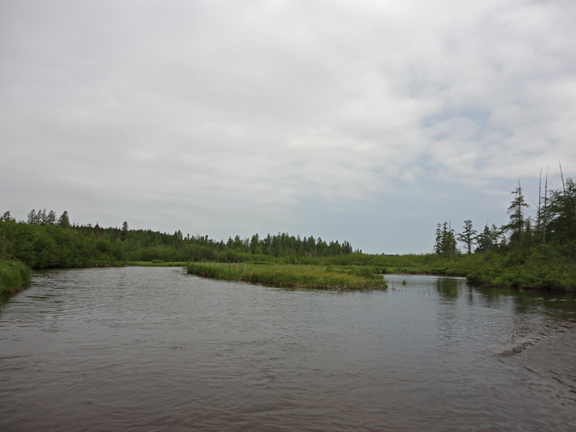
I’ve been drawn to rivers since that day as a young boy my father gave me my own spinning outfit and took me to a little creek where I caught my first trout. I find it hard to pass a river without stopping to check it out. Why go all the way to Upper Michigan, you might ask. Why not stay home and fish the Credit or the Grand up the road? Part of the reason is simply the adventure of the roadtrip. Then there is the special literary lore of UP rivers, thanks to Robert Traver and Ernest Hemmingway. As well, on the Upper Peninsula you can fish two, three, four streams all within an hour or so of driving. Parts of the mountain west are like that too, where some fishermen give themselves challenges such as catching three different species of trout in a day. (in the mountain west they also like to combine fishing and hunting in an extravaganza known as a “cast & blast”).
Indian River at the campground
Indian River at the downstream end of the prime trout water
UP Rivers mostly have a brown tinge from tannins in the water. This makes it difficult to discern how deep some of the runs are without getting in there for a look. Most of the rivers are lined with deadfalls and tag alders. Some are difficult to wade. Bottoms are mostly sandy but there are holes and there are spots where you take a step and sink down, down, down, spots where you get mired in the muck and can barely move.
The Indian in the campground stretch is difficult fishing but it is a stream that boasts outstanding growth rates and big trout. There is a lot of wood in the river to snag your fly, and there are many trees across the stream, forming deep pools and making it very hard to move about without getting out of the river and negotiating around through the bush. In the absence of bug hatches, this is streamer water. I hooked a very large brown trout in the pool featured in the top photo. I only glimpsed it before it wrapped itself around a log and shed the hook, but I would say it was a brown of 20+ inches. In the bigger water featured in the lower photo above, I caught a very nice brook trout of about 13 inches. The lower water was way easier to fish than the campground stretch. First, the mosquitoes were not nearly so bad. Second, rather than a jumble of logs, the stream was defined by pools and runs and bank cover. I tried to access the Indian at another spot, in which I drove along a two-track to a primitive campsite. A trail then led toward the river. I checked out the trail prior to gearing up and came across these mushrooms growing out of moss.
Unidentified mushrooms
I don’t know what these are. They are among the few mushrooms I came across all trip. Their caps were about 2.5 inches across. I found them where the trail became mossy and spongy and wet. At this point, well along the trail, and knowing the river couldn’t be far away, I got the sudden feeling that I might get lost deep in these woods, never to be found. There was a time when I would not have even considered my safety in a situation like this. I would have sallied forth without a worry. But these days I think about it, and I decided the river was just too far from the car and the car was just too far from the road and the river was difficult….and I turned back.
The Little Indian
The Little Indian is beaver water. It’s slow and meandering. When you try to wade it, the bottom is spongy and silty and you need to have a care you don’t sink into a hole or trip on a hidden branch and go for a spill. It’s beautiful water. I found it to be like a hatchery for small trout, 6 and 7 inchers. And then surprisingly, a fat 9 incher came up for my tiny dry fly. There will be big brook trout in this stream but I think the only time to get them would be late evening, just before dark. In the heat of the afternoon when I visited, a 9 inchers was about the best I could expect.
The Driggs
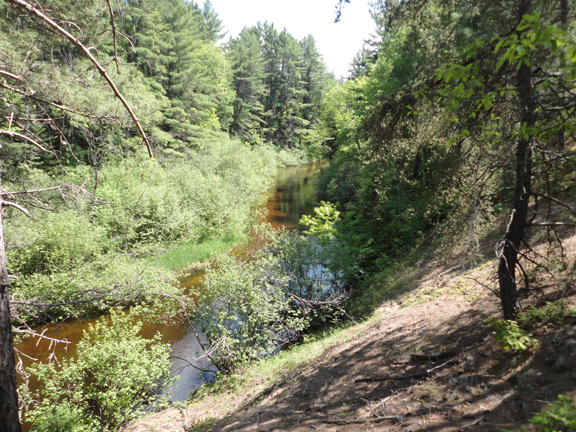
Deadfalls, tag alders and deep runs make parts of the Driggs a challenge to fish. The river has great access with a two-track that runs along much of its length. It features many S-curves, some surprisingly deep pools and runs and a very health population of brook trout. I didn’t catch any larger than 11 inches in this river but when it was hot, as it was all day Tuesday, I lost count of the the trout I caught and released. (what is this strange compulsion to chase after trout, anyway?…I can’t explain it. Robert Traver took a shot at it with this famous quote: “I fish because I love to. Because I love the environs where trout are found, which are invariably beautiful, and hate the environs where crowds of people are found, which are invariably ugly. Because of all the television commercials, cocktail parties, and assorted social posturing I thus escape. Because in a world where most men seem to spend their lives doing what they hate, my fishing is at once an endless source of delight and an act of small rebellion. Because trout do not lie or cheat and cannot be bought or bribed, or impressed by power, but respond only to quietude and humility, and endless patience. Because I suspect that men are going this way for the last time and I for one don’t want to waste the trip. Because mercifully there are no telephones on trout waters. Because in the woods I can find solitude without loneliness. … And finally, not because I regard fishing as being so terribly important, but because I suspect that so many of the other concerns of men are equally unimportant and not nearly so much fun.”). The Driggs seems inaccessable until you get in the water. It looks deep and tangled. How do you cast with all those trees and tag alders? Once you are in the water, it is as if you have been enveloped by the river. You find the rhythm of casting to avoid the alders on the backcast and on the landing. When you move, it is a wee step at a time, slowly and gently.
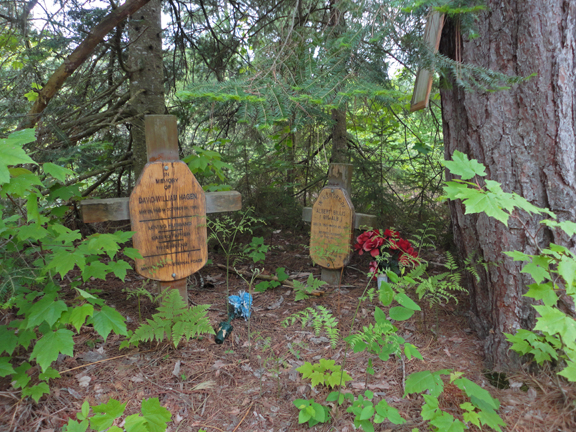
I pulled off on one of the two-tracks that follow the river, and as many of them do, the trail ended beside the river at a primitive campsite. But this one was special. I found a memorial there.
Memorial
Memorial
Was this a favourite camping place, a spot where a group of guys met and camped and fished together? Are there remains buried there or is this simply a memorial recognizing the importance of this remote pinprick in the universe to a few people who cared about it? I decided not to fish the river at this memorial. It was their spot, and I left it for them.
Fox River
The Fox is among the most famous trout rivers in Upper Michigan. There is a lot of water and many accesses. Wading a stretch like this one, I tie a bandana in an obvious spot on some tag alders so I can find my way out again later. Once you wade a half mile upstream or downstream it become very difficult to find the trail that took you to the river. Years ago I fished this river and almost got myself badly lost. Now I leave a marker.
Fox River
Many of the locals float the Fox, usually in 12 or 14 foot aluminum car top boats, occasionally in canoes. Tourist fly fishermen often float the river too, in belly boats or one-man pontoon boats. The local guys I talked to are somewhat bemused by fly fishermen. “Ya, some of those fly fishermen are mighty fancy, but if you really want trout, you’ll use a minnow (dead or alive, apparently it matters not) with an inline spinner tied about 10 inches from the hook.” One fellow I talked to complained that they lowered the possession limit from 10 to 5 trout in the Fox to better manage the pressure on the river. “It ain’t right. We deserve to take 10 trout.”
This post has background music. Lanquidity by Sun Ra and the Arkestra.
I pulled into the Indian River Campground with the duel idea of fishing the river and checking out the campground, with an eye to setting up camp there for a couple days. It was deserted. Why? It was clearly deserted because it was home to an unbelievable number of the fiercest mosquitoes in America. I opened the car door and ducked out of the way as millions of the little bastards flew in. This led to the question, how do you get them to leave? The answer is to drive fast with all the windows open. On this stretch of the Indian, there was no respite and eventually the mosquitoes drove me off the river. In other places, the mosquitoes came in waves. At the campground on the Fox River, I tried to play the canjo. The rhythm went bum-ditty bum-ditty bum-whack. WHACK. Bum-ditty whack. Whack WHACK. Bum-ditty whack. On Wednesday, a warm day with gusty swirling west winds, the mosquitoes just about disappeared. Curiously enough, Wednesday offered the slowest fly fishing of the trip as well. There seemed to be a connection between being tormented by biting insects and catching trout, a connection I can’t understand.
Mosquitoes are not the only insect pest around the UP. I saw several of those parasitic nasties we call ticks during my travels. I took to checking in the tent, checking my clothes, and having a good look at my legs in the tent each night before bed, just because the idea of having one of these mini-monsters attaching itself to me does not impress. I don’t like any of the other critters that attach themselves to me either (like leeches and lamprey). Last year, around home, a tick found its way to Memphis’ head and one got Rossi too, and in both cases I had to gently but firmly remove them with pliers. Certain black-legged ticks or deer ticks carry the bacteria responsible for Lyme disease and as far as I’m concerned that makes them extra nasty. I guess ticks really don’t belong in this post because I think they are arachnids (like spiders), rather than insects, but to me, they’re bugs, so I’m including them.
The Driggs river runs through a sandy plane and at every place I accessed the river, the sandy banks were mottled with anthills. Big ants. Medium-sized ants. Tiny Ants. Anthills everywhere. Everywhere. Thousands and thousands of anthills. At one point I thought it was one really really huge ant colony, a world we know nothing of. The number of ants on the edge of the river did not escape my attention, as ants are trout ice cream, and I always carry a few ant imitations in my fly foxes. (the trouble with most ant imitations is that they are hard to see on the water. There is one clever pattern that solves this problem – the parachute ant, but that is for another post).
Stenonema vicarium? The March Brown or the Gray Fox
The real good guys of the insect world are the mayflies. First, they don’t bite. I like that. Second, they’re lovely, like flying sailboats. Third, trout love them. The one in the photo was with two of its friends on my tent one morning. Let me say that I’m not a mayfly identification expert, although I sometimes like to imagine I can tell one variety from another. I suspect the one in the picture is the mayfly I always called the Gray Fox. Somewhere along the way, guys who spend their lives thinking about bugs decided that Gray Foxes don’t exist, that they’re actually March Browns that have a slightly different colour about them. That is to say, they are both Stenonema vicarium. In any case I didn’t see any of these guys on the river, only on the tent. I did see a number of light coloured mayflies, the kind we fly fishers call Cahills. And I saw some others that, if it were still May in Ontario, I would say were the ones we call Hendricksons, but it isn’t May, so I don’t know, either the timing is different on the UP or they are another variety of mayfly altogether. Finally, the predominant mayfly emerging from the rivers were the ones we simply call Olives, or Blue-winged olives, or Baetis. There are different Olives, different sizes from very tiny to pretty small in the scheme of things. Trout like all of them. I found a fly pattern known as the Usual to be an effective imitation most of the times I saw the bugs emerging.
There were June bugs and other beetles and dragons and damsels and loads of those yellow swallowtail butterflies. And, there were little wormy larvae that fell from the pines at my campsite onto the picnic table and the tent. Let’s not forget caddisflies, another trout favourite, flitting and bouncing about the surface of the stream. Bees. Wasps. Sowbugs. Those oddball stick-like mantids. House flies and other true flies (Diptera – two wings) like midges and deer flies. I’m sure there were many more I failed to notice, little bugs that live in the bark, in wood, munching leaves, or just hanging out being bugs.
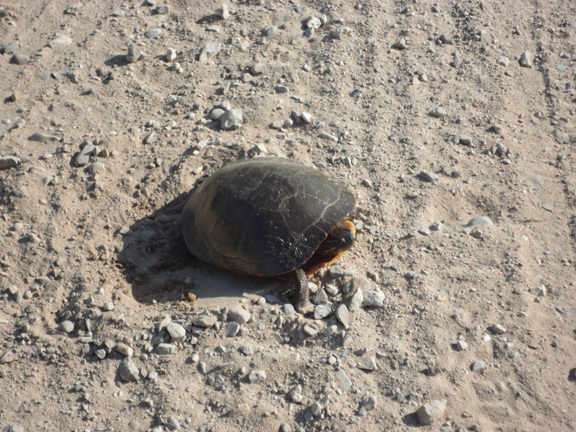
The weather changed quickly from a cool morning with a menacing cloud overhead to a hot clear afternoon, one of several rapid weather shifts I experienced on the Upper Peninsula. This turtle was crossing Country Road 450 where it crossed The Driggs River very slowly in the heat. This turtle had places to go, things to see. I agree with my friend here that the river on the upstream side of the bridge is more interesting than the river on the downstream side.
Here are Steve Earle and the Del McCoury Band performing Pilgrim, from the recording “The Mountain”. I listened to this full blast in the car several times while rolling down the highway last week.
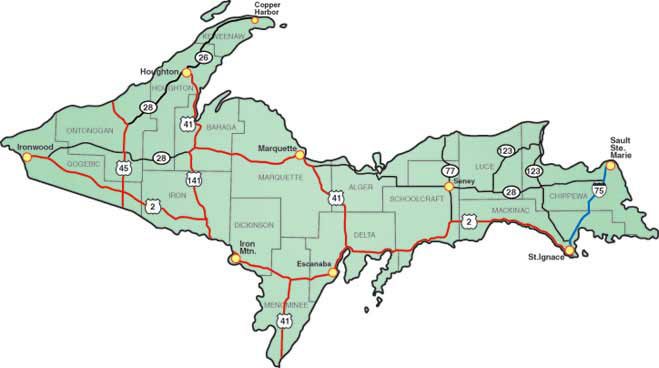
I traced a big circle by car. I began by driving to Sarnia and crossing into Michigan. West to Flint, and on the I-75, straight north up the Lower Peninsula to the Mackinac (that’s Mackinaw) bridge and Upper Michigan. On the UP, I made a small circle (on other trips to the UP I ventured further west than this time around) – West on 2, along the north shore of Lake Michigan to Manistique, then back east a little and up the 77 to Seney, east on the 28 until it runs into the 75 near the Soo, and across the bridge to Canada. East on the 17, the 69 and south as it becomes the 400. When I was a kid, the main chunk of the 400 ended at Barrie, followed by a 2-laner my dad used to call The Big 400. Now of course the 400, 69 and 17 are one seamless line of highway.
Within the small circle within the big circle, I drove over many county roads and many more roads so small I can only call them two-tracks. In Upper Michigan, many of these two-tracks, roads so small tree-branches scrape the sides of the car, roads so small, you might reconsider driving them without 4-wheel drive, many of these tiny roads have signs where you turn onto them, identifying them by number. They are serious about their roads in Upper Michigan. Twice while I fished the Driggs river, a truck drove along the two-track that followed the stream, grading it. This road may have seen two or three cars on each of the days I was on it. Upper Michigan has dozens and dozens of these tiny roads. Most of them go to hunt or fish camps or along rivers and creeks or they dead end at some little swampy lake in the middle of the middle. I’m convinced some others go nowhere, but are just remnants of the logging and the mining that exploited the UP along the way.
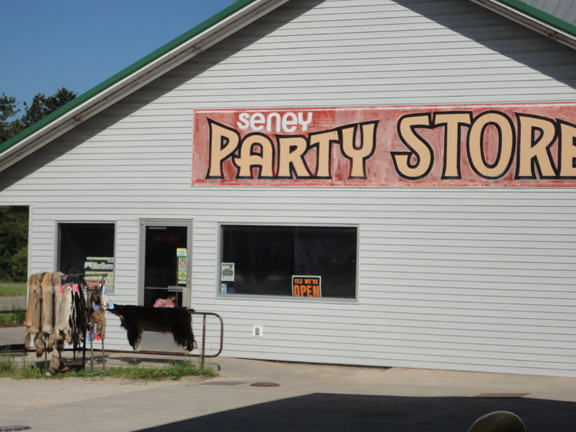
Seney Party Store
I had forgotten all about party stores and when I arrived on the UP and started seeing them, my first thought was party store, why would they have a store that sells party supplies way up here in the middle of the middle? And then I realized that that party stores on the UP sold a different kind of party supplies….the name simply meant “buy your booze here”. Of course at the Seney Party Store, you could also buy pelts.
And everywhere I was reminded I was in America.
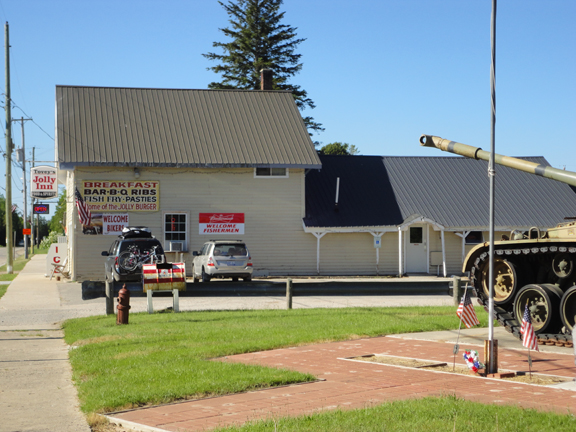
Welcome bikers, welcome fishermen
Welcome bikers. Welcome fishermen. The Flag. In Gemfask, there was even a tank and a memorial. The red and white oil drum in the photo is there for you to drop in any American flags in need of replacement. The sign on the drum reads, “flags for burning only”. Even some restaurant menus contained memorials. The closest thing I can think of to this in Canada is the Highway of Heroes stretch of the 401, the road taken by vehicles bringing back fallen Canadian soldiers who died in the line of duty. The restaurant pictured above, Tovey’s Jolly Inn, the home of the Jolly Burger, served a mighty fine breakfast. I knew it would be good because it was at the top of the list on their sign, above BBQ Ribs, Fish Fry, Pasties and the aforementioned Jolly Burger.
Throughout the UP, there are places that sell Pasties, and often at the same stop, Smoked Fish, or more specifically, Smoked Whitefish. I told myself that this time I was going to try some famous UP pasty action AND some smoked Lake Michigan Whitefish. Unfortunately, it seemed that I usually passed these places in the morning, at which time pasties and smoked whitefish were the furthest things from my mind. So once again, I have missed out. I regret this. I really wanted to try one. Most nights at dinner time, I returned from a day of fishing, and I fired up my portable charcoal bbq and grilled up some meat and veggies for dinner. The idea of driving out to get a pasty just didn’t work for me. Next time, no matter what, I’m having pasties and smoked whitefish. Promise.
One thing the same on both sides of the border within my big circle is that little tourist places are hurting bad. Dead motels. Dead restaurants. A chip truck sign in front of a burned out trailer. Falling apart ramshackle structures that still have the sign up, telling passers by, hey we had better times. How many people opened up along the highway, full of dreams to make a go of it in a tough economy, where the tourist industry is the best thing going when the mines stop operating and the big clear-cuts are done, and there just aren’t enough tourists to go around. It’s especially hard for the independent. I stopped at a Tims for a coffee in a little town around the North Shore of Lake Huron. There were a dozen cars in the parking lot and there was a line-up at the drive-through. Next door was a “Trading Post”. They were trying everything. They had ice cream and frozen yogurt and souvenirs and First Nations crafts. It was clean, independent and looked inviting, but there were no cars in the parking lot next to Timmy’s. I wish I could say I patronized the little guy, but all I wanted was a small, with milk and half a sugar, so I followed the crowd into the “brand” outfit. I wish I had gone into the place next door and bought a pair of moccasins or something, just to support them. I made up for it a little further down the road, when I saw a fellow selling bird houses on the side of the road. I skidded my buggy to a stop and bought two for the yard, a small one with a bark roof and a two-family log unit that will will make some extended bird family very happy I’m sure.
Single Family Home
The Condo Lifestyle
I enjoyed looking at the selection of houses and feeders. It seemed that each one was unique in some way. All were well made and imaginative. These houses are certainly going to attract some excellent dwellers, birds movin’ on up to 27th Street.
At this point, dear readers, I had the clever idea of ending this post with a video of Jonathan Richman and the Modern Lovers performing New Kind of Neighborhood, linking the song up to the new bird houses making a new kind of bird neighbourhood in our yard. So much for being clever, however. The YouTube Machine failed me. I thought it had everything, but no, no, no, I couldn’t find New Kind of Neighborhood anywhere. However, I did find another fun Jonathan Richman song I really like – Dancing in the Lesbian Bar. There is just no way to segue into that song from this post. Still, it’s a fun song and it’s late and I’m ready for bed and I’d like to end this long post with some light-hearted music, so what the heck. Let’s just enjoy the song and pretend it fits in.
G’night all. I have lots on my mind to post, but it can all wait until tomorrow.
….and while I’m gone, Tuffy P. re-ups our cat population. Regular readers know that 2013 has been a disastrous year for our gang of cats. First we lost dear old Delia, who gave us 20 faithful years. Then Rossi, who suffered a stroke, and survived a year of seizures which increased in frequency and severity. Finally, we lost Jerry, who you know was the best cat you’ll ever meet. For sure it was time for a kitten, but when I called from Manistique Michigan I was surprised Tuffy brought home two. Meet Phyllis and Gracie. Phyllis is the one with the longer hair. Tuffy shot the video down in my painting studio….
Tuffy started the kittens out in a room away from the other animals and has been gradually introducing them to the house. Today, they were allowed the run of the house and they’ve been exploring everywhere. They’re both lovely kittens, playful and happy to be with people. The dogs seem fine with them. Jacques seems fine with them too. Shadow is a little stand-offish but he’s going to be OK. Jack Shadbolt is having the hardest time dealing with the new kittens and has been showing who is boss with some well-placed hisses. Hopefully, he will soon decide to be friends.
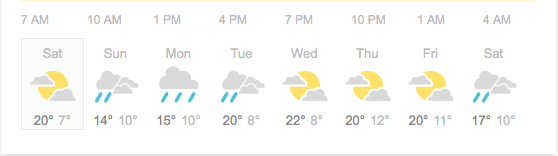
I’ve been watching the weather in Upper Michigan, since I’m planning to camp during the week. The picture above is for Manistique on the South Side of the Upper Michigan Peninsula. Looking further north to Munising or Seney, the forecast adds possible thunderstorms for Friday. There is a greater than 50:50 chance of rain on Monday and 20% chance of rain on Tuesday. I don’t mind camping in damp weather but I much prefer it if it isn’t raining when I’m setting up camp. My initial plan was to stay in a motel Sunday night and again Friday night and camp in between, but now I’m planning for the possibility of staying an extra night with a solid roof over my head, in the event Monday is very rainy. There was a time I’d camp through anything, but I’m more comfort-minded these days.
The next question is what the rain will do to the fishing. In general cloudy skies will make for better fishing, particularly during mid-day when sunny skies drive the trout under cover. On the other hand, if there is lots of rain, there is a chance it will blow out some of the streams. Some streams are affected to a greater degree by the rain, and a lengthy rain will turn some of them to chocolate milk. I’m anticipating some good fishing (of course the fishin’ is usually good, even when the catchin’ is slow – any old fool knows that)
I’ll be hitting the road tomorrow morning. I’ll update this blog if I can find some WiFi in my travels.